Transcription of Advanced Critical Reading - Generations - English …
1 Name_____ Date_____ AAddvvaanncceedd CCrriittiiccaall RReeaaddiinngg -- GGeenneerraattiioonnss Authors William Strauss and Neil Howe are known for their theories about cycles of Generations in American history. In their seminal Generations , and the subsequent 13th Gen, and The Fourth Turning, they explore the history of America from 1584 to the present as a repeating cycle of 4 consecutive generational archetypes. They refer to each cycle of four Generations as a constellation, and they posit that each constellational era corresponds to recurring types of 5 historical events and moods.
2 They state that adjacent Generations do not live similar lives, and that each generation ages as a singular cohort as time moves forward. If one were to place this progression on a graph, the line would form a diagonal which Strauss and Howe call the generational diagonal. According to Strauss and Howe, each generation is comprised of people who possess 1) common age, 2) common beliefs, and 3) perceived membership in the same 10 generation . A generation is approximately 22 years in length. Since a lifetime may reach 80 90 years, members of 4 Generations are alive at one time. The four generational archetypes identified by Strauss and Howe are Idealist, Reactive, Civic, and Adaptive.
3 Idealists are increasingly indulged youths after a secular crisis, come of age inspiring a spiritual awakening, cultivate principle rather than practicality or pragmatism 15 in midlife, and emerge as visionary elders. Reactives grow up underprotected and criticized youths during a spiritual awakening, mature into risk taking adults, unlike the preceding generation at midlife, mellow into pragmatic midlife leaders during a secular crisis, and become reclusive elders. Civics grow up increasingly protected youths after a spiritual awakening, become a heroic and achieving cadre of young adults, build institutions as 20 midlifers, and emerge as busy midlifers, attacked by the next spiritual awakening.
4 Adaptives grow up as overprotected and suffocated youths during a secular crisis, unlike the previous generation as young adults, become risk averse, conformist rising adults, mature into indecisive arbitrator leaders during a spiritual awakening, and become sensitive elders. The authors believe that the archetypical Generations have recurred in fixed order 25 throughout American history with one exception: following the Civil War, one type did not appear. As each generational archetype shifts from one phase of life to the next, the succeeding Generations line up in a predictably recurring pattern. For example, when the Idealists are elders, the Reactives are in midlife, the Civics are in rising adulthood, and the Adaptives are in youth.
5 The central role of the elders, aged 66 87, is that of stewardship, such as supervising and 30 mentoring. The central role of midlife, aged 44 65, is leadership, such as parenting and teaching. The central role of rising adulthood is activity, such as working and starting families. The central role of youth, aged 0 to 21 is dependence, such as growing and learning. 35 QQuueessttiioonnss According to the passage, which of the following statements can be inferred? II)) At a time when a Reactive generation member is a pragmatic leader, an Idealist generation member is a visionary elder. IIII)) At a time when a Civic generation member is a protected youth, a Reactive generation member is a risk taking adult.
6 IIIIII)) At a time when an Adaptive generation member is a sensitive elder, a Civic generation member is an institution building midlifer. AA)) I only BB)) II only CC)) III only DD)) I and II only EE)) II and III only According to the passage, what happens to the Civic generation as its members enter midlife? AA)) It is attacked by Idealists who are coming of age. BB)) It is attacked by Idealists who are visionary elders. CC)) It is attacked by Reactives who are pragmatic leaders. DD)) It is attacked by Adaptives who are rising adults. EE)) It is attacked by Adaptives who are youths. In line 15, pragmatic most closely means AA)) acting on the basis of principle.
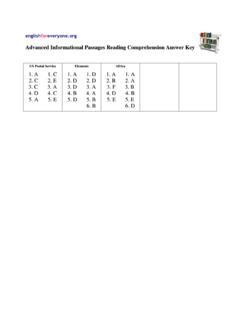
7 BB)) behaving in a hermit like way. CC)) being in the final stage of life. DD)) acting in a practical way. EE)) behaving in a reckless way. AAnnsswweerrss aanndd EExxppllaannaattiioonnss The correct answer is D. II)) Correct. Since the Reactives are one generation younger than the Idealists, the member of the Reactive generation are one life phase younger than the members of the Idealist generation . Therefore, when the Idealists are elders, the Reactives are in midlife (lines 28 29.) IIII)) Correct. Since the Civics are one generation younger than the Reactives, the members of the Civic generation are one life phase younger than the members of the Reactive generation .
8 Therefore, when the Reactives are adults, the Civics are youths (lines 28 29.) IIIIII)) Incorrect. Since the Adaptives are one generation younger than the Civics, the members of the Adaptive generation are one life phase younger than the members of the Civic generation . Therefore, when the Civics are midlifers, the Adaptives are not elders; they are rising adults (lines 28 29.) AA)) I only BB)) II only CC)) III only DD)) I and II only EE)) II and III only The correct answer is A. AA)) Correct. According to lines 20 21, Civics emerge as busy midlifers, attacked by the next spiritual awakening. The generation which attacks them is the Idealist generation , which comes of age inspiring a spiritual awakening, shown in lines 14 15.
9 BB)) Incorrect. According to lines 20 21, Civics emerge as busy midlifers, attacked by the next spiritual awakening. The generation which attacks them is the Idealist generation , which comes of age inspiring a spiritual awakening, shown in lines 14 15. When the idealists age, they become visionary elders, as shown in line 16. CC)) Incorrect. According to lines 20 21, Civics emerge as busy midlifers, attacked by the next spiritual awakening. The generation which attacks them is the Idealist generation , which comes of age inspiring a spiritual awakening, shown in lines 14 15. When the Civics are in midlife, the Reactives are elders, as can be inferred from line 29.
10 When the Reactives are in midlife, the Civics are in rising adulthood. When the Reactives are at midlife, they do not attack. Instead, they mellow into pragmatic midlife leaders during a secular crisis according to line 18. DD)) Incorrect. Although it can be inferred that when the Civics are midlifers, the Adaptives are rising adults (line 29), the generation which attacks the Civics is the Idealist generation , which comes of age inspiring a spiritual awakening, shown in lines 14 15. EE)) Incorrect. Since the Adaptives are one generation younger than the Civics, the members of the Adaptive generation are one life phase younger than the members of the Civic generation .