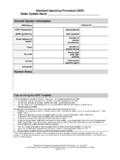
Transcription of STANDARD OPERATING PROCEDURE (SOP) - WSU …
1 STANDARD OPERATING PROCEDURE (SOP) PROCEDURE No.: Revision: Effective Date: Title: Page Count: Work Location: PROCEDURE Review Cycle: Annual Other (cannot be less than annual):Summary: This STANDARD OPERATING PROCEDURE (SOP) describes the STANDARD operation of the located/installed in: Identified Hazards (X = applies): Hazardous Environment Physical Hazards Radiological Hazardous Materials Other [state hazard]: _____Maximum Relative Hazard Index (from Section 6): RoleNameSignatureDateProcedure Preparation and Reviewer Concurrence AuthorPeer Reviewer Principal Investigator Affected Functions/Organizations and Subject Matter Expert Concurrence Laboratory Manager Unit Safety Committee Chair Other:_____Procedure Approval note: approval must be documented from one of the following sources which may be campus specific, contact your department administration and/or EH&S for additional information.
2 Department Chair Environmental Health & Safety This PROCEDURE is approved to be performed as indicated below. Violations will result in suspension of laboratory access privileges. This PROCEDURE may not be performed after hours. It can only be conducted during regular business hours (Monday-Friday, 7AM-5PM. This PROCEDURE may be performed after hours only when a second individual is present in the laboratory. Other: STANDARD OPERATING PROCEDURE Revision: Page 2 of 20 SOP for CHANGE HISTORY Revision Effective Date Description of Change STANDARD OPERATING PROCEDURE Revision: Page 3 of 20 SOP for PURPOSE AND APPLICABILITY This SOP describes the STANDARD operation of the located in the facility. Brief description of the process (1-2 sentences): Restrictions (Operator qualifications, training/location requirements This SOP has been developed to supplement the requirements of the department, college, and university.))
3 The equipment-specific requirements described in this SOP apply in addition to all relevant WSU requirements. RESPONSIBILITIES Staff with responsibilities for implementing this PROCEDURE : Principal Investigator: Project Manager: Operator (of the equipment/system):Laboratory Coordinator or Manager: DEFINITIONS Operator: The staff member who has been trained to perform the work described in this SOP. Principal Investigator: The faculty member responsible for the research project and possibly also the laboratory facility where the research is being performed. Project Manager: The student, research assistant, staff, or faculty member conducting the research work identified in Section Laboratory Coordinator/Manager : Individual other than the PI who is responsible for overseeing the laboratory facility where the research is being performed (where applicable).
4 ACRONYMS AND ABBREVIATIONS CHP Chemical Hygiene Plan DOSH Department of Occupational Safety and Health EHS Environmental Health and Safety LSM Lab Safety Manual OSHA Occupational Safety and Health Administration PPE personal protective equipment PIPrincipal InvestigatorR&D research and development RHI Relative Hazard Index SOP STANDARD OPERATING PROCEDURE STANDARD OPERATING PROCEDURE Revision: Page 4 of 20 SOP for PROCESS/EQUIPMENT OVERVIEW Process Overview Describe the chemistry involved and provide an overview of the OPERATING conditions/parameters. This information allows SOP users to see a concise summary of the process and key OPERATING conditions/parameters near the beginning of the SOP.
5 Describe the chemistry involved: Identify OPERATING conditions per the SOP: ParameterExperimental OPERATING Range Equipment Maximum rating TemperaturePressureProduct Flow Rate Liquids Gases Solids Identify all feed streams, and their associated flow rate (attach separate page if needed): Feed Stream description Flow rate List all materials and supplies required for this process: EquipmentMaterialsChemicalsSTANDARD OPERATING PROCEDURE Revision: Page 5 of 20 SOP for Facility Description is constructed/equipped with the following: EquipmentYes/NoNumber/Capacity/TypeLabor atory Benches Yes No Chemical Fume Hoods Yes NoFlammable Storage Cabinets Yes NoCorrosive Storage Cabinets Yes NoOther Storage Cabinets Yes NoGas Cylinder Storage (indicate type of storage) Yes NoFire suppression equipment (indicate type) Yes NoGas detection equipment Yes NoEmergency Shower/eyewash Yes NoOther (specify): Other (specify): Description of experimental Equipment/Systems Describe the equipment, systems, and processes used in this PROCEDURE in sufficient detail to be meaningful in the context of the SOP and the intended use of the PROCEDURE (pictures are helpful).
6 Attach additional page(s) as necessary. Equipment/System Function in this Process STANDARD OPERATING PROCEDURE Revision: Page 6 of 20 SOP for HAZARD IDENTIFICATION Identify and describe the hazards associated with the equipment, its operations, the location, the facility, etc. Describe precautions and limitations to mitigate risk to staff, the equipment, the facility, the public, and the environment. Several types of common hazards are identified below. Chemical Hazards List all chemicals used for this process, including concentration and quantity. Also list any microorganisms, bodily tissues/fluids, and/or radionuclides Attach additional page(s) as necessary. ChemicalConcentration QuantityIndicate all hazard(s) associated with the chemicals identified above Irritant Carcinogen Corrosive Pyrophoric Sensitizer Reproductive Hazard Explosive Water Reactive Toxic Respiratory Hazard Flammable Self-Reactive Poison Oxidizer Peroxide Former Target Organ Hazard (specify organ): Other Hazard (specify) Chemical Process Hazard Evaluation Identify procedural elements where there is increased risk associated with the chemical hazards identified above, as a direct result of that procedural element ( flammable gases potentially introduced to the atmosphere, potential hazardous reaction byproducts etc.)
7 STANDARD OPERATING PROCEDURE Revision: Page 7 of 20 SOP for Physical Hazards & RHI Describe the hazards and precautions associated with use of the chemicals, equipment, systems, or processes covered by the SOP. If no hazards exist, include a statement to this effect. Check all that apply. HazardCheck if presentFire Hazards Elevated Temperatures Cryogenic/Low Temp Compressed Gases Pressure or Vacuum Biological Radiation Laser UV light Electrical Moving Parts Tools (hand/power) Noise/Vibration Sharps Other (Describe:) Provide details regarding each physical hazard here: STANDARD OPERATING PROCEDURE Revision: Page 8 of 20 SOP for Hazard Control Summary Indicate what control measures will be implemented to mitigate hazards identified in Sections and above ( use of irritants will be confined to a fume hood, personnel will be wearing nitrile gloves and safety glasses).
8 Controls must be emplaced using engineering controls first, administrative controls second, and PPE only as a last resort. PPE selection must consider manufacturer data on chemical compatibility of materials. Hazard Control Summary Table Engineering Controls Chemical Fume Hood Biological Safety Cabinet Barrier (machine guards, blast shield, etc.) Other: Administrative Controls Describe policies, procedures , training, etc. which will administratively mitigate identified hazard(s): PPE: Safety Glasses Splash Goggles Face Shield Lab Coat Other skin protection (apron, gauntlets, etc. specify): Dust mask Air-Purifying Respirator Supplied Air Gloves (specify type): Describe additional control measures here: Chemical Hazards (Note: controls may be chemical specific or grouped per chemical hazard class as appropriate) Chemical/Hazard Engineering Controls Administrative Controls PPE Physical Hazards Hazard Engineering Controls Administrative Controls PPE STANDARD OPERATING PROCEDURE Revision: Page 9 of 20 SOP for Hazard Assessment For each hazard, indicate the potential severity as determined with only intrinsic controls ( engineering), the probability as determined with all controls ( a user applies a strap to a compressed gas cylinder), and the resulting relative hazard index as looked up from the following matrix.
9 Use the risk matrix in this section to assign a Relative Hazard Index, and enter this value on the SOP cover sheet Probability Frequent: Likely to occur repeatedly Probable: Likely to occur multiple but infrequent times Occasional: likely to occur at some time Remote: Possible, but not likely to occur Improbable: Very unlikely; can reasonably assume it will not occur Severity Catastrophic: Death, permanent disability; system or facility loss; lasting public health or environmental impact Severe: Serious injury; temporary disability; subsystem loss or facility damage; temporary public health or environmental impact Moderate: Medical treatment; lost work days; minor facility damage; external reporting cleanup requirements Minor: First aid only; negligible or slight facility damage; routine cleanup Risk Matrix for Determining Relative Hazard Index (RHI) Potential Severity of Hazard Catastrophic Severe Moderate Minor Likelihood of Occurrence or Exposure Frequent Critical RHI = 4 Critical RHI = 4 Serious RHI = 3 Medium RHI = 2 Probable Critical RHI = 4 Critical RHI = 4 Serious RHI = 3 Medium RHI = 2 Occasional Critical RHI = 4 Serious RHI = 3 Medium RHI = 2 Low RHI = 1 Remote Serious RHI = 3 Medium RHI = 2 Medium RHI = 2 Low RHI = 1 Improbable Medium RHI = 2 Low RHI = 1 Low RHI = 1 Minimal RHI = 0 STANDARD OPERATING PROCEDURE Revision: Page 10 of 20 SOP for Hazard RHI For each chemical and physical hazard identified in Sections and , assign a Relative Hazard Index based on.
10 Conditions under which the object or material presenting the hazard is used Control measures identified in Section The hazard matrix in Section Chemical Hazard RHI For each hazard indicated in Section , assign a Relative Hazard Index score, as described in Section Physical Hazard RHI For each hazard indicated in Section , assign a Relative Hazard Index score, as described in Section HazardRHISTANDARD OPERATING PROCEDURE Revision: Page 11 of 20 SOP for EMERGENCY RESPONSE In the event of any life safety emergency, call 911, then notify the Single Point of Contact (372-7234). The Single Point of Contact emergency number (372-7234) is a monitored telephone line managed for the Safety needs of staff, students, and the general community in order to coordinate appropriate responses and actions for events. The Single Point of Contact will notify other required personnel.