Transcription of Aminoglycosides Staphylococcus - BSAC
1 Version May 2012 Table 10. MIC and zone diameter breakpoints for staphylococci Comments 1-3 relate to urinary tract infections (UTI) only. 1 These recommendations are for organisms associated with uncomplicated urinary tract infections only. For complicated infections and infections caused by Staphylococcus aureus and Staphylococcus epidermidis, which are associated with more serious infections, systemic recommendations should be used. 2 If an organism is isolated from multiple sites, for example from blood and urine, interpretation of susceptibility should be made with regard to the systemic site ( , if the blood isolate is resistant and the urine isolate susceptible, both should be reported resistant irrespective of the results obtained using interpretative criteria for urine isolates).
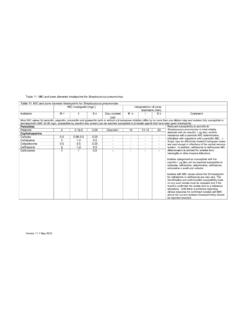
2 3 Direct susceptibility tests on urine samples may be interpreted only if the inoculum gives semi-confluent growth. Table 10. MIC and zone diameter breakpoints for staphylococci MIC breakpoint (mg/L) Interpretation of zone diameters (mm) Antibiotic R > I S Disc content ( g) R I S Comment Aminoglycosides Amikacin for Staphylococcus aureus 16 16 8 30 15 16-18 19 Amikacin for coagulase-negative staphylococci 16 16 8 30 21 22-24 25 Gentamicin 1 - 1 10 19 - 20 Tobramycin
3 For Staphylococcus aureus 1 - 1 10 20 - 21 Tobramycin for coagulase-negative staphylococci 1 - 1 10 29 - 30 Neomycin - - - 10 16 - 17 For topical use only. The zone diameter breakpoint distinguishes the wild type susceptible population from isolates with reduced susceptibility. Version May 2012 Table 10.
4 MIC and zone diameter breakpoints for staphylococci -Lactams Most staphylococci are penicillinase-producers. The benzylpenicillin will mostly, but not unequivocally, separate -lactamase producers. Isolates positive for -lactamase are resistant to benzylpenicillin, phenoxymethylpenicillin, amino-,carboxy-and ureidopenicillins. Isolates negative for -lactamase and susceptible to cefoxitin (cefoxitin is used to screen for methicillin resistance ) can be reported susceptible to these drugs. Isolates positive for -lactamase and susceptible to cefoxitin are susceptible to penicillin- -lactamase inhibitor combinations and penicillinase-resistant penicillins (oxacillin, cloxacillin, dicloxacillin and flucloxacin).
5 Isolates resistant to cefoxitin are methicillin resistant and resistant to -lactam agents, including -lactamase inhibitor combinations, except for cephalosporins with approved anti-MRSA activity and clinical breakpoints. MIC breakpoint (mg/L) Interpretation of zone diameters (mm) Antibiotic R > I S Disc content ( g) R I S Comment Ampicillin UTI1-3 Staphylococcus saprophyticus - - - 25 25 - 26 Cefoxitin Staphylococcus aureus (Screen) 4 - - 10 21 - 22 Cefoxitin S.
6 Saprophyticus (Screen) - - - 10 19 - 20 Cefoxitin coagulase-negative staphylococci (Screen) 4 10 21 22-26 27 Oxacillin (Screen) 2 1 14 - 15 Penicillin - 1 unit 24 - 25 Staphylococci exhibiting resistance to oxacillin/cefoxitin should be regarded as resistant to other penicillins, cephalosporins, carbapenems and combinations of -lactam and -lactamase inhibitors.
7 For coagulase negative staphylococci with cefoxitin zone diameters of 22-26 mm, PCR for mecA is required to determine susceptibility for treatment of deep seated infection with any -lactam. For oxacillin tests on Mueller Hinton or Columbia agars with 2% NaCl: Some hyper-producers of -lactamase give zones within the range of 7-14 mm and if possible, should be checked by a PCR method for mecA or a latex agglutination test for PBP2a. Increase in oxacillin zone size in the presence of clavulanic acid is not a reliable test for hyper-producers of -lactamase as zones of inhibition with some MRSA also increase in the presence of clavulanic acid. Rarely, hyper-producers of -lactamase give no zone in this test and would therefore not be distinguished from MRSA.
8 For S. saprophyticus there is very little data for resistant mecA strains. With penicillin check for a heaped zone edge which indicates -lactamase mediated resistance. Version May 2012 Table 10. MIC and zone diameter breakpoints for staphylococci MIC breakpoint (mg/L) Interpretation of zone diameters (mm) Antibiotic R > I S Disc content ( g) R I S Comment Quinolones Ciprofloxacin 1 - 1 1 13 - 14 MIC breakpoints relate to high-dose therapy (750 mg BD).
9 Ciprofloxacin UTI1-3 Staphylococcus saprophyticus 1 - 1 1 17 - 18 Moxifloxacin 1 1 1 15 16-19 20 Ofloxacin 1 - 1 5 27 - 28 Glycopeptides Teicoplanin Staphylococcus aureus 2 - 2 - - - - Teicoplanin Coagulase negative staphylococci 4 - 4 - - - - Vancomycin Staphylococcus aureus 2 - 2 - - - - Vancomycin Coagulase negative staphylococci 4 - 4.
10 - - - Disc diffusion for staphylococci does not give reliable results. An MIC method should be used to determine susceptibility, positive results requiring confirmation. Population analysis is the most reliable method for confirming resistance and for distinguishing susceptible, hetero-GISA and GISA isolates. If, on clinical grounds, resistance to vancomycin is suspected, it is recommended that the organism be sent to a specialist laboratory, such as Southmead Hospital in Bristol1 or the Antibiotic Research Laboratory in Cardiff2. ( ) Macrolides, lincosamides and streptogramins Azithromycin 2 2 1 15 19 - 20 The zone diameter breakpoint relates to an MIC of 1 mg/l as no data for the intermediate category are currently available.