Transcription of GUIDANCE OF THE MANAGEMENT OF THE …
1 Area Drug and Therapeutics Committee Author: Dr. Piegsa, Consultant in Sexual and Reproductive Health Version: 3 Date : February 2014 Review Date : February 2017 Approved on behalf of NHS Fife by Fife Area Drugs & Therapeutics Committee Date : February 2014 APPENDIX 6B - GUIDANCE ON MANAGEMENT OF THE MENOPAUSE IN PRIMARY CARE GENERAL POINTS The average age of the menopause in the UK is 52 years. Women in the UK can expect more than 30 years of postmenopausal life (based on current average life expectancy of 81 years). 70% of women will experience vasomotor symptoms such as hot flushes or night sweats. Some women also report psychological or physical symptoms, including tiredness, insomnia, low mood, memory problems, mood swings, loss of libido, joint pains or vaginal dryness.
2 Menopausal symptoms can occur several years before the menopause. DEFINITIONS Menopause - Permanent cessation of menstruation. Retrospective diagnosis after 12 consecutive months of amenorrhoea. Perimenopause - Starting from the first features of the approaching menopause (vasomotor symptoms, menstrual irregularity) and ending 12 months after the last menstrual period. Postmenopause - Dating from the final menstrual period, but can only be defined after 12 months of spontaneous amenorrhoea. Climacteric - Transition from reproductive to non-reproductive state. The menopause itself is a specific event during the climacteric. Early menopause - Menopause occurring before the age of 45 years (but over age 40 years). Premature menopause - Menopause occurring before the age of 40 years.
3 DIAGNOSIS OF THE MENOPAUSE Clinical diagnosis based on cessation of menstrual periods for 12 months. Do not routinely measure FSH or LH in perimenopausal women, as levels fluctuate. Test result may be normal in women with vasomotor symptoms and raised levels do not indicate that contraception is no longer required in this group. FSH levels may be useful in diagnosing the menopause in patients under 45 years with atypical symptoms, amenorrhoea on progestogen-only contraception or history of hysterectomy with conservation of the ovaries. If FSH, LH or oestradiol levels are measured blood should be taken on two occasions 6 to 8 weeks apart. If the woman is not amenorrhoeic the first sample should ideally be taken in the first 5 days of the cycle.
4 INDICATIONS FOR HRT Intolerable vasomotor symptoms = main indication for HRT. Distressing psychological or physical menopausal symptoms (see General Points for details). While HRT may be helpful it less reliable in controlling these symptoms than in controlling vasomotor symptoms. Urogenital symptoms long-term treatment with topical oestrogens as alternative to, or in addition to systemic HRT. Premature or early menopause continue with HRT until median age of the menopause. Add-back HRT for women on long-term gonadotrophin releasing hormones (GnRH) treatment for benign gynaecological conditions. This is required for osteoporosis prevention +/- menopausal symptom control (usually managed in secondary care). Area Drug and Therapeutics Committee Author: Dr.
5 Piegsa, Consultant in Sexual and Reproductive Health Version: 3 Date : February 2014 Review Date : February 2017 Approved on behalf of NHS Fife by Fife Area Drugs & Therapeutics Committee Date : February 2014 GENERAL PRESCRIBING INFORMATION Use lowest effective dose for shortest duration to control menopausal symptoms. Tablets should be offered in preference to patches as they are more cost-effective and avoid problems with detachment from skin and local side effects. The transdermal route may be appropriate where there is a clinical need to avoid first-pass metabolism of oestrogens ( liver disease, diabetes, possibly also if increased risk factors for venous thrombosis), if woman cannot tolerate tablets or if they express a strong preference for a non-oral preparation.
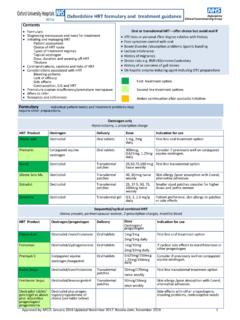
6 Addition of a progestogen is required for protection against endometrial cancer in women with an intact uterus, including those with endometrial ablation or subtotal hysterectomy. Contraception is still required in perimenopausal women on HRT. The risks and benefits of long-term use of HRT should be assessed for each individual at regular intervals. HRT should not be used first line in asymptomatic postmenopausal women for primary prevention of osteoporosis (see Appendix 6A GUIDANCE on Diagnosis and MANAGEMENT of Osteoporosis). HRT does not prevent coronary heart disease (CHD) and should not be prescribed for this purpose. See flowchart for general advice on prescribing. Area Drug and Therapeutics Committee Author: Dr.
7 Piegsa, Consultant in Sexual and Reproductive Health Version: 3 Date : February 2014 Review Date : February 2017 Approved on behalf of NHS Fife by Fife Area Drugs & Therapeutics Committee Date : February 2014 GENERAL PRESCRIBING INFORMATION cont. Women without a uterus Oestrogen only HRT Tablets and transdermal products available - patches or gel. Transmucosal systemic products - nasal spray, vaginal ring (Menoring). Women with intact uterus, after endometrial ablation or subtotal hysterectomy Sequential (cyclical) HRT Tablets and transdermal patches available. Use in perimenopause while woman still has periods. Most women have regular monthly withdrawal bleed.
8 Absence of regular bleeds in 5% of women but no investigation needed if correct use and no unscheduled bleeding. 3-monthly bleed preparation (Tridestra) suitable for women with infrequent periods. Continuous combined HRT (ccHRT) Tablets and transdermal patches available. No monthly bleeds. Indicated for postmenopausal women & women over 54 years (80% postmenopausal by then). Women currently on sequential HRT may consider changing to ccHRT after 1-2 years (if 50 years or over) or after 4-5 years (if under 50 years). Suitable as add-back HRT for women on long term GnRH treatment. Reduced risk of endometrial cancer. Tibolone Synthetic compound with oestrogenic, progestogenic and androgenic compounds. No monthly bleeds.
9 Beneficial effect on libido. Similar indications as ccHRT, including add-back HRT for women on long term GnRH. Unlike other ccHRT may not reduce the risk of endometrial cancer. Insufficient data. Breast cancer risk comparable to oestrogen-only HRT. Ovarian cancer, venous thrombosis, and coronary heart disease risk insufficient data. Stroke: significantly increased risk about times from first year of treatment: additional 9 cases per 1,000 age 50-59 years additional 20 cases per 1,000 age 60-69 years Mirena Intra-uterine system (used in combination with oestrogen only HRT) No monthly bleeds. Provides contraception. IUS only licensed for 4 years if used as part of HRT. Possibly reduced risk of endometrial cancer as with ccHRT.
10 Breast cancer risk insufficient data. Likely to be low. Women with urogenital symptoms Local oestrogen preparations are best treatment for control of urogenital symptoms. Women with urogenital symptoms should have a pelvic examination to exclude other pathology prior to commencing topical treatment. Low-potency estriol cream or pessaries, estradiol vaginal tablets or vaginal ring (Estring) are available. Long-term treatment usually required, as symptoms will return on discontinuation. Can be combined with systemic HRT if clinically indicated. Low-dose maintenance treatment (twice weekly) does not appear to increase endometrial thickness and endometrial cancer risk. No apparent adverse effect in women with a history of breast cancer or venous thrombosis.