Transcription of eiere Nav Rules Exam: Introduction - The Meiere's …
1 eiere Nav Rules Exam: Introduction file: Forrest Meiere The Nav Rules exam for the Auxiliary and the coast guard Captain s license are very similar. Both are based on the Navigation Rules of the coast guard , a book with over 200 pages. Very few people can memorize that much stuff. Fortunately, you don t have too. There is a lot of help available. For one thing, there are professionals who offer courses on how to pass the exam. Most of their customers are people who need a coast guard license for their job and are willing to pay hundreds of dollars for a course about the exam. We can use their methods for free. Here are some practical suggestions: 1 Organize your thoughts. Try to make some sense out of the Rules . If you just start reading from page one, they probably won t make sense. There is a lot of material that is needed for the courtroom that is not needed on the water or for the exam.
2 A class can help! 2 Study at a pace you feel comfortable with. You should enjoy the learning process. 3 When you feel ready, schedule an exam. Then cram for 3 days before the exam. You need many small details that you will never use again in order to pass the exam. This way you put all the agony into only 3 days. Here is my suggestion for organizing you thoughts. Step 1: Memorize how vessels are characterized for purposes of the Nav Rules . Memorize which vessels give way to other vessels. This is primarily in Rule 18. {There are exceptions. You can learn these exceptions as you go or you can learn them later. Rule 13, Overtaking, is important. Rule 9, Narrow Channel is moderately important. Rule 10, Traffic Separation Schemes is not relevant until you cram for the exam.} IT IS CRUCIAL TO START HERE.
3 Step 2: Pick a section to concentrate on and learn it at a comfortable pace. Most of the sections are relatively independent of each other but all of them depend on essentially perfect knowledge of Step 1. You will eventually have to learn all the sections mentioned below but the order in which you tackle them is a matter of preference. Here is how I group the information. The Part refers to the Nav Rules classification. I have prepared suggestions for each part. Lights and Shapes (Part C) Different types of vessels show different lights at night and different shapes in daylight. These match almost exactly with the classification of vessels. Sounds (Part D) Different types of vessels give different sound signals when maneuvering, anchoring and operating in limited visibility.
4 These roughly match the classification of vessels (learned in Step 1) but the correspondence is not quite a clean cut as for Lights and Shapes. This makes learning the Sounds a bit more difficult. Maneuvering (Part B) For the most part, this is short and sweet. Some of this subject is related to sounds used in maneuvering so it can t be studied completely out of context. I have taken both exams and helped teach one of the Captain s License prep courses at the Institute for Marine Technology. file: page: 2 of 2 Towing and Pushing (Rule 24) This subject doesn t follow the patterns of the other subjects. In addition, this is not of great practical importance our patrol area. {It is of great practical importance in the shipping lanes just off shore, especially at night.} Just learn the idiosyncrasies of this subject separately.
5 You probably want to get some of the under sections under your belt before tackling this one. General Concepts These ideas jump all over the place. A good idea is to mention them as they appear in the individual sections but then summarize them at the end. For example, there are International Rules and Inland Rules . Often these are identical and when they differ, they are still very similar. The recommended method to learn these is to start out thinking that the International and Inland Rules are the same. Then when you encounter a situation where they differ just remember OK, the difference between the Rules for this situation is .. This way you cut almost in half what you have to remember. There are numerous aids to help learn the Nav Rules . There are computer programs that are supposed to help.
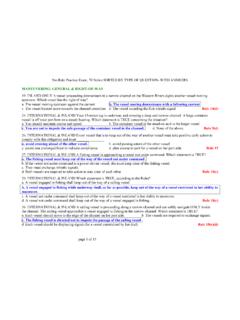
6 My personal opinion is that these are neat programs but are not the most efficient way to learn the Nav Rules . For Lights and for Sound signals, there are flash cards available. These were a big help to me 25 years ago and may help take some of the boredom out of learning these subjects that some people experience. Again, a personal preference. The Auxiliary used to have a Nav Rules exam for practice. I don t think this is available (June 2010). DO NOT TAKE THE Nav Rules 95 exam. This is open book for people who have passed Nav Rules 70. This exam difficult to pass without the book and IS NOT USEFUL FOR STUDY. I have some questions from these exams grouped by subject so we can discuss these as we study. I strongly suggest you don t try this exam before you start studying in some systematic way. It will just discourage you.
7 However, when you feel like you have learned quite a bit, try these for practice. For the cram session, it is essential that you take these practice exams over and over until you have the stuff down cold. Then take the exam immediately. If you wait a few weeks after you cram, forget it. Here is my experience. I took the Nav Rules exam for my Captain s license about 25 years ago. I breezed right through. {I felt bad about the experience because I was taking the exam at a coast guard Marine Safety office with people who looked like they knew a lot more about boating than I did but had failed the exam several times already.) Right away, I took the Nav Rules exam for the Auxiliary and scored 100% (unlike the coast guard the Auxiliary will provide your score.) When I moved here, I tried the on-line version of the Series 70 exam and flunked (82%).}
8 I brushed up for a few days and scored over 90% three times in a row. I signed up to take the exam for real but cancelled when my Mom died two days before the exam date. I took the practice exam a few months later without studying. Flunked again. My conclusion from those experiences is that the general ideas will stay with you for a lifetime but the exam picks out little minor details to ask about and words the questions in sneaky ways about 30% of the time. To pass the exam, you should learn the basics at your leisure and then cram the nit-picking stuff for a few days just before the exam. (I did brush up and passed easily.) This method has 100% passing rate for those who stick with it. One student passed with 100% the first time. Most pass on the first or second try but miss one or two questions. (~ 20 in all.)
9 I know of classes where the approach is pure memorization that have a 100% failure rate.