Transcription of IC-7100 User Evaluation & Test Report
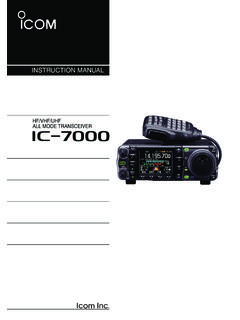
1 1 IC-7100 user Evaluation & Test Report By Adam Farson VA7OJ/AB4OJ Iss. 3, Sept. 9, 2014. Figure 1: The icom IC-7100 . Introduction: This Report describes the Evaluation of IC-7100 S/N 02001352 from a user perspective. Appendix 1 is a comparison of IC-7100 and IC-7000 features in tabular form. Appendix 2 presents results of an RF lab test suite performed on the radio. I was able to spend a few days with the IC-7100 in my ham-shack, and thus had the opportunity to exercise the radio s principal features and evaluate its on-air behavior. 1. Physical feel of the IC-7100 : The packaging of the IC-7100 represents somewhat of a new departure for icom . It is a 2-piece radio consisting of a main unit and a separate control head. Unlike the IC-7000, IC-706 series and IC-703, though, the control head is in the form of a small sloping-front console and cannot be attached to the main unit. The IC-7100 features a large touch-screen display, which offers easy band/mode selection and navigation through the radio s menus.
2 Owners of current icom IF-DSP transceivers should find the IC-7100 quite familiar, and should feel comfortable with it after a little familiarization with the touch-screen. In addition to the display, the control head has a number of feature keys below the display and two concentric knobs (AF, power on/off, RF/Squelch) and multi-function (memory/Twin PBT/RIT/Mic Gain/RF Power) to the right of the display. The learning curve will be minimal for owners of other icom IF-DSP radios. 2 The main tuning knob is lightly detented and has a knurled Neoprene ring; it turns very smoothly with minimal side-play. RJ-45 jacks for the control and mic cables, and PHONES and ELEC KEY jacks, are on the rear panel of the control head. A slide switch on the bottom of the control allows connection of an external speaker or headphones to the PHONES jack. The supplied HM-198 hand mic, the optional HM-151 control mic or the OPC-589 8-pin round/modular adapter cable can be plugged into the mic jack. The IC-7100 is solidly constructed and superbly finished.
3 It conveys a tight, smooth, and precise overall feel (as do other icom radios). The main unit is built in a die-cast alloy chassis, and its sheet-steel case is finished in an attractive black crinkle coating. The control head has a smooth, matte surface. The IC-7100 main unit weighs and the control head 500g. The radio is fitted with the new 4-pin DC power socket. A mini-USB socket is provided on the rear panel, allowing direct CI-V and baseband connectivity to a PC via the supplied USB cable. Both the case and the rear panel are well-ventilated. The air-intake grille and the SD card slot are on the front panel of the main unit. 2. Control knob/key and touch-screen functions and menus: Apart from some differences in placement, the IC-7100 s control knobs will be familiar to users of the IC-7000, IC-706 series and IC-703. The concentric multi-function controls and MIC GAIN/RF-SQL knobs are to the left of the screen. The multi-function controls are multi-turn and detented. The large monochrome touch-screen displays a very clear, crisp image, with excellent contrast and a white backlight.
4 The touch-activated menu softkeys in the lower field of the screen change with menu selection via the MENU key. Pressing the MIC/RF PWR or SPEED/PITCH key in the lower row (below the screen) redefines the multi-function controls correspondingly, and an appropriate pop-up is displayed in the lower field of the screen. I found that even with a bright desk lamp shining on it, the display was still highly legible and did not wash out . Figure 2: Control head, with screen and panel. 3 Pressing the inner multi-function knob switches the controls to Twin PBT. A bandwidth/shift pop-up appears, and the green PBT LED is lit. When the RIT key is pressed, the yellow RIT LED is lit. Pressing the inner knob now toggles between memory, PBT and RIT functions. When RIT is activated, an RIT pop-up is displayed. Pressing and holding the inner knob now clears the PBT or RIT setting (as selected). The menus are somewhat akin to those in other icom radios, allowing for the addition of menus for D-Star Digital Voice (DV) and GPS functions.
5 The row of touch-activated menu softkeys at the bottom of the screen, in effect, adds a third row of feature keys to the control head. I found the set-up process fairly intuitive after consulting the relevant user -manual sections in cases of doubt. icom continues the use of a Smart Menu system which changes available functions based on the mode currently in use. Menus are selected by pressing the MENU key on the bottom left of the screen; this key also serves as an EXIT key. Menu selections with default values can be returned to default by pressing and holding their DEF softkey. For several menu items, the F-3 key serves this purpose even though it is not marked DEF. Touching the leading (MHz) digits of the frequency display opens a band-selection matrix; the desired band is selected by touching its designator. Mode selection is similar; touching the current mode icon opens the mode-selection matrix. Tuning steps for kHz and Hz are set by touch, or by touch/hold, on the respective digit groups.
6 In addition a touch-matrix can be opened for DTMF digit keysending. The filter selection and adjustment procedure is similar to that on other icom DSP radios. Touch the FIL-(n) icon to toggle between FIL-1, FIL-2 and FIL-3. Touch and hold this icon to adjust the filter bandwidth and select CW/SSB Sharp/Soft shape. All IF filters are continuously adjustable. As in other icom IF-DSP radios, filters with 500 Hz or narrower bandwidth have the BPF shape factor, but a non-BPF filter can be configured via Twin PBT. The key toggles between preamps 1 sand 2, and a 20 dB RF attenuator. The DR key brings up the D-Star (DV) menu. The SET key opens easily navigable setup menus, and the QUICK key opens a menu of common feature selections. Many of the menu values can be selected by touching a bar, and touch arrows for up/down scrolling and return to the previous screen are provided. The DR key accesses a D-Star repeater setup menu, facilitating D-Star service configuration. The DR mode is the enhanced user interface for VHF/UHF D-Star operation.
7 For HF D-Star, or for those more accustomed to the basic D-Star operation, simply selecting DV will give access to the D-Star mode. The Time-Out Timer feature limits transmissions to a preset duration (3, 5, 10, 20 or 30 minutes, selectable by menu.) The PTT Lock function inhibits transmit. This feature is useful when receiving via active antennas or mast-mounted preamplifiers without T/R switching, or to avoid damaging test equipment when conducting receiver measurements. 4 Being a current IC-7700 and IC-7600 owner, I found that the IC-7100 s controls and menus fell readily to hand. A user familiar with a radio such as the IC-756 Pro3 or IC-7000 should find the IC-7100 s learning curve manageable. The IC-7100 s default settings are very usable, allowing the radio to be placed in service with minimal initial set-up. 3. LCD display screen: The monochrome LCD screen is 80 x 50mm (H x W). The display is very bright and crisp, and presents all radio parameters. The display layout is somewhat similar to that of the IC-7410.
8 The IC-7100 offers a limited, non-real-time spectrum scope and SWR Plot indicator very similar to those of the IC-7000. The spectrum scope is initiated via menu and displays an approximate, qualitative histogram of band occupancy in the lower field of the screen. It mutes the receiver during its acquisition cycle. Scope span is configurable in the range to 25 kHz. The SWR indicator operates in a similar manner. Touching the currently-displayed meter scale toggles between scales. Touching and holding the meter scale opens the multi-function meter, which displays all scales simultaneously. The Notch, NR and NB keys, and the Twin PBT controls, open pop-ups in the lower field of the screen. These can be used to select notch width, NR level, NB parameters and filter/PBT bandwidth respectively. 5. USB interfaces: The IC-7100 is equipped with a rear-panel mini-USB B port. The radio can be directly connected via the B port to a laptop or other PC via the supplied USB cable. This is without doubt one of the IC-7100 s strongest features.
9 The USB port transports not only CI-V data, but also TX and RX PCM baseband between the IC-7100 and the computer. As a result, the USB cable is the only radio/PC connection required. Gone forever is the mess of cables, level converters and interface boxes! This feature is now standard on all icom HF radios released since 2009. An icom driver is required in the PC; this is downloadable from the icom Japan World website. Note that not all rig-control software will support the IC-7100 ; the CI-V PTT command, introduced with the IC-756 Pro3, has encountered issues with certain programs such as MMTTY. 6. Filter selections and Twin PBT: As do the other icom DSP transceivers, the IC-7100 offers fully-configurable RX IF selectivity filters for all modes. Three default filter selections are available via the touch-screen for each mode, with continuously variable bandwidth via the FILTER menu. In addition, there are selectable Sharp and Soft shape factors for SSB and CW. The BPF filter configuration feature (for filter bandwidths of 500 Hz or less) operates in the same manner as on other icom IF-DSP radios.
10 To use SWR Plot ( IC-7100 user manual, p. 6-14): 1. Tune VFO to desired SWR measuring frequency. 2. In Menu M-3, touch SWR. 3. Touch SET, then set desired SWR measuring step size. 4. Touch to start sweep. mark below the graph bar shows sweep progress. 5. When sweep is complete, an SWR/frequency bar-graph is displayed. 5 Twin PBT is one of the modes of the concentric multi-function controls. Pressing and holding the inner knob [CLR] restores PBT to neutral. The TPF menu item in the RTTY SET menu selects the Twin Peak Filter (TPF) in RTTY mode. No CW APF (Audio Peak Filter) is provided. However, the CW RX LPF and HPF in the TONE SET menu are a reasonable alternative to the "missing" APF; their ranges are 100 - 2000 and 500 - 2400 Hz respectively. The HPF and LPF can be set to "bracket" the received CW tone in a tight 100 Hz audio bandwidth. The DEF softkey restores these filters to default (off). 7. BPF vs. non-BPF filters: As in other icom IF-DSP radios, the IC-7100 allows the user to select two additional shapes for 500 Hz or narrower filters, in addition to SHARP and SOFT.