Transcription of Hemispheric Stroke Scale
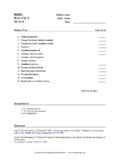
1 Hemispheric Patient Name: _____ Stroke Rater Name: _____ Scale Date: _____ Scored to give 0 ( = good) to 100 ( = bad) Score LEVEL OF CONSCIOUSNESS 15 Glasgow Coma Scale Score _____ LANGUAGE Comprehension _____ Give three commands: Stick out your tongue or Close your eyes Point to the door Place left/right hand on left/right ear and then on left/right knee (using unaffected side) Score on number correctly followed: 0 = 5 1 = 4 2 = 2 3 = 0 Naming _____ Ask patient to name the following items: Watch or Belt Watch strap or Belt buckle Index finger or Ring finger Score on number correctly named: 0 = 5 1 = 4 2 = 2 3 = 0 Repetition _____ Ask the patient to repeat the following: A single word, such as dog or cat The president lives in Washington No ifs, ands, or buts Score on number repeated: 0 = 5 1 = 4 2 = 2 3 = 0 Page 1 TOTAL _____ Provided by the Internet Stroke Center Fluency _____ Score according to patient s spontaneous speech fluency, or Ask patient to name as many words as he can within one minute beginning with the letter A (excluding proper names) Score as: 5 = Essentially no verbal output 3 = Moderately loss; inability to recognize stationary finger, sees moving finger 1 = Mild loss.
2 Defect to double simultaneous stimulation 0 = Normal OTHER CORTICAL FUNCTIONS AND CRANIAL NERVES Visual fields _____ Test clinically and score hemi-field loss as: 3 = Severe loss; inability to recognize moving hand, no response to threat 2 = Moderate loss; inability to recognize stationary finger, sees moving finger 1 = Mild loss: defect to double simultaneous stimulation 0 = Normal Gaze _____ Score eye movements: 2 = Gaze play, or persistent deviation 1 = Gaze preference, or difficulty with far lateral gaze 0 = Normal Facial expression _____ Score movement: 3 = Severe weakness; drooling 2 = Moderate loss; asymmetry at rest 1 = Mild weakness; asymmetry on similing 0 = Normal Dysarthria _____ Score talking: 2 = Severe dysarthria 1 = Moderate dysarthria 0 = Normal Dysphagia _____ Score swallow of glass water: 2 = Severe dysphagia 1 = Moderate dysphagia 0 = Normal Neglect syndrome _____ Ask about weak limbs, and ask to bisect a line 7 inches (20 cm) long on piece of paper in visual midline Score: 2 = Anosagnosia, or denial of body part 1 = Consistently bisects line towards good side of body 0 = Bisects line in middle Visual construction _____ Ask patient to copy three figure given, and score: 3 = Unable to copy any figure 2 = Can copy a square 1 = Can copy a Greek Cross ( Cross of St.)
3 George ) 0 = Can copy 3D drawing of cube Page 2 TOTAL _____ Provided by the Internet Stroke Center MOTOR FUNCTION Arm, proximal _____ Arm, distal _____ Leg, proximal _____ Leg, distal _____ All scored 0-7 as: 7 = No movement (MRC 0) 6 = Trace movement only (MRC 1) 5 = Motion without gravity only (MRC 2) 4 = Moves against gravity but not against resistance (MRC 3) 3 = Moderate weakness (MRC 4 -) 2 = Mild weakness (MRC 4) 1 = Positive drift of arm/leg (MRC 4 +) 0 = Normal (MRC 5) Deep tendon reflexes _____ 2 = Hypoactive or hyperactive 0 = Normal Pathologic reflexes _____ 2 = Babinski (plantar) and another abnormal 1 = Babinski (plantar) or another abnormal 0 = Normal Muscle tone _____ 2 = Increased or decreased 0 = Normal Gait _____ Test ability to stand and walk, and score.
4 6 = Unable to stand unsupported or cannot evaluate 5 = Can stand with support but cannot walk 4 = Severely abnormal; walking distance limited even with support (from aid or person) 3 = Moderately abnormal; no assistance required (apart from a stick/cane), but distance limited 2 = Mildly abnormal (weak, uncoordinated); can walk independently but slowly 1 = Minimally abnormal, no reduction in speed or distance 0 = Normal SENSORY Primary modalities (of affected side only), arm _____ Test touch, pain and score as: 4 = Anaesthesia 3 = Severe hypaesthesia 2 = Moderate hypaesthesia or deficit only; or extinction to double simultaneous stimulation 1 = Mild hypaesthesia or dysaesthesia 0 = Normal Page 3 TOTAL _____ Provided by the Internet Stroke Center Stereoagnosis _____ Test ability to distinguish two coins and a key, and score: 3 = Unable to achieve any distinctions 2 = Can distinguish a coin from a key 1 = Can distinguish between two very different sized coins (penny and ten-pence piece, penny and quarter) 0 = Can distinguish between two similar sized coins (penny and nickel, or two-pence piece and ten-pence piece) Page 4 TOTAL _____ OVERALL TOTAL _____ Reference Adams RJ, Meador KJ, Sethi KD, Grotta JC, Thomson DS.
5 Graded neurologic Scale for use in acute Hemispheric Stroke treatment protocols. Stroke . 1987;18:665-9. Provided by the Internet Stroke Center