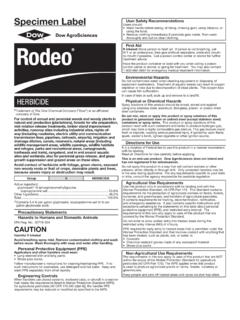
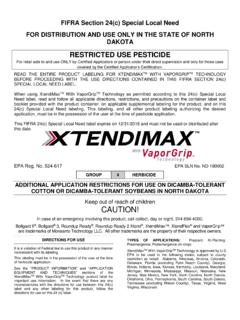
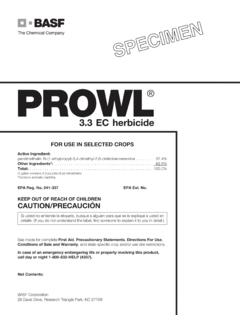
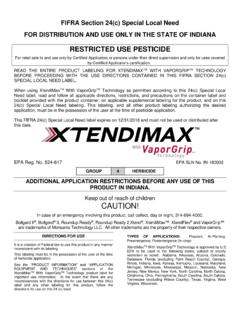
Transcription of KEEP OUT OF REACH OF CHILDREN CAUTION - …
1 Page 1 of 14 Linuron Flowable ACTIVE INGREDIENTS .. BY WEIGHT Linuron 3-(3, 4-dichlorophenyl)-1-methoxy-1-methylurea .. INERT INGREDIENTS This product contains 4 lbs. of Linuron per gallon.. TOTAL keep OUT OF REACH OF CHILDREN CAUTION Si usted no entiende la etiqueta, busque a alguien para que se la explique a usted en detalle. (If you do not understand this label, find someone to explain it to you in detail.) FIRST AID IF SWALLOWED: Call a poison control center or doctor immediately for treatment advice. Have person sip a glass of water if able to swallow. Do not induce vomiting unless told to do so by the poison control center or doctor.
2 Do not give anything by mouth to an unconscious person. IF ON SKIN OR CLOTHING: Take off contaminated clothing. Rinse skin immediately with plenty of water for 15-20 minutes. Call a poison control center or doctor for treatment advice. IF INHALED: Move person to fresh air. If person is not breathing, call 911 or an ambulance, then give artificial respiration, preferably mouth-to-mouth, if possible. Call a poison control center or doctor for further treatment advice. IF IN EYES: Hold eye open and rinse slowly and gently with water for 15-20 minutes. Remove contact lenses, if present, after the first 5 minutes, then continue rinsing eye.
3 Call a poison control center or doctor for treatment advice. Have the product container or label with you when calling a poison control center or doctor, or going for treatment. For medical emergencies involving this product, call toll free 1-866-374-1975. Refer to accompanying labeling for additional precautions and complete directions for use. Reg. No. 61842-21 Est. No. 37429-GA-001 Produced for: Tessenderlo Kerley, Inc. 2255 N. 44th Street, Suite 300 Phoenix, AZ 85008 USA 1-800-525-2803 Copyright 2006, 2008, 2013. All rights reserved. LINEX4L-0213 Page 2 of 14 PRECAUTIONARY STATEMENTS HAZARDS TO HUMANS & DOMESTIC ANIMALS CAUTION CAUTION !
4 Harmful if swallowed or absorbed through the skin. Avoid contact with eyes, skin, or clothing. Prolonged or frequently repeated skin contact may cause an allergic reaction in some individuals. Remove contaminated clothing and wash clothing before reuse. PERSONAL PROTECTIVE EQUIPMENT Some materials that are chemical-resistant to this product are listed below. If you want more options, follow the instructions for category A on an EPA Chemical resistance category selection chart. Mixers and loaders must wear: - Coveralls over long-sleeved shirt and long pants - Chemical resistant footwear - Chemical resistant gloves made of any waterproof material such as nitrile, butyl, neoprene, and/or barrier laminate - Chemical resistant apron.
5 Applicators and other (other than mixers and loaders) handlers must wear: - Long-sleeved shirt and long pants - Chemical-resistant gloves made of any waterproof material such as nitrile, butyl, neoprene, and/or barrier laminate - Shoes plus socks Follow manufacturer s instructions for cleaning/maintaining PPE. If no such instructions for washables, use detergent and hot water. keep and wash PPE separately from other laundry. Engineering controls statement: When handlers use closed systems, enclosed cabs, or aircraft in a manner that meets the requirements listed in the Worker Protection Standard (WPS) for agricultural pesticides (40 CFR (d)(4-6), the handler PPE requirements may be reduced or modified as specified in the WPS.)
6 USER SAFETY RECOMMENDATIONS USERS SHOULD: Wash hands before eating, drinking, chewing gum, using tobacco or using the toilet. Remove clothing immediately if pesticide gets inside. Then wash thoroughly and put on clean clothing. ENVIRONMENTAL HAZARDS This pesticide is toxic to fish and aquatic invertebrates. Do not apply directly to water or to areas where surface water is present or to intertidal areas below the mean high water mark. Do not apply where weather conditions favor drift from areas treated. Do not contaminate water when cleaning of equipment or disposing of equipment washwater and rinsate.
7 Ground Water Advisory: This chemical is known to leach through soil into ground water under certain conditions as a result of agricultural use. Use of this chemical in areas where soils are permeable, particularly where the water table is shallow, may result in groundwater contamination. Surface Water Advisory: Linuron may contaminate surface water through spray drift or under certain conditions from surface runoff into adjacent surface water bodies (ponds, lakes, streams, etc.). For several weeks post-application, linuron has a high potential to runoff when applied to fields with any of the following conditions: sloping land draining into nearby surface waters; very poorly to somewhat poorly drained soils; areas with extremely shallow ground water; frequently flooded areas; fields with surface water canals or ditches; and highly erodible land cultivated with poor management practices.
8 Page 3 of 14 DIRECTIONS FOR USE It is a violation of Federal law to use this product in a manner inconsistent with its labeling. Do not apply this product in a way that will contact workers or other persons, either directly or through drift. Only protected handlers may be in the area during application. For any requirements specific to your State or Tribe, consult the agency responsible for pesticide regulation. RESISTANCE When herbicides that affect the same biological site of action are used repeatedly over several years to control the same weed species in the same field, naturally-occurring resistant biotypes may survive a correctly applied herbicide treatment, propagate, and become dominant in that field.
9 Adequate control of these resistant weed biotypes cannot be expected. If weed control is unsatisfactory, it may be necessary to retreat the problem area using a product affecting a different site of action. To better manage herbicide resistance through delaying the proliferation and possible dominance of herbicide resistant weed biotypes, it may be necessary to change cultural practices within and between crop seasons such as using a combination of tillage, retreatment, tank-mix partners and/or sequential herbicide applications that have a different site of action. Weed escapes that are allowed to go to seed will promote the spread of resistant biotypes.
10 It is advisable to keep accurate records of pesticides applied to individual fields to help obtain information on the spread and dispersal of resistant biotypes. Consult your agricultural dealer, consultant, applicator, and/or appropriate state agricultural extension service representative for specific alternative cultural practices or herbicide recommendations available in your area. INTEGRATED PEST MANAGEMENT This product may be used as part of an Integrated Pest Management (IPM) program that can include biological, cultural, and genetic practices aimed at preventing economic pest damage. IPM principles and practices include field scouting or other detection methods, correct target pest identification, population monitoring, and treating when target pest populations REACH locally determined action thresholds.