Transcription of Negative pressure isolators for cytotoxics - Envair
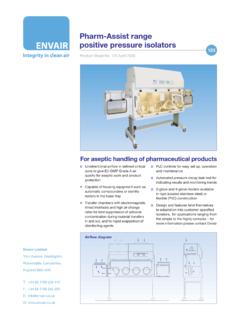
1 1 Negative pressureisolators for EN ISO 14644-4. GMP RevisedAnnex. pressure isolators are increasingly used for dispensing of article looks at whether turbulent flow can be as effective as unidirectionaland whether positive pressure isolators might be as safe as Negative onesHospital Pharmacy Europe March/April 2004 Sponsored profile EnvairThe term unidirectional flow has superseded laminar flow in international flow is defined as follows:controlled airflow through the entire cross-section ofa clean zone with a steady velocity and approximatelyparallel streamlines - Note: this type of airflow resultsin a directed transport of particles from the following statement in the European GMPamplifies the meaning of grade A.
2 The particulateconditions for grade A in operation given in the tableshould be maintained in the zone immediatelysurrounding the product whenever the product oropen container is exposed to the environment. 2 Envair believes that only unidirectional flowcomplies with this requirement, by quickly and effec-tively removing process-generated contamination fromthe critical further point is that a unidirectional flow isola-tor has an air change rate of 1,800 TAC (total airchanges/h), compared with 180 TAC for a typicalturbulent flow isolator. In this example, the clean-uptime for the whole isolator is ten times over the use of cartridge HEPA filtersCartridge HEPA (high-efficiency particulate air) filtersare frequently used in turbulent flow isolators .
3 It is notpossible to test these filters for single leaks duringmanufacture or during routine tests in situ, and onlythe mixed volume can be tested for overall penetra-tion or efficiency (volumetric testing). On the otherhand, panel HEPA filters can be scan-tested for singleleaks. In both cases, testing is carried out using a cali-brated upstream aerosol challenge (DOP) and anaerosol photometer with a sampling probe down-stream. The sampling probe is designed to be isokinetic, ie,to draw air in at approximately the same velocity as theunidirectional air passing the probe. This ensures100% sampling in unidirectional flow systems whenthe probe is scanned back and forth across the filter inoverlapping sweeps.
4 The probe of the aerosolphotometer normally samples at 1cfm (cubic feet/min)= 10-4m3/s. In turbulent flow systems, the probecan only take a sample of the mixed air. For the typi-cal turbulent flow isolator, with an air change rate of180 TAC and a volume of 1m3, the volume flow rate is180m3/h = 180/3600m3/s = 5 10-2m3/s. All leakagethrough single leaks in the cartridge HEPA filter isdiluted into this airflow. Thus, in this particular exam-ple, volumetric testing is 100 times less sensitive thanscanning. This cannot be overcome by increasing thesample size or the number of tests, because neither ofthese can overcome the dilution. Therefore even if anisolator is built and tested to a high standard of leak-tightness, there is still a significant risk of microbialcontamination (if its air supply is through a cartridgeHEPA filter).
5 Aseptic techniquesTechnicians are usually taught aseptic techniques inunidirectional flow. They are trained to carry out crit-ical operations in a streamline of air that is unconta-minated (ie, that has come straight from the HEPA filter). If work is carried out downstream of, for exam-ple, hanging bags, technicians have to pay special atten-tion to the prior disinfection of these bags. Technicianshave expressed genuine concern about the risks ofrecontamination in turbulent flow environments. Positive versus Negative pressureBoth types of isolator provide operator protection inmost circumstances, due to the physical barrier. Themain difference is that, in the (hopefully rare) eventof a major leak or breach in a Negative isolator, thereis no outward flow of potentially contaminated air.
6 Whatever the technical arguments, the largenumber of Negative pressure isolators being manufac-tured by Envair demonstrates the preference of phar-macy technicians around the world. When engaged inlong-term intensive work with cytotoxics , they need tofeel that everything possible is being done to ensuretheir personal safety. It is important to remember thatthe isolator is not a magic box it will only providesafety if properly used, cleaned and maintained. To continue receiving your free copy of HPE, register now