Transcription of International Prostate Symptom Score (I-PSS)
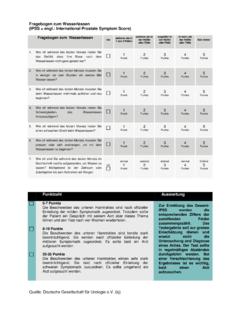
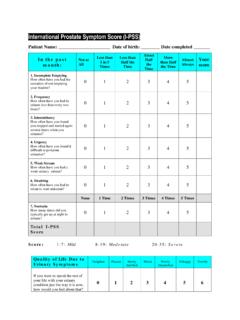
1 International Prostate Symptom Score (I-PSS) Patient s Name Date of Birth Date Completed Not at all Less than 1 time in 5 Less than the time About the time More then the time Almost always Your Score 1. Incomplete Emptying Over the past month, how often have you had a sensation of not emptying your bladder completely after you finished urinating? 0 1 2 3 4 5 2. Frequency Over the past month, how often have you had to urinate again less than two hours after you finished urinating? 0 1 2 3 4 5 3. Intermittency Over the past month, how often have you found your stopped and started again several times when you urinated? 0 1 2 3 4 5 4. Urgency Over the past month, how often have you found it difficult to postpone urinating? 0 1 2 3 4 5 5.
2 Weak Stream Over the past month, how often have you had a weak urinary stream? 0 1 2 3 4 5 6. Straining Over the past month, how often have you had to push or strain to begin urination? 0 1 2 3 4 5 None 1 Time 2 Times 3 Times 4 Times 5 Times or more 7. Nocturia Over the past month, how many times did you most typically get up to urinate from the time you went to bed at night until the time you got up in the morning? 0 1 2 3 4 5 Total I-PSS Score Delighted Pleased Mostly satisfied Mixed Mostly dissatisfied Unhappy Terrible Quality of Life Due to Urinary Symptoms If you were to spend the rest of your life with your urinary condition just the way it is now, how would you feel about that. 0 1 2 3 4 5 6 The International Prostate Symptom Score (I-PSS) is based on the answers to seven questions concerning urinary symptoms.
3 Each question allows the patient to choose one of six answers indicating increasing severity of the particular Symptom . The answers are assigned points from 0 to 5. The total Score can therefore range from 0 to 35 (asymptomatic to very symptomatic). Furthermore, the International Scientific committee recommends the use of a question to assess the quality of life. The answers to this question range from delighted to terrible or 0 to 6. Although this single question may or may not capture the global impact of benign prostatic hyperplasia (BPH) symptoms or quality of life, it may serve as a valuable starting point for doctor-patient conversation. The International Scientific Committee recommends that all physicians who counsel patients suffering from symptoms of prostatism utilize these measures not only during the initial interview but also during and after treatment in order to monitor treatment response.
4 The International Scientific Committee, under the patronage of the World Health Organization (WHO) and the International Union Against Cancer (UICC), has agreed to use the Symptom index for BPH, which has been developed by the American Urological Association (AUA) Measurement Committee, as the symptoms assessment tool for patients suffering from prostatism.