Transcription of Measurement of the Adhesion Strength of Paint A …
1 Measurement of the Adhesion Strength of Paint A report by Dr. Long LIN Department of Colour & Polymer Chemistry University of Leeds Summary Several identical samples of The Colour Station painted glass panels were supplied by Decorative Resins International for Measurement of the Adhesion Strength of the Paint to the glass panel. Thus, measurements of the Adhesion Strength of the Paint to the glass panel were carried out following the American Standard Test Method for coating Adhesion ASTM D3359, with modifications suggested by Decorative Resins International. It was found that the Paint film retained 100% of its Adhesion even after being boiled in water for 2 hours. This report details the test results. Introduction There exist various methods for the evaluation of Adhesion Strength of coatings on substrates.
2 Such methods can be found in both British Standard and American Standard of Test Methods. It was felt that the most appropriate test method for the samples provided by Decorative Resins International was the ASTM (American Standard Test Method) D3359 - Standard Test Methods for Measuring Adhesion by Tape Test. As such, the coated panels provided by Decorative Resins International were subjected to the Adhesion test following ASTM D3359. This report details the test procedures, the test results and relevant interpretations. Test Procedure Principle of the test The ASTM D3359 test method is designed to assess the Adhesion of coating films to substrates by applying and removing pressure - sensitive tape over cuts made in the film. A cross - hatch cutter with multiple preset blades was used to make sure that the incisions are properly spaced and parallel.
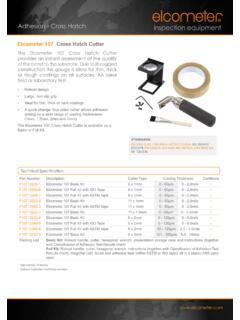
3 After the tape has been applied and pulled off, the cut area is then inspected and rated according to the percentage of the squared remaining on the test panel. Equipment and Materials cross hatch cutter The cross hatch cutter employed in the test was an Elecomer seven blades cross hatch cutter (forming a pattern of 49 squares), which is shown in Figure 1. Figure 1: Elecomer Seven Blades cross hatch Cutter Pressure sensitive adhesive tape It is very important that an accurate amount of pulling force is applied onto the coating film. As such, ASTM D3359 emphasises the use of a specific, standard pressure sensitive Adhesion tape for the test. The pressure - sensitive tape (Part No. X1002) employed in the test gave an accurate adhesive Strength of to comply with the standard ISO 2409 and ASTM D3359. Test panels The test panels used were The Colour Station painted glass panels of 2 4 supplied by Decorative Resins International.
4 A pair of typical test panels is shown in Figure 2. Figure 2: The Colour Saturation Glass Test Panels Un-boiled and boiled tests Adhesion tests were carried out on both un-boiled and boiled test panels. Thus, one test panel was boiled in water for two hours, dried with soft tissue paper prior to Adhesion test. Results and discussion Test results, together with relevant interpretations are given in this section. Test panels after cutting The test panels after cut using the cross hatch cutter are shown in Figure 3. It can be seen, from Figure 3, that the coating film is relatively brittle, as indicated by the detachment of the coating film at locations where the cut has been sustained. Test Panel No. 2 Test Panel No. 4 Figure 3: Test Panels After Cut Using the cross hatch Cutter Test panels and Adhesion tapes after Adhesion tests As mentioned earlier, both un-boiled and boiled test panels were subjected to Adhesion tests.
5 The following sections detail the relevant results. Standard (un-boiled) Adhesion The test panel, together with the adhesive tape, after Adhesion test are shown in Figure 4. It can be seen from Figure 4 that there is no square pulled off by the tape, which indicates that the un-boiled sample has 100% pass of the Adhesion test. However, slight flaking occurred along the cutting line edges and intersection, which can also be seen on the tested tape. This is caused by the brittleness of the coating film as mentioned earlier. Figure 4: Test Panels and Adhesion Tapes After the Adhesion Tests Adhesion after boil The test panel and the Adhesion tape, after the Adhesion test of the test panel boiled for two hours in water, are shown in Figure 5. It can be seen from Figure 5, there were only a small amount of coating detached from the glass panel, while all squares remained intact.
6 This indicates that the coating film did not lose its Adhesion after being boiled in water for two hours. As such, it was concluded that the coating film retained 100% Adhesion after being boiled for two hours in water. The transfer of small amount of the coating onto the Adhesion tape was the residual coating damaged by cutting. Figure 5: Test Panel and Adhesive Tape After Adhesion Test of the Boiled Test Panel Conclusions The following conclusions can be made based on the experimental results obtained. 1. The coating film has excellent Adhesion on the glass panel as indicated by the 100% retainment of the coating film on the glass surface even after boiling in water for two hours. 2. The coating film appears to be relatively brittle indicated by the cracking of the coating film along the cuts.