Transcription of Cognitive Therapy Overview - Specialty Behavioral …
1 Cognitive Therapy Overview Thoughts are Related to our Feelings and Behavior One of the assumptions of Cognitive Therapy is that our own thoughts can play an important role in maintaining unpleasant mood states and unhealthy behavior patterns. Let s consider an example to illustrate how this may happen. Imagine a person is taking a math class and she has been working very hard at learning the lessons. She gets the first test back and her score is 63%. She feels extremely discouraged and is depressed for the next few days. She skips the next class, considers dropping the class altogether, and even considers changing her career goals.
2 A figure of the process is below: Feelings or Behaviors Depressed and discouraged Avoid next class Drop class? Change career plans? Events or Situation Working hard at class Got 63% on test Now let s consider the possibility that thoughts played a critical role in linking the situation with the feelings and actions. The process may now look something like this. Events or Situation Working hard at class Got 63% on test Feelings or Behaviors Depressed and discouraged Avoid next class Automatic Thoughts That s a horrible score. What did I do wrong? I m going to fail the class. I can t do this kind of math. Drop class?
3 Change career plans? But what if her thoughts about the situation were different? Imagine that she later found out that the highest score on the test was 64% and that her grade was in the high A range. What if she also found out that it was the instructor s first time teaching the class and that he received poor ratings when he taught a different class last semester? Even though the events or situation remains the same, her feelings and actions would be likely to change because she would have quite different thoughts. The process may now look like this: Events or Situation Working hard at class Got 63% on test Feelings or Behaviors Happy, proud, curious Keep studying hard Stay in class Keep focused on goals Different Thoughts That s an excellent score.
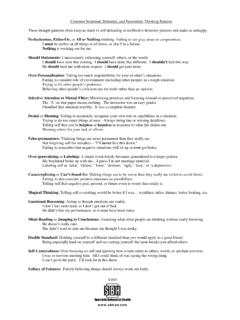
4 Is he a bad teacher? I m good at math. I ll make a good electrician. Of course, the example above is overly simplified. Rarely are things in real life that simple or easy to change. In fact, there may be several other factors that influence your mood and reactions including some biological and environmental factors that may be outside your control. Even though there are probably multiple factors related to your situation, focusing on thoughts and thought patterns as a primary target for change during Therapy may still be very helpful for you. Several decades of scientific research has revealed that there are some commonalities among persons thought-behavior-feeling patterns associated with specific conditions ( , specific diagnoses) and this has led to the development of Cognitive Therapy models for many conditions.
5 The Cognitive Therapy models can be useful for you and your therapist as a means to develop hypotheses about your particular situation, and consider which changes may best help you to accomplish your goals for treatment. Rev. 2010 Cognitive Therapy Overview Although the Cognitive Therapy approach depicts explanatory and treatment models for many specific conditions, it does not assume that a person s thoughts cause specific conditions such as depression or anxiety . In fact, the Cognitive Therapy approach does not even assume that our thoughts cause the way we feel or act. Such an idea would be over-simplifying the complexity of the human mind.
6 Instead, the Cognitive Therapy model assumes that there are complex and reciprocal relationships between our thoughts, feelings, and actions that allow us the flexibility needed to cope with a variety of situations in life. As shown in the figure below, a specific disorder can develop when the combined effects of predisposing and precipitating factors lead to a sufficient level of dysregulation of the normal systems of mental functioning: the affective, Cognitive , and Behavioral response systems. Once the response systems become dysfunctional, they can actually work against normal healthy adaptation and serve to maintain the condition, even after the precipitating factors have diminished.
7 Let s look at an example to see how the model could apply to a specific condition panic disorder. If a person has a high level of predisposing factors, then a moderate or even mild level of precipitating factors could result in panic attacks and subsequent dysregulation of the normal response systems. Alternatively, even a person with very low levels of predisposing risk factors could still develop panic disorder if the level of precipitating factors was high enough. For panic disorder, some of the known predisposing factors are genetically inherited responses to fearful situations and learned coping strategies modeled by caregivers during childhood.
8 Some of the common precipitating factors for panic disorder are substance use, stressful life situations, and serious medical problems among family members. Once the panic disorder has developed, a person may predictably experience dysregulation in affective responses ( , false alarms of the fight, flight, or freeze coping response), Cognitive responses ( , misinterpretation of bodily sensations), and Behavioral responses ( , hyperventilation). It is the dysregulation in these response systems which primarily determines whether the panic attacks diminish or continue to occur over time. Therefore, even though genetics may play a key role in development of panic disorder, treatments that target Behavioral and Cognitive response are often quite helpful to alleviate the condition.
9 Behavioral Response System Predisposing Factors + Precipitating Factors Dysregulation in Normal Response Systems of Function Affective Response System (Feelings) Cognitive Response System (Thoughts) Rev. 2010 Cognitive Therapy Overview If you decide to pursue Cognitive Therapy and focus on changing your thoughts, you may wonder how one goes about changing thoughts. Although there is no right way to change thoughts, below is a simple model which delineates specific skills you may develop throughout the process. Specific Skills Related to Changing Unhealthy Thought Patterns Below is a simple model for changing thought patterns by developing three specific skills: 1.
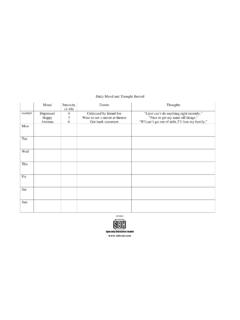
10 Catch the thoughts - become more aware of thoughts. 2. Check the thoughts - question the accuracy of your assumptions and interpretations. 3. Challenge the thoughts actively challenge thoughts that are unhealthy for you. Stage 1: Catching the Thoughts When an event happens (or is about to happen), we all have thoughts about the event without even trying. In Cognitive Therapy , these are referred to as automatic thoughts. When we are feeling emotions such as fear or sadness the automatic thoughts can become biased towards more negative outcomes or evaluations. One of the first steps of changing your response to events is to become more aware the associated thoughts.