Transcription of Conservation ES&H Section
1 Slide 1 ES&H SectionHearing ConservationHearing ConservationFERMILAB Introduce yourself and the Section you represent - give a work history and mention your responsibilities at Fermilab. Slide 2 ES&H SectionHearing ConservationObjectives Anatomy and Physiology of the Human Ear What is considered hazardous noise Sound level measurement How noise effects the ability to hear The Elements of Fermilab s Hearing Conservation Program Ways to protect your hearing Q & A Review class objectives. Slide 3 ES&H SectionHearing ConservationOuter Ear The Outer Ear is made up of a flesh and cartilage structure called the auricle or pinna. Ask someone from the class to explain what s the main function of the Pinna? The main function of the Pinna is to funnel the sound waves into the ear canal and perhaps aid in the direction of where the sound is originating.
2 Slide 4 ES&H SectionHearing ConservationMiddle EarHammer (malleus)Eardrum (tympanic membrane)Anvil (incus)Stirrup (stapes) Sound waves travel down the ear canal and cause the eardrum (tympanic membrane) to vibrate. The vibrating eardrum, in turn, sets into motion the three smallest bones {auditory ossicles: hammer (malleus), anvil (incus), stirrup (stapes)} in the human body. The final bone in this small chain is called the stirrup and the stirrup is connected to the oval widow. Ask the class if anyone can tell you what s the purpose of the middle ear? It has been estimated that the amplitude of sound waves is magnified twofold by the mechanical leverage of the ossicles and tenfold by the difference in area between the eardrum and the oval window of the inner ear, a twenty fold increase in all. Fun Fact: Sound is transmitted through the system with remarkably little distortion and with such exquisite responsiveness that the faintest sounds we can hear cause the eardrum to oscillate by less than the diameter of a hydrogen molecule.
3 Slide 5 ES&H SectionHearing ConservationInner EarSemicircular Canals (control Sense of Balance)Auditory NerveCochlea (organ of Hearing) The Inner Ear includes the Cochlea (organ of hearing), the Auditory nerve and the Semicircular Canals (controls sense of balance). The cochlea is snail-shaped bony tubular structure lined with a membrane containing thousands of feathery hair cells tuned to vibrate to different sound frequencies. Vibrations of the stapedial footplate in and out of the oval window set into motion the fluids of the inner ear. As the basilar membrane is displaced, a shearing movement occurs on the tectorial surface that drags the hair cells attached to the nerve endings. This sets up electrical impulses that are appropriately coded and transmitted to the brain via the auditory (cochlear) nerve. The nerve endings in the cochlea are sensitive to different frequencies.
4 Those sensitive to high frequencies are located at the large base end of the cochlea near the oval and round windows. The nerve endings that respond to low frequencies are located at the small end of the cochlea. Also within the inner ear is our balance mechanism, the vestibular system. The semicircular canals lie in planes at right angles to each other. The canals contain fluid that responds to movements and, over intricate nerve pathways to the brain, gives information about positions of the body. Slide 6 ES&H SectionHearing ConservationNerve Cells This is a simple illustration of what the hair cells look like inside the human ear. Under normal conditions the hair cells stand up tall and vibrate back and forth with the movement of the fluid inside the cochlea. However, over time, especially when we refer to noise induced hearing loss, the hair cells ability to recover (stand-up) becomes diminished.
5 Let me give you an analogy. Take a nice field of grass. If one individual crosses the field, no problem. However, if a number of people walk across that same path in the grass over a long period of time the grass will eventual die back and you will be left with a bold dirt trail. The hair cells inside the inner ear behave much in the same way. Slide 7 ES&H SectionHearing ConservationThreshold Limit Valuesfor Continuous NoiseT, Duration per Day (hours) SPL Sound Pressure Level (dBA) 24 80 16 82 8 85 4 88 2 91 1 94 97 100 What is considered hazardous noise ? Hazardous noise is defined by its loudness or sound pressure level. The sound pressure level of noise is measured in decibels. noise measurements can further be defined by various weighting scales. The weighting scale used for occupational exposures to noise is the A-weighted scale.
6 The A-weighted sound level measurement is used because it s thought to provide the best representation of the injurious effects noise has on the human ear. The chart indicates that no employee shall be exposed to noise greater than 85 dBA for an 8-hour time-weighted average (TWA). Also note from the chart that for each 3 dB increase in the sound pressure level there is a halving of exposure time permitted. This is called the exchange rate. Employees with TWA noise exposures of greater than 85 dBA are required to enter into a Hearing Conservation Program that includes Annual Audiometric Testing, Access to hearing protection and training. Note: Hearing Conservation FESHM Chapter 5061 requires that when sources of noise may expose personnel above an 8-hour time-weighted average of 85 dBA the area must be posted with a Hearing Protection Required Sign.
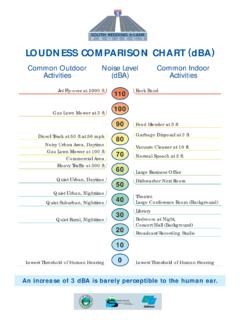
7 Slide 8 ES&H SectionHearing ConservationSound level measurement Sound level meter (SLM) noise Dosimetry Sound level measurements are conduct with the aid of two different types of monitoring equipment. The sound level meter (SLM) is a noise -monitoring device used to measure area sound pressure levels. noise Dosimeters are personal measuring devices that are worn by the employee around his waist and the microphone is click on the employee s shirt lapel as close to the ear as possible. The noise exposure is integrated over the sampling period and a TWA is automatically calculated. Slide 9 ES&H SectionHearing ConservationTypical A Weighted Sound Levels 80 Vacuum Cleaner 70 60 Conversation at 1 m 50 Urban Residence 40 30 Soft Whisper at 2 m / Rice Krispies 20 North Rim of Grand Canyon 10 0 Threshold of Hearing (1000Hz) Lets take a look at some sound pressure levels of common noise sources.
8 Slide 10 ES&H SectionHearing ConservationTypical A Weighted Sound Levels 140 Threshold of Pain 130 120 Jet Takeoff at 100 m 110 Rock Concert 100 Jackhammer at 15 m 90 Drilling Concrete 85 Heavy Truck at 15 m You re probably thinking, what are the noise sources at FERMILAB Slide 11 ES&H SectionHearing ConservationTypical A-Weighted Sound Levels80 TORO Ground Master 72 Riding Mower (87 dBA)70 Personnel Dosimetry Results {near compressors and performing some grinding operations (73dBA-77 dBA)IB-1 Shop Area (68dBA-70dBA) During Drilling Operations60504030 Lab Audiometric Testing Booth (< 25 dBA)2010 Here are some of the common noise sources at FERMILAB. Since you are all enrolled into Fermilab s Hearing Conservation program, each year you are required to receive audiometric testing. The OSHA standard outlines the requirements for audiometric testing booths.}
9 The testing booth is subjected to maximum background sound pressure levels of 25 dBA for all frequencies you will be tested on. Slide 12 ES&H SectionHearing ConservationTypical A-Weighted Sound Levels140 Threshold of Pain130120110 Testing of Fire Alarm System in FCC100 MRRF -F0 Compressor RoomCHL Nitrogen Plant90 TORO Grounds Master 322-D Riding MowerTORO TV5004 Master Push MowerCUBLab D Compressor RoomCDF A/C unitsCHL Chiller Room As you can see the high noise areas at Fermilab are those areas with large industrial machinery ( , compressor rooms, pump rooms, CHL and CUB). Slide 13 ES&H SectionHearing ConservationTimeWeightedEmployee PopulationAverageExperiencingExposure (dBA)Hearing Loss (%)< 80080585109020100~100>100100 Why the concern for occupational noise ? Take a look at this table for a minute or two and give me some of your own observations with the current ACGIH standards in mind.
10 noise exposures at the current ACGIH standard of 85 dBA TWA over a working lifetime (30-40 years) will still result in approximately 10% of the employees experiencing some amount of hearing loss. At 80 dBA TWA exposures over a working lifetime, 5% of the employees will experience some amount of hearing loss. Slide 14 ES&H SectionHearing ConservationEffects of Hearing Loss Everybody Mumbling Communication with people Tinnitus There are two important characteristics of normal hearing-the ability to hear sounds as loud as they truly are, and the ability to hear sounds with complete clarity. Characteristic speech sounds can be related to the two principal kinds of speech- vowels and consonants. The vowel sounds-located in the lower frequencies-are the more powerful speech sounds. In contrast, the consonant sounds-located in the higher frequencies-are the keys to distinguishing one word from another, especially if the words sound alike.


![SAFETY TALK [hearing protection] - WorkSafeNB – …](/cache/preview/3/4/b/8/d/f/0/4/thumb-34b8df04d33dcf40e26b345789106441.jpg)