Transcription of Brief&Cogni+ve&Assessment&Tool&(BCAT®)&Training&Program&
1 Brief Cogni+ve Assessment Tool (BCAT ) Training Program Presented by Dr. William Mansbach CEO & Founder, Mansbach Health Tools, LLC 1 Proficiency in the cogniBve assessment of persons who have a subjecBve or objecBve memory or cogniBve complaint is criBcally important to effecBve diagnosis, treatment, educaBon, and support. The primary goal of this program is to equip you with the knowledge and skills necessary to be proficient in administering, scoring, and interpreBng the BCAT. Cer+fied BCAT Trainer INTRODUCTION TO BCAT 2 Program Objec+ves Be able to administer, score.
2 And interpret the BCAT Be able to apply BCAT scores to clinical care Understand the strengths and limitaBons of cogniBve screening tools Understand basic neuro- cogniBve structure- funcBon concepts 3 INTRODUCTION TO BCAT Course Outline The basics of primary neuro- cogniBve domains in everyday living The uBlity of cogniBve screening tools Commonly used cogniBve screening tools The BCAT and BCAT System of tests 4 INTRODUCTION TO BCAT Neuro- Cogni+ve Domains 5 The basics of primary neuro- cogni+ve domains in everyday living Structure- funcBon Neurons Basic brain structures NEURO- COGNITIVE DOMAINS 6 Basic Brain Structures Whole Brain 7 NEURO- COGNITIVE DOMAINS Basic Brain Structures Frontal Lobes Execu+ve Processes 8 NEURO- COGNITIVE DOMAINS Basic Brain Structures Temporal Lobes Learning & Memory 9 NEURO- COGNITIVE DOMAINS Basic Brain Structures Parietal Lobes AMen+onal Awareness of the Environment 10 NEURO- COGNITIVE DOMAINS Basic Brain Structures Hippocampus Early Memory
3 Stage 11 NEURO- COGNITIVE DOMAINS Contextual memory The case of story recall ExecuBve funcBons The case for execuBve controls A_enBonal capacity The case for a_enBon as the oil The Three Central Cogni+ve Domains (The Cogni+ve Task Manager) 12 NEURO- COGNITIVE DOMAINS U+lity of Cogni+ve Screening Tools 13 We have an aging society with associated problems. As people live longer, the incidence/prevalence of demenBa rates increase. Over 5 million people have Alzheimer s disease (AD), anBcipated to be 13 million by 2050.
4 Numbers are vastly greater if you include other demenBas and people with Mild CogniBve Impairment (MCI). UTILITY OF COGNITIVE SCREENING TOOLS The u+lity of cogni+ve screening tools 14 PrevenBve Services Task Force Statement RouBne screening versus screening when there is a subjecBve or objecBve memory complaint Age as risk factor and screening for people over 80 The special case of MCI and demenBa conversion (10- 15% annually) When to use screening tools 15 UTILITY OF COGNITIVE SCREENING TOOLS Aide in diagnosis Early recogniBon enhances efficacy of treatments Improve disease management and planning IdenBfy funcBonal issues Manage expectaBons of paBents, families, providers, staff Time and cost effecBve Lowers paBent resistance and encourages compliance Uses of screening tools 16 UTILITY OF COGNITIVE SCREENING TOOLS What should a good cogni+ve screening tool be able to do?
5 Administered by professionals and techs Completed in less than 15 minutes (someBmes five minutes) Able to differenBate between MCI and demenBa Broadly assess memory skills Broadly assess execuBve skills Assess a_enBonal skills Predict ADLs & IADLs 17 UTILITY OF COGNITIVE SCREENING TOOLS Commonly Used Screening Tools 18 Mini- Mental State ExaminaBon (MMSE) Short Test of Mental Status (STMS) Montreal CogniBve Assessment (MoCA) Saint Louis University Mental Status ExaminaBon (SLUMS) Brief CogniBve Assessment Tool (BCAT) & BCAT- SF COMMONLY USED SCREENING TOOLS Commonly used cogni+ve screening tools 19 The first major screening instrument SensiBve for moderate to severe demenBa Less sensiBve for MCI and mild demenBa EducaBon bias (overesBmates for those with li_le educaBon) Weak on memory and execuBve funcBons Floor effect MMSE (Folstein, Folstein, & McHugh, 1975)
6 20 COMMONLY USED SCREENING TOOLS Verbal features are more complex than MMSE RelaBvely poor sensiBvity to MCI STMS (Kokmen et al., 1987) 21 COMMONLY USED SCREENING TOOLS SensiBve to cogniBve spectrum Designed primarily for frontline providers RelaBvely weak on memory No story recall component Stronger on execuBve funcBons, but no complex reasoning item MoCA (Nasreddine et al., 2005) 22 COMMONLY USED SCREENING TOOLS SensiBve to cogniBve spectrum Designed primarily for frontline providers Has a story recall, but no free recall or delayed recall Has complex reasoning, but no cogniBve set- shiming SLUMS (Tariq et al.)
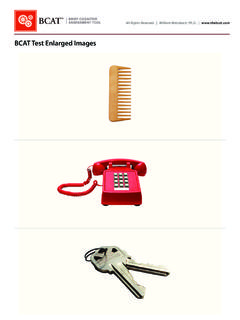
7 , 2006) 23 COMMONLY USED SCREENING TOOLS Four studies, starBng in 2005 21 items, 50 maximum points 10- 15 minutes in administraBon Has a MCI versus demenBa cut score (37/38) Has score ranges for cogniBve categories Has three cogniBve clusters Predicts ADL & IADL Website- based scoring program BCAT (Mansbach, MacDougall, & Rosenzweig 2012) 24 COMMONLY USED SCREENING TOOLS BCAT Test 25 COMMONLY USED SCREENING TOOLS BCAT Item Detail 26 COMMONLY USED SCREENING TOOLS BCAT Item Detail 27 COMMONLY USED SCREENING TOOLS BCAT Item Detail 28 COMMONLY USED SCREENING TOOLS 28 COMMONLY USED SCREENING TOOLS BCAT Item Detail 29 COMMONLY USED SCREENING TOOLS BCAT Item Detail 30 COMMONLY USED SCREENING TOOLS BCAT Item Detail 31 COMMONLY USED SCREENING TOOLS BCAT Scoring Program 32 Computer- assisted scoring Total score & Factor scores
8 Clinical consideraBons Report that can be printed and/or emailed BCAT SCORING PROGRAM BCAT Scoring & Interpre+ng 33 BCAT CROSSWALK TO FUNCTIONAL STATUS CogniBve Stage BCAT Range CogniBve & FuncBonal Issues Normal 46- 50 No funcBonal deficit; independent living; may be subjecBve memory complaints but li_le to no objecBve evidence. Mild CogniBve Impairment (MCI) 34- 46 Generally funcBonally normal, but early specific funcBonal declines (IADL); subjecBve and objecBve memory deficits. Individuals at lower range more likely to have more significant cogniBve deficits.
9 Lower scores more suggesBve of residenBal support needs. Mild DemenBa 26- 34 IADL deficits; typically requires residenBal support services; clear objecBve evidence of memory and other cogniBve declines. Moderate to Severe DemenBa 0- 25 Moderate (upper end of the range) - Pervasive funcBonal deficits (IADLs), but ADLs generally intact; marked deficits in memory and execuBve funcBons; behavioral and psychological symptoms are common; requires significant residenBal support. Severe (lower end of the range) - Needs assistance in ADLs/IADLs; pervasive cogniBve deficits; requires complex care.
10 Adapted by Dr. William Mansbach from Mansbach, W. E., MacDougall, E. E., & Rosenzweig, A. S. (2012). The Brief Assessment Tool (BCAT): a new test emphasizing contextual memory, execuBve funcBons, a_enBonal capacity, and the predicBon of instrumental acBviBes of daily living. Journal of Clinical and Experimental Neuropsychology, 34(2), 183- 194. Note: The score ranges reported above are general guidelines based on descripCve staCsCcs from the normaCve study. They should not be interpreted as absolutes.