Transcription of Alternatives to Nifedipine in the Oral Treatment of ...
1 The Rx Files: Q&A Summary May, 98 LDR Loren Regier BSP,BA Alternatives to Nifedipine in the Oral Treatment of hypertensive Urgencies (HU) See more recent hypertensive urgency Q&A at urgency Summary of recent literature: y It is important to distinguish HU from true hypertensive emergencies which usually require IV therapy (with nitroprusside, nitroglycerin, labetalol, etc.) and hospitalization. The presence of acute or ongoing end organ damage constitutes a hypertensive emergency rather than a HU. y Asymptomatic patients with severe hypertension may not benefit from acute BP reduction and lowering BP too rapidly in patients with cardiovascular risk factors, can be harmful ( risk of MI, stroke, & mortality).
2 Y A short period (30+ min) of rest in a quiet, dark room often is effective in lowering BP 15-20% & is usually recommended for initial management. y The four oral agents most used in HU are Nifedipine , clonidine, captopril, and labetolol. Literature regarding the use of oral agents is not well established. y Concerns regarding short acting Nifedipine (Adalat) have arisen due to association with increased AMI, CVA & mortality. Revised labeling for short acting Nifedipine in the USA recommends against its use in hypertensive crisis. The recent report of the JNC VI (Nov, 1997) also cautioned against the use of Nifedipine in hypertensive crisis.
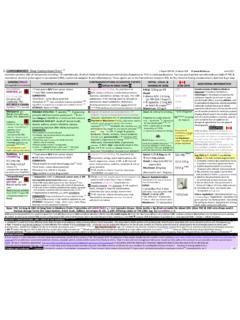
3 In practice, this concern may be greater in older individuals and those at higher risk of cardiovascular/cerebrovascular disease. As always, the risk verses benefit ratio must be considered. y Captopril and Clonidine have been suggested as better oral Alternatives to Nifedipine based on the current understanding of their cardiovascular & cerebral effects. (See Table: hypertensive Urgencies - Oral Antihypertensives) Table: hypertensive Urgencies - Oral Antihypertensives Drug Administration Duration Advantages Disadvantages / Contraindications Captopril CAPOTEN SL/PO - ; (up to 25mg) onset: 10-15 min (SL) 15-30 min (PO) peak effect: 60 min (SL) 1-2 h (PO) 4-8 h yPossibly beneficial effects on cerebral autoregulation and blood flow; may favorably effect regional myocardial perfusion; reduces pre- and afterload; no fluid retention.
4 Excellent for CHF and scleroderma ySL / PO / or Crush & Chew yBilateral renal artery stenosis; heavy proteinuria; immunosuppressive drugs; immune-mediated diseases; pregnancy yFine control of BP not possible. yBeware in volume depleted patients & high renin states (patients on diuretics). Clonidine CATAPRES - PO; ( initial , then q1h) onset: 30-60 min peak effect: 2-4 h can repeat q1-2h (total dose ) 3-12 h yDecreases heart rate and no increase in myocardial oxygen consumption. ySedation in up to 50%; orthostatic hypotension; can dramatically decrease cerebral blood flow; avoid in CHF due to decreased cardiac output and in > than first degree heart block.
5 YFine control of BP not possible; profound falls reported; decrease dose if > 60y/o, recent antihypertensives, volume depletion. Labetalol TRANDATE 200 - 400mg PO; onset: variable (30-120min) peak effect: 3 - 4 h food increases but delays onset. 8-12 h yFavorable cardiac and possibly CNS effects yHeart failure; reactive airway disease; second and third degree heart block; no dose which will reliably lower BP within a couple of hours in the majority of patients. Nifedipine ADALAT 5-10mg PO/bite & swallow onset: 5-20 min peak effect: 30-60 min ) revised labeling recommends against its use in hypertensive crisis!
6 2-6 h yRapid onset; dilates coronary arteries and relieves spasm; usually does not decrease cardiac output. yReflex tachycardia lasting 1 h; can precipitate angina in patients with high grade stenosis; nonhomogeneous cerebral perfusion; possible increase risk of MI, CVA, & mortality with regular Nifedipine . yFine control of BP not possible; large falls in BP after 10 mg dose . yTrue hypertensive Emergencies usually require IV therapy (eg. Sodium nitroprusside, Nitroglycerin, Enalaprilat, Hydralazine, Labetalol, Esmolol) References: Thach AM, Schultz PJ.
7 Nonemergent Hypertension, New perspectives. Advances and Updates in Cardiovascular Emergencies 1995; 13(4):1009-1023. Murphy C. hypertensive Emergencies. Advances and Updates in Cardiovascular Emergencies 1995; 13(4):973-1007. Hirschl MM. Guidelines for the Drug Treatment of hypertensive Crises. Drugs 1995;50(6): 991-1000. Micromedex Inc. Drug Data Base. Nifedipine , 1997. The Sixth Report of the Joint National Committee on Prevention, Detection, Evaluation, and Treatment of High Blood Pressure (JNC VI). Arch Int Med, Nov 24,1997. Aldelwahab W et al.
8 Management of hypertensive urgencies and emergencies. J Clin Pharmacol 1995; 35:747-62. Varon J, Fromm RE. hypertensive crises. The need for urgent management. Postgrad med 1996;99:189-203.