Transcription of 1 Communication in health and social care
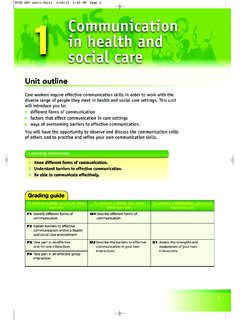
1 111 know different forms of barriers to effective able to communicate outcomesUnit outlineCare workers require effective Communication skills in order to work with thediverse range of people they meet in health and social care settings. This unitwill introduce you to:different forms of communicationfactors that affect Communication in care settings ways of overcoming barriers to effective will have the opportunity to observe and discuss the Communication skillsof others and to practise and refine your own Communication guideTo achieve a pass, you must showyou can:To achieve a merit, you mustshow you can:To achieve a distinction, you mustshow you can:P1 Identify different forms ofcommunicationM1 Describe different forms ofcommunicationP2 Explain barriers to effectivecommunication within a healthand social care environmentP3 Take part in an effective one-to-one interactionM2 Describe the barriers to effectivecommunication in your twointeractionsD1 Assess the strengths andweaknesses of your twointeractionsP4 Take part in an effective groupinteractionCommunicationin health andsocial careThe Communication cycleCommunication is about making contact with others and beingunderstood.
2 It involves people sending and receiving messages .We all communicate, or send messages , continuously. Figure the Communication cycle. It shows that a communicationcycle occurs person has an code their message (using words or non-verbal means). send their message to someone else ( by speaking). second person then receives the message ( by hearingwhat has been said or by noticing non-verbal Communication ). second person decodesthe message is topic introduces you to the forms of Communication usedby health and social care workers and the contexts in whichthey are used. When you have completed this topic, you should: be able to describe and explain the Communication cycle know about one-to-one, group, formal and informalcommunication in health and social care settings be able to describe a range of different forms ofcommunication used by health and social care startedTopic of communicationKey termsDecode:make sense of the information contained in a messageEmpathy:understanding and entering into anotherperson s feelingsFormal Communication :official or correct forms ofcommunicationInformal Communication :doesn t stick to the formalrules of Communication ( a casual, relaxedconversation, written note or text message)Makaton.
3 A system of Communication using simple hand signs, which is used by people with language andlearning difficulties Non-verbal Communication :forms of communicationthat do not use words ( body language)Objects of reference:objects that have a particularmeaning for a person ( a special ring or ornament)Symbol:an item or image that is used to representsomething elseVerbal Communication :forms of Communication thatuse words ( conversation)Figure Communication cycle125436 IdeaoccursMessagecodedMessagedecodedMess agesentMessagereceivedMessageunderstood3 1 Communication in health and social care Once the original message has been understood, the cycle will be repeated if thesecond person replies or responds. Repetitions of the Communication cycle are anessential part of our relationships, and occur every time we have a conversation.
4 Forms of communicationCare workers use different forms of Communication during theirworking day (or night). These include the verbal Communication skills oftalking and listening, and various forms of non-verbal Communication ,such as touch, eye contact and facial expression. A care worker has touse both of these forms of Communication when they:give or receive information about the care that is being provided foran individualprovide emotional support to a individual or member of their familycarry out an assessment of an individual s care communicationVerbal communicationoccurs when one person speaks and anotherperson listens. Care workers need a range of verbal communicationskills to:respond to questions find out about an individual s problems or needscontribute to team meetingsbreak bad newsprovide support to othersdeal with problems and Communication cycle demonstrates that effective verbalcommunication is a two-way process speaking andlistening must occur.
5 Listening is much harder than speaking andthere is more to this skill than just waiting for the other person tostop is 2 years of age. He enjoys helpinghis mum in the kitchen when she is makinga meal. When she says, Can I get some fruitfor you Charlie? , he puts his arms in the air,says me, me and smiles at her. His mumresponds by picking him up and saying, Okay, you take something yourself this time, Charlie . 1. How does Charlie s mum communicate withhim in this example?2. How does Charlie communicate non-verballywith his mum in response to her question?3. Describe how a cycle of communicationoccurs in this studyAre you a good listener? Think aboutwhat you do when you really listento another person. Try to identifythe skills and qualities needed foreffective listening. Over to you!
6 4 Non-verbal communicationAs well as communicating through speech, people use a variety of forms of non-verbal Communication . Some of these are referred to as body is because they involve the individual using their body and appearance tocommunicate in some way. For example, a care worker s behaviour, appearanceand attitude send messages to people who receive care (as well as to colleagues)about what they think and feel. Similarly, a person s body language may tell acare worker that they are uncomfortable or experiencing pain even when theysay, I m okay . Non-verbal Communication is a channel of Communication thatis always on . Figure of non-verbal communicationSigns, symbols and objects of referenceCare organisations sometimes use signs and symbols to communicatewith the people who use their premises.
7 Signs and symbolsaregraphical ways of communicating essential information. Using imagesenables people who cannot speak or understand a spoken language,such as English, to communicate. Objects of referenceare items such as toys, clothes, jewellery orother everyday objects that have a special meaning for somebody. For achild, a cuddly toy may represent comfort and safety. An older personmay treasure their photographs because they represent and providememories of family, friends and relatives. Objects of reference, such as photos or toys might be used by a teacher to stimulate Communication and interaction with individuals with learning of communicationNon-verbalcommunicationWhat does it involve?ExamplesFacial expressionMovements of the face thatexpress a person s feelings Smiling FrowningTouch or contactPhysically touching or holdinga person Holding someone s hand Placing a hand on a person s arm or shoulder to reassure themGesturesDeliberate movements of thehands to express meaning Thumbs-up gesture to show agreement or pleasure Shaking a fist to show anger or aggressionProximityThe physical closenessbetween people duringinteractions Being physically close to someone may be reassuring and may beseen as accepting the person.
8 On the other hand, it might make the person feel uncomfortableand threatened. People need less personal space when they have a close, contactLooking another persondirectly in the eyes Short or broken eye contact can express nervousness, shynessor mistrust. Long unbroken eye contact can express interest, attractionor you have a chance, watch agroup of people talking or socialisingtogether. Observe the way they usetheir bodies to communicate. Try to work out what they are saying non-verbally. Over to you!51 Communication in health and social care Technological aidsTechnological aids, such as electronic communicators, hearing aids andvideophones are designed to help disabled people who have difficulty sendingor receiving messages as part of the Communication cycle.
9 Many non-disabledpeople now also use technology in the form of mobile phones, text messagingand emails to communicate with others. Websitessuch as Facebook, Twitter and Bebo are also examplesof technological aids that promote communicationbetween aidsThese include people who work as:interpreters, who listen to a person speak in onelanguage and then communicate what they havesaid to a second person in a different languagetranslators, who translate what is written in onelanguage into a second language ( English toHindi)signers, who use forms of sign language tocommunicate what has been said or written intoa sign language, such as British Sign Language forms of communicationPeople who are unable to communicate in conventional ways sometimesuse alternative Communication systems to send and receive example:People with visual impairments often use theirsense of touch to read documents written inBraille.
10 This uses a series of indentations madeby a special stylus on one side of paper. Thecombinations of indentations represent letters thatcan be touch-read by people who understand theBraille with hearing impairments or learningdisabilities sometimes use lip reading andsign language to communicate. Signlanguage systems include finger spelling(dactylography), British Sign Language range of graphical signs and symbols arealso widely used in health and social care settingsto warn people of health and safety hazards,provide directions and give information to peoplewho are unable to speak or understand English. 6 Contexts of communicationThe two main contexts in which health and social care workers use the communicationcycle are one-to-one and group Communication . One-to-one communicationCare workers talk to work colleagues, to people who use care services and to theirrelatives on a one-to-one basis many times each day.