Transcription of Illinois Housing Empowerment Handbook
1 Illinois Housing Empowerment Handbook February 28, 2014 Illinois Housing Empowerment Handbook by DCFS & Heartland Alliance is licensed under a Creative Commons Attribution-NonCommercial-NoDerivatives International License. Page2 ACKNOWLEDGEMENTS The creation of this Handbook has truly been a collaborative process. The idea came from a former DCFS ward who participated in a focus group facilitated by Beacon Therapeutic s Family Assertive Community Treatment (FACT) program. The FACT System Integration Manager helped create the Homeless Prevention Sub-Committee of the Mayor s Task Force on Homeless Youth (MTFHY) in Chicago.
2 With assistance and guidance from subcommittee members, DCFS and Heartland Health Outreach created this Handbook to help first time renters obtain and maintain Housing . I would like to acknowledge the contributions made by Aimee Gendusa-English (Citizen Utility Board), Alaina Duca (DCFS intern from Loyola University), Amy Dworsky (Chapin Hall), Arielle Weston (DCFS Intern from the University of Chicago), Carrie Bosch (Heartland Health Outreach intern from the University of Illinois ), Carie Bires (Ounce of Prevention), Fiona Anderson (FACT System s Integration Manager from Heartland Health Outreach), Jeremy Harvey (Office of the Public Guardian), John Bartlett (Metropolitan Tenant s Organization)
3 And Victoria Ogunsanya (Lawyers Committee for Better Housing ). I am especially grateful to Blake Wilkinson (Heartland Health Outreach intern from the University of Illinois ) for his work on an early draft. Finally, I would like to thank Marion Latzko whose I Need a Place to Live provided us with a template for creating this Handbook . John Cheney Egan Housing Specialist, DCFS Chairperson, MTFYH-Prevention Sub-Committee Page3 TABLE OF CONTENTS Disclaimer 4 Overview 4 Types of Housing 5 Cash Assistance Programs 12 Homeless Assistance Services 14 The Housing Search 19 Background Checks 25 Signing a Lease 31 Moving In 33 Tenants Rights and Responsibilities 38 Pest Control 42 Other Health and Safety Considerations 45 Moving Out 46 Evictions 48 Foreclosures 52 Financial Planning 57 Job Seeking Advice 66 Entitlements 69 Final Thoughts 71 Page4 DISCLAIMER This manual is provided as a public service by the Illinois Department of
4 Children and Family Services and is intended for the informational use and convenience of interested persons and should not be considered a substitute for the advice of legal counsel. Although the information found in this manual is believed to be reliable as of the time of this manual s publication, no warranty, expressed or implied, is made regarding the accuracy, completeness, or legality of any information, either isolated or in the aggregate. The information is provided as is . Changes may be periodically made to the information contained herein; these changes may or may not be incorporated into this manual; and information contained in the manual may quickly become out of date.
5 This guide is not a legal manual. We do not offer any legal advice. Therefore, if you need legal advice, we encourage you to consult an attorney of your choice. You will find a number of places in this Handbook to help you do this. OVERVIEW We wrote this Handbook to help make obtaining and maintaining Housing easier and less confusing, especially for first time renters. We provide information that every apartment hunter should know. We explain how to search for a place, how to build a productive relationship with your landlord, how to prepare your home, and discuss ways you can move out of your apartment.
6 We also provide useful tips for increasing your success. There are perks to finding your own apartment or home -- you establish credit and responsibility, and build your own life. You find that you have more freedom and privacy. Finding and maintaining Housing provides you safety and stability, better health, and a platform for you to work on other goals such as education or employment. Page5 Most of the information you need is already on the internet. You will find that we often recommend visiting websites in this Handbook . We encourage you to read this Handbook while online so you can quickly access these resources.
7 Obtaining and Maintaining Housing : There s an App for that. The Metropolitan Tenant s Organization (MTO) has created a brand-new, free web-based app called Squared Away Chicago. As the name suggests, the app currently is only available in Chicago but with success it will be extended statewide and then nationally. The app provides access to resources about rights as well as the ability to document and share issues between tenants and landlords in real-time. This app helps resolve issues faster with increased accountability and fewer misunderstandings. Any tenant or landlord can access the app at MTO offers comprehensive information about landlord-tenant issues and supplies sample letters on their website at: You can also call MTO s tenants hotline (773-292-4988).
8 If you live outside of Chicago, we suggest that you consult your county s website for information regarding specific landlord-tenant laws. TYPES OF Housing Private Market Rentals Private market rate Housing accounts for the vast majority of Housing options. Landlords price market rate rental Housing to maximize their profits. If they charge too much, nobody will want to rent the unit. The amount that they will charge depends on a number of things, including the quality of the neighborhood, the quality of the unit, the amenities and number of rooms. Perhaps the greatest factor affecting the price of Housing is location.
9 Generally speaking, Housing in urban areas, like Chicago and the Cook County suburbs, will be more expensive than rural areas. Some neighborhoods have higher priced Housing than others. Page6 Without a subsidy, a private market rate unit is often expensive. The general rule is that people should not spend more than 30% of their income on Housing (rent and utilities). Unfortunately, many people do. Because of this, persons who have a low income typically search for less expensive market rate Housing (with a smaller size, fewer amenities and located in a less desirable location) and still pay more than 30% (often even more than half) of their income on Housing .
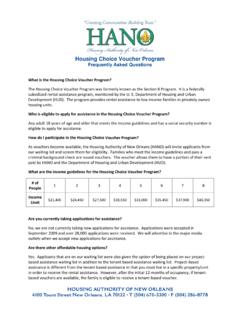
10 Emergency Housing Occasionally, persons in inadequate Housing request emergency Housing . There is no such thing as emergency Housing . The process of finding affordable Housing can take weeks, months or even years. The only form of emergency Housing is an emergency shelter. Housing Choice Voucher (HCV, also known as the Section 8) Program HCV is a Housing subsidy that eligible persons receive to reduce their share of the cost of rent. Typically the tenant pays 30% of their income on Housing (though in certain situations participants can choose to pay up to 40%).