Transcription of Material Safety Data Sheet - Welcome to Finar …
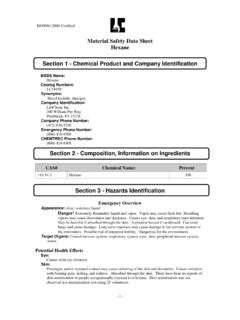
1 P. 1 3 1 0He a lt hFireRe a c t iv it yP e rs o n a lP ro t e c t io n230 GMaterial Safety data Sheetn- hexane MSDSS ection 1: Chemical Product and Company IdentificationProduct Name: n-HexaneCatalog Codes: 20749,10750, 20750, 20751, 30750, 60750 CAS#: 110-54-3 RTECS: MN9275000 TSCA: TSCA 8(b) inventory: HexaneCI#: Not : Chemical Name: HexaneChemical Formula: C6-H14 Contact Information: Finar Limited 184-186/P, Chacharwadi Vasna, Sarkhej-Bavla Highway, Ta.: Sanand, Dist.: Ahmedabad, Email: Web: 2: Composition and Information on IngredientsComposition:NameCAS #% by data on Ingredients: hexane : ORAL (LD50): Acute: 25000 mg/kg [Rat].Section 3: Hazards IdentificationPotential Acute Health Effects:Hazardous in case of skin contact (permeator), of ingestion, of inhalation. Slightly hazardous in case of skin contact (irritant),of eye contact (irritant).Potential Chronic Health Effects:CARCINOGENIC EFFECTS: Not available.
2 MUTAGENIC EFFECTS: Mutagenic for bacteria and/or yeast. TERATOGENICEFFECTS: Not available. DEVELOPMENTAL TOXICITY: Not available. The substance may be toxic to peripheral nervoussystem, skin, central nervous system (CNS). Repeated or prolonged exposure to the substance can produce target 4: First Aid MeasuresEye Contact:p. 2 Check for and remove any contact lenses. Immediately flush eyes with running water for at least 15 minutes, keeping eyelidsopen. Get medical attention if irritation Contact: Wash with soap and water. Cover the irritated skin with an emollient. Get medical attention if irritation Skin Contact:Wash with a disinfectant soap and cover the contaminated skin with an anti-bacterial cream. Seek medical :If inhaled, remove to fresh air. If not breathing, give artificial respiration. If breathing is difficult, give oxygen. Get medicalattention if symptoms Inhalation:Evacuate the victim to a safe area as soon as possible.
3 Loosen tight clothing such as a collar, tie, belt or waistband. Ifbreathing is difficult, administer oxygen. If the victim is not breathing, perform mouth-to-mouth resuscitation. Seek :Do NOT induce vomiting unless directed to do so by medical personnel. Never give anything by mouth to an unconsciousperson. Loosen tight clothing such as a collar, tie, belt or waistband. Get medical attention if symptoms Ingestion: Not 5: Fire and Explosion DataFlammability of the Product: Temperature: 225 C (437 F)Flash Points: CLOSED CUP: C ( F). (TAG)Flammable Limits: LOWER: UPPER: of Combustion: These products are carbon oxides (CO, CO2).Fire Hazards in Presence of Various Substances:Highly flammable in presence of open flames and sparks, of heat. Non-flammable in presence of Hazards in Presence of Various Substances:Risks of explosion of the product in presence of mechanical impact: Not available.
4 Risks of explosion of the product inpresence of static discharge: Not Fighting Media and Instructions:Flammable liquid, insoluble in water. SMALL FIRE: Use DRY chemical powder. LARGE FIRE: Use water spray or Remarks on Fire Hazards:Extremely flammable liquid and vapor. Vapor may cause flash Remarks on Explosion Hazards: Not 6: Accidental Release MeasuresSmall Spill: Absorb with an inert Material and put the spilled Material in an appropriate waste Spill:Flammable liquid, insoluble in water. Keep away from heat. Keep away from sources of ignition. Stop leak if without with DRY earth, sand or other non-combustible Material . Do not get water inside container. Do not touch spilledmaterial. Prevent entry into sewers, basements or confined areas; dike if needed. Call for assistance on disposal. Be carefulthat the product is not present at a concentration level above TLV. Check TLV on the MSDS and with local 7: Handling and Storagep.
5 3 Precautions:Keep locked Keep away from heat. Keep away from sources of ignition. Ground all equipment containing not ingest. Do not breathe gas/fumes/ vapor/spray. Avoid contact with skin. Wear suitable protective clothing. In caseof insufficient ventilation, wear suitable respiratory equipment. If ingested, seek medical advice immediately and show thecontainer or the label. Keep away from incompatibles such as oxidizing :Store in a segregated and approved area. Keep container in a cool, well-ventilated area. Keep container tightly closed andsealed until ready for use. Avoid all possible sources of ignition (spark or flame).Section 8: Exposure Controls/Personal ProtectionEngineering Controls:Provide exhaust ventilation or other engineering controls to keep the airborne concentrations of vapors below their respectivethreshold limit value. Ensure that eyewash stations and Safety showers are proximal to the work-station Protection: Safety glasses.
6 Lab coat. Vapor respirator. Be sure to use an approved/certified respirator or equivalent. Gloves (impervious).Personal Protection in Case of a Large Spill:Splash goggles. Full suit. Vapor respirator. Boots. Gloves. A self contained breathing apparatus should be used to avoidinhalation of the product. Suggested protective clothing might not be sufficient; consult a specialist BEFORE handling Limits:TWA: 500 (ppm) from OSHA (PEL) [United States] Inhalation TWA: 1800 (mg/m3) from OSHA (PEL) [United States] InhalationTWA: 176 (mg/m3) from ACGIH (TLV) [United States] SKIN TWA: 50 (ppm) from ACGIH (TLV) [United States] SKIN TWA:500 STEL: 1000 (ppm) from ACGIH (TLV) [United States] Inhalation TWA: 1760 STEL: 3500 (mg/m3) from ACGIH (TLV)[United States] Inhalation Consult local authorities for acceptable exposure 9: Physical and Chemical PropertiesPhysical state and appearance: : Gasoline-like or petroleum-like (Slight.)
7 Taste: Not Weight: : Clear (1% soln/water): Not Point: 68 C ( F)Melting Point: -95 C (-139 F)Critical Temperature: Not Gravity: (Water = 1)Vapor Pressure: kPa (@ 20 C)Vapor Density: (Air = 1)Volatility: Not Threshold: 130 ppmWater/Oil Dist. Coeff.: The product is more soluble in oil; log(oil/water) = (in Water): Not 4 Dispersion Properties: See solubility in water, diethyl ether, :Soluble in diethyl ether, acetone. Insoluble in cold water, hot 10: Stability and Reactivity DataStability: The product is Temperature: Not of Instability: Heat, ingnition sources, with various substances: Reactive with oxidizing : Not Remarks on Reactivity: hexane can react vigorously with strong oxidizers ( chlorine, bromine, fluorine)Special Remarks on Corrosivity: Not : Will not 11: Toxicological InformationRoutes of Entry: Absorbed through skin. Dermal contact. Inhalation.
8 To Animals:WARNING: THE LC50 VALUES HEREUNDER ARE ESTIMATED ON THE BASIS OF A 4-HOUR EXPOSURE. Acute oraltoxicity (LD50): 25000 mg/kg [Rat]. Acute toxicity of the gas (LC50): 48000 ppm 4 hours [Rat].Chronic Effects on Humans:MUTAGENIC EFFECTS: Mutagenic for bacteria and/or yeast. May cause damage to the following organs: peripheral nervoussystem, skin, central nervous system (CNS).Other Toxic Effects on Humans:Very hazardous in case of ingestion, of inhalation. Hazardous in case of skin contact (permeator). Slightly hazardous in caseof skin contact (irritant).Special Remarks on Toxicity to Animals: Not Remarks on Chronic Effects on Humans:May cause adverse reproductive effects based on animal data . May be tumorigenic based on animal data . May affect geneticmaterial. Passes through the placental barrier in Remarks on other Toxic Effects on Humans:Acute Potential Health Effects: Skin: May cause mild skin irritation.
9 It can be absorbed through the skin in harmful : May cause mild eye irritation. Inhalation: May be harmful if inhaled. Inhalation of vapors may cause respiratory tractirritation. Overexposure may affect, brain, spinal cord, behavior/central and peripheral nervous systems (lightheadness,dizziness, hallucinations, paralysis, blurred vision, memory loss, headache, euphoria, general anesthetic, muscle weakness,numbness of the extremeties, asphyxia, unconciousness and possible death), metabolism, respiration, blood, cardiovascularsystem, gastrointestinal system (nausea) Ingestion: May be harmful if swallowed. May cause gastrointestinal tract irritationwith abdominal pain and nausea. May also affect the liver, blood, brain, peripheral and central nervous systems. Symptoms ofover exposure by ingestion are similar to that of overexposure by 12: Ecological InformationEcotoxicity: Not and COD: Not 5 Products of Biodegradation:Possibly hazardous short term degradation products are not likely.
10 However, long term degradation products may of the Products of Biodegradation: The product itself and its products of degradation are not Remarks on the Products of Biodegradation: Not 13: Disposal ConsiderationsWaste Disposal:Waste must be disposed of in accordance with federal, state and local environmental control 14: Transport InformationDOT Classification: CLASS 3: Flammable : : hexane UNNA: 1208 PG: IISpecial Provisions for Transport: Not 15: Other Regulatory InformationFederal and State Regulations:Connecticut hazardous Material survey.: Hexanes Illinois toxic substances disclosure to employee act: Hexanes Illinoischemical Safety act: Hexanes New York release reporting list: Hexanes Rhode Island RTK hazardous substances: HexanesPennsylvania RTK: Hexanes Florida: Hexanes Minnesota: Hexanes Massachusetts RTK: Hexanes Massachusetts spilllist: Hexanes New Jersey: Hexanes New Jersey spill list: Hexanes Louisiana spill reporting: Hexanes TSCA 8(b) inventory:Hexanes SARA 313 toxic chemical notification and release reporting: Hexanes CERCLA: Hazardous substances.