Transcription of Informational Passages RC - Elements - English …
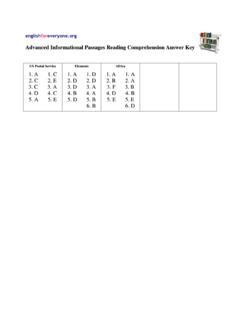
1 Name_____ Date_____ CChheemmiiccaall EElleemmeennttss Reading Comprehension Informational Passages Directions: Read the passage. Then answer questions about the passage below. Elements make up everything in the world. Elements are the basic substances that we cannot divide into simpler substances. We group Elements by the things they have in common what they look like, how they react with other substances, if they conduct electricity, etc. We group Elements into nine official groups. The element, Hydrogen is in a group by itself. It is different from all the other Elements . Hydrogen is a basic substance. 90% of all atoms in the universe are hydrogen atoms. Hydrogen atoms are the lightest atoms. Hydrogen got its name from the scientist Lavoisier. Lavoisier noticed that hydrogen atoms are always present in water.
2 The word root Hydro means water. Therefore, it was iinnttuuiittiivvee to represent hydrogen with the letter H. The second group is the alkaline-earth metals. You can find these Elements in the earth s crust. They react with water. This group of Elements contains Elements such as Calcium. Calcium is a basic substance found in substances like milk and chalk. It is a member of the second group of Elements . Some other members of the second group are beryllium and magnesium. The third group is the alkali metals. These Elements react very strongly with water. They might even explode if they touch water. This group of Elements contains Elements such as Sodium. Sodium is an element found in table salt. Scientists represent sodium with the letters Na. Some other members of the third group are lithium and potassium. The fourth group of Elements includes metals. It is the largest group of Elements .
3 It includes iron, silver, gold, nickel, platinum and titanium. Elements in this group conduct electricity. They are hard and shiny. Members of this group are called the transition metals. The fifth group of Elements is the actinides. The Elements in this group are radioactive metals. Most of the members of this group are ssyynntthheettiicc Elements . They are non-natural Elements . They are made in special labs. Some members of this group are uranium and plutonium. The sixth group of Elements is the lanthanides. Some people call this group the rare earth Elements . Some people call them the inner transition Elements . These metals are silver or silvery white. They conduct electricity very well. They tarnish when they come into contact with air. The seventh group consists of the nonmetals. Carbon is a member of this group. Every living thing depends on carbon.
4 Oxygen is also a member of this group. We take in oxygen and eexxhhaallee carbon dioxide (which is a combination of carbon and oxygen) when we breathe. The eighth group consists of the inert gases. They are called iinneerrtt gases because they do not react easily with other substances. Most of these gases are present in lighting. When a current of electricity goes through neon, it glows red. Some other members of this group are argon and xenon. This group is sometimes called Group Zero or Group 0. The ninth group consists of the poor metals. These metals are different from the metals in the fourth group because these metals are soft. These metals melt easily. They also mix well with other metals to form aallllooyyss. Both lead and aluminum are poor metals. The last group consists of the semi metals. The members of this group are like metals in some ways.
5 They are also like non metals in some ways. Some semi metals are arsenic and bismuth. Depending on which other substances touch them, they can be conductors of electricity or they can iinnssuullaattee, or protect, substances from electricity. Some scientists call the semi metals double metals because of their structure. QQuueessttiioonnss:: 11)) WWhhaatt ddiidd LLaavvooiissiieerr nnoottiiccee aabboouutt hhyyddrrooggeenn?? A. That it was always in water. B. That it was the lightest atom. C. That 90% of all atoms in the universe are hydrogen atoms. D. That it is a basic substance. E. All of the above are correct. 22)) WWhheerree ccaann ccaallcciiuumm bbee ffoouunndd?? A. In milk. B. In chalk. C. In the earth s crust. D. All of the above are correct. E. Both A and B are correct. 33)) WWhhaatt ddoo tthhee tthhiirrdd,, ffoouurrtthh,, ffiifftthh,, aanndd ssiixxtthh ggrroouuppss hhaavvee iinn ccoommmmoonn?
6 ? A. They all tarnish in the air. B. They are all present in water. C. They are all synthetic. D. They are all metals. E. They are all inert. 44)) WWhhyy aarree uurraanniiuumm aanndd pplluuttoonniiuumm ggrroouuppeedd ttooggeetthheerr?? A. They are found in the earth s crust. B. They are radioactive. C. They are metals. D. Both A and C are correct. E. Both B and C are correct. 55)) WWhhyy aarree lleeaadd aanndd aalluummiinnuumm ggrroouuppeedd ttooggeetthheerr?? A. They mix with other metals. B. They are soft metals. C. They melt easily. D. All of the above are correct. E. Both A and C are correct. VVooccaabbuullaarryy:: 11)) TThhee bbeesstt ssyynnoonnyymm ffoorr iinnttuuiittiivvee A. non-natural. B. inclined. C. automatic. D. simple. E. passionate. 22)) SSoommeetthhiinngg ssyynntthheettiicc A.
7 Non-natural. B. manmade. C. artificial. D. All of the above are correct. E. Both B and C are correct. 33)) WWhheenn yyoouu eexxhhaallee,, yyoouu .. A. breathe out. B. take out. C. consist of. D. Both A and B are correct. E. Both B and C are correct. 44)) IInneerrtt A. non reactive. B. radioactive. C. reactive. D. shiny. E. hard. 55)) AAnn aallllooyy A. a combination of carbon and oxygen. B. a mixture of metals. C. a chemical laboratory. D. a soft metal. E. a non metal. 66)) TThhee bbeesstt ssyynnoonnyymm ffoorr iinnssuullaattee A. melt. B. protect. C. conduct. D. combine. E. represent.