Transcription of Internal Affairs Policy and Procedures - New Jersey
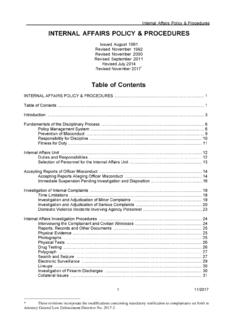
1 (11/2000)11-1 Internal Affairs Policy & PROCEDURESI ssued August 1991 Revised November 1992 Revised November 2000 Table of ContentsTable of Contents .. 11-4 Fundamentals of the Disciplinary 11-8 Policy Management System .. 11-8 Prevention of 11-11 Responsibility for 11-13 Fitness for Duty .. 11-13 Internal Affairs Unit .. 11-14 Duties and 11-14 Selection of Personnel for the Internal Affairs 11-15 Accepting Reports of Officer Misconduct .. 11-16 Accepting Reports Alleging Officer 11-16 Immediate Suspension Pending Investigation and 11-18 Investigation of Internal Complaints .. 11-20 Time Limitations .. 11-20 Investigation and Adjudication of Minor 11-21 Investigation and Adjudication of Serious 11-22 Domestic Violence Incidents Involving Agency 11-24 Internal Affairs Investigation 11-26 Interviewing the Complainant and Civilian 11-26 Reports, Records and Other 11-27 Physical 11-28 Physical Tests.
2 11-28 Drug 11-29 Polygraph .. 11-29 Search and 11-30 Electronic Surveillance .. 11-33 Investigation of Firearms Discharges .. 11-33 Collateral Issues .. 11-34 Internal Affairs Policy & Procedures (11/2000)11-2 Interviewing Members of the 11-36 General 11-36 Criminal Investigation, Officer Is 11-39 Criminal Investigation, Officer Is 11-40 Administrative Investigation, Officer Is 11-41 Administrative Investigation, Officer Is 11-42 Interviewing 11-43 Internal Affairs Records .. 11-45 The Internal Affairs 11-45 Internal Affairs Records .. 11-45 Retention 11-48 Personnel 11-49 Risk Management 11-50 Appendix 11-53 Model Internal Affairs Standard Operating 11-53 Appendix 11-65 Sample Citizen Complaint Information 11-65 Appendix 11-66 Internal Affairs Report 11-66 Appendix 11-67 Model Performance 11-67 Appendix 11-68 Sample Immediate Suspension 11-68 Appendix 11-69 Internal Affairs Complaint Notification.
3 11-69 Appendix 11-70 Witness Acknowledgment Form .. 11-70 Appendix 11-71 Sample Administrative Advisement Form .. 11-71 Appendix 11-72 Miranda Warnings & Waiver .. 11-72 Appendix 11-73 Internal Affairs Policy & Procedures (11/2000)11-3 Sample Use Immunity Grant Advisement Form .. 11-73 Appendix 11-74 Sample Response 11-74 Appendix 11-76 Sample Case Checklist and Summary 11-76 Appendix 11-77 Statutes and Rules Recommended for 11-77 Appendix 11-79 Department of Personnel Time Table and Steps for Disciplinary 11-79 Appendix 11-83 Department of Personnel Preliminary Notice of Disciplinary 11-83 Appendix 11-84 Department of Personnel Final Notice of Disciplinary 11-84 Appendix 11-85 Sample Internal Affairs Case 11-85 Appendix 11-86 Internal Affairs Summary Report 11-86 Internal Affairs Policy & Procedures 1 40A:14-181(11/2000)11-4 IntroductionInternal Affairs Policy and Procedures was first published in 1991.
4 An update to theoriginal Policy occurred in 1992. The purpose of the Policy is to assist the State s lawenforcement agencies with the receipt, investigation and resolution of citizen complaints ofpolice misconduct. The ultimate goal of the Policy is to improve the delivery of police servicesto the citizens of New Jersey . Since 1992, the process we call Internal Affairs has come under increasing scrutiny bythe courts, the community and the media. In fact, it would be fair to say that the properadministration of the Internal Affairs function by the State s law enforcement agencies is one ofthe primary issues facing the criminal justice system in New Jersey today. The New Jersey Legislature recognized the importance of the Internal Affairs function in1996 with the enactment of 40A:14-181.
5 The statute provides that:Every law enforcement agency shall adopt and implement guidelines which shallbe consistent with the guidelines governing the " Internal Affairs Policy andProcedures" of the Police Management Manual promulgated by the PoliceBureau of the Division of Criminal Justice in the Department of Law and PublicSafety, and shall be consistent with any tenure or civil service laws, and shall notsupersede any existing contractual addition, the courts, particularly the federal courts, have begun to focus on theimportance of the Internal Affairs function. The courts have come to perceive the Internal affairsfunction as an important means of protecting the constitutional rights and civil liberties of thecitizens of this State.
6 Under current case law, law enforcement agencies must do three thingswith respect to the Internal Affairs function. First, agencies must implement an Internal affairspolicy that provides for a meaningful and objective investigation of citizen complaints of policemisconduct. Second, agencies have a duty to monitor the behavior of their police officers forincidents of misconduct. Third, when officers are found to have engaged in misconduct,agencies have an affirmative duty to correct the behavior. The courts have with increasingfrequency issued decisions that set minimum standards of performance for the Internal affairsfunction. In view of the above developments, the Attorney General has decided to issue, throughthe Division of Criminal Justice, a revised and updated version of Internal Affairs Policy andProcedures.
7 The revisions attempt to incorporate and reflect the numerous changes that haveoccurred in law enforcement and the Internal Affairs function since the Policy was first issued in1991. The revised Policy is also designed to assist law enforcement agencies in their efforts tocomply with emerging legal principles governing the Internal Affairs function. It is important for county and municipal law enforcement agencies to recognize that asInternal Affairs Policy & Procedures (11/2000)11-5they conduct Internal Affairs investigations, they do so under the general supervision of theAttorney General. The Criminal Justice Act of 1970 designates the Attorney General as theState s chief law enforcement officer.
8 ( 52:17B-98) As such, the Attorney General isresponsible for the general supervision of the State s law enforcement agencies in order toprovide for the efficient administration of the criminal justice. Subordinate law enforcementagencies, including county and municipal police forces, have a duty to cooperate with theAttorney General in order to improve the administration of the criminal justice system includingthe efficient delivery of police services. For county and municipal law enforcement agencies,cooperation in Internal Affairs matters begins with strict adherence to the requirements set forthby the newly revised and municipal law enforcement agencies must also recognize that they conductinternal Affairs investigations, particularly those investigations that involve allegations of criminalconduct, under the direct supervision of the county prosecutors.
9 County and municipal lawenforcement agencies must inform the appropriate county prosecutor when allegations of policemisconduct involve potential criminal conduct. In addition, county and municipal lawenforcement agencies must confer with and follow the instructions given by the countyprosecutor at all critical points in the investigative process. This is particularly true when theagency is in the process of gathering evidence, including the taking of statements, concerningallegations of criminal newly revised Policy contains several mandates which, at the direction of theAttorney General, must be implemented by every law enforcement agency. However, themanner in which these mandates must be implemented is a decision that is left to discretion ofindividual law enforcement agencies.
10 For instance, every agency must establish an internalaffairs function. However, the manner in which the mandate is satisfied is a decision that is leftto the discretion of the individual agencies. Individual agencies shall decide based on thecharacteristics of their jurisdiction and the workload of their agency whether the Internal affairsfunction is a full or part-time unit and how many officers are assigned to work in the unit. Other Policy requirements which the Attorney General has determined are critical innature and must be implemented by every law enforcement agency include the following: Each agency must establish by written Policy an Internal Affairs function. Each agency must accept reports of officer misconduct from any person,including anonymous sources, at any time.