Transcription of MATERIAL SAFETY DATA SHEET OF GLYPHOSATE …
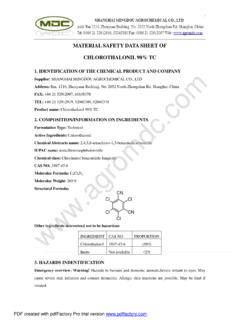
1 MATERIAL SAFETY DATA SHEET OF GLYPHOSATE 480 G/L SL 1. IDENTIFICATION OF THE CHEMICAL PRODUCT AND COMPANY Supplier: SHANGHAI MINGDOU AGROCHEMICAL CO., LTD Address: Rm. 1210, Zhenyuan Building, No. 2052 North Zhongshan Rd, Shanghai, China FAX: +86 21 52912097, 61638378 TEL: +86 21 52912919, 52045380, 52045370 Product name: GLYPHOSATE 480 g/l SL Product use: Herbicide 2. COMPOSITION/INFORMATION ON INGREDIENTS Formulation Type: Soluble concentrate Active Ingredients: GLYPHOSATE (in the form of its isopropylamine salt) Chemical Abstracts name: N-(phosphonomethyl)glycine compound with 2-propanamine (1:1) IUPAC name: N-(phosphonomethyl)glycine - isopropylamine (1:1) or isopropylammonium N-(phosphonomethyl)glycinate CAS NO. : 38641-94-0 Molecular Formula: C6H17N2O5P Molecular Weight: Structural Formula: Other ingredients determined not to be hazardous INGREDIENT CAS NO PROPORTION GLYPHOSATE (in the form of its isopropylamine salt) 38641-94-0 480 G/L Inerts Not available Up to 100% created with pdfFactory Pro trial version 3.
2 HAZARDS IDENTIFICATION Emergency overview: Causes moderate eye irritation. Avoid contact with eyes or clothing. Health hazards: Likely Routes of Exposure: Skin contact and inhalation Eye Contact: The product may cause pain, redness and tearing as shown by toxicity studies. Skin Contact: The product is only slightly toxic and only slightly irritating as shown by toxicity studies. Ingestion: The product is only slightly toxic as shown by toxicity studies. No significant adverse health effects are expected to develop if only small amounts (less than a mouthful) are swallowed. Ingestion of similar formulations has been reported to produce gastrointestinal discomfort with irritation of the mouth, nausea, vomiting and diarrhea. Oral ingestion of large quantities of one similar product has been reported to result in hypotension and lung edema.
3 Inhalation: The product is only slightly toxic if inhaled as shown by toxicity studies. Physical hazards: May react with metals such as galvanized or mild steel to produce hydrogen gas, potentially forming a highly combustible gas mixture. 4. FIRST AID MEASURES General: Have the product container, label or MATERIAL SAFETY Data SHEET with you when going for treatment. Tell the person contacted the complete product name, and the type and amount of exposure. Describe any symptoms and follow the advice given. Skin contact: Wash with plenty of soap and flowing water for at least 15 minutes while removing contaminated clothing. Wash clothing before reuse. Eye contact: Immediately flush with flowing water for at least 15 minutes. Seek medical attention if irritation occurs. Ingestion: If swallowed, drink several glasses of water.
4 DO NOT induce vomiting unless patient has induced high doses. Seek medical advice. Inhalation: If ill-effects occur, move the victim to fresh air. If ill-effects persist, consult a doctor. Note to physician: No specific antidote. Treat symptomatically. 5. FIRE FIGHTING MEASURES Flash point: above 113 C. Flammable Limits (LFL-UFL): N/A Fire and Explosion Hazards: During a fire, product may generate irritating or toxic gasses through thermal decomposition. Means of Extinction: Use water spray, foam or dry chemical. created with pdfFactory Pro trial version Fire Fighting Instructions: Evacuate area and fight fire from a safe distance. Approach from upwind to avoid hazardous vapors and decomposition products. A foam or dry chemical fire extinguishing system is preferred to prevent environmental damage from excessive water run off.
5 If water is used, avoid heavy hose streams. If possible, dike and collect water used to fight fire to prevent/minimize run off. Fire Fighting Equipment: Self-contained breathing apparatus with full face piece. Wear full firefighting turn-out gear (Bunker gear). Hazardous Combustion Products: Carbon monoxide, nitrogen oxides, phosphorous oxides. 6. ACCIDENT RELEASE MEASURES Personal precautions: Wear protective clothing and personal protective equipment as prescribed in Section 8 Exposure Controls/Personal Protection . Keep unprotected persons and animals out of area. Environmental precautions: Do not allow to enter drains or water courses. If contamination of drains, streams, watercourses etc. is unavoidable, warn the local water authority. Method for cleaning up: Clean up spills immediately.
6 Small Spill: Absorb spill with inert MATERIAL such as dry sand, vermiculite or fuller s earth, then place in a chemical waste container. Large Spill: Dike large spills using absorbent or impervious MATERIAL such as clay or sand. Recover and contain as much free liquid as possible for reuse. Allow absorbed MATERIAL to solidify and scrape up for disposal. After removal, scrub the area with detergent and water and neutralize with dilute alkaline solutions of soda ash or lime. 7. HANDLING AND STORAGE Handling: Read the label before use. Keep out of reach of children. Harmful if swallowed. Causes skin irritation and sensitivity. Avoid contact with skin and clothing. After work, remove protective clothing and equipment, wash hands before eating, drinking, chewing gum, using tobacco, or using the toilet.
7 Clean up spilled MATERIAL immediately, and wash clothes, equipment and work area after use. Storage: Store in tightly closed original container in a cool, dry well-ventilated area out of direct sunlight when not in use. This product can be stored in an unheated building. Do not store with food, feed stuffs, fertilizers and seeds. See product label for further handling/storage precautions relative to the end use of this product. 8. EXPOSURE CONTROLS/PERSONAL PROTECTION Exposure limits: No exposure limits have been established for this MATERIAL . Engineering controls: To keep exposure to airborne contaminants below exposure limits, proper ventilation is required when handling or using this product. Local mechanical exhaust ventilation may be required. Facilities storing or using this MATERIAL should be equipped with an eyewash facility and a SAFETY shower.
8 Personal protective equipment (PPE): created with pdfFactory Pro trial version Skin protection: All pesticide handlers must wear a long-sleeved shirt and long pants and shoes plus socks. Waterproof gloves are recommended when mixing, loading or cleaning equipment. Eye protection: SAFETY goggles are recommended when mixing, loading or cleaning equipment. User SAFETY recommendations: Do not get in eyes or get in or on clothing. Avoid breathing vapor or spray mist. Wash hands before eating, drinking, chewing gum, using tobacco, or using the toilet. Wash thoroughly with soap and water after handling. Remove contaminated clothing immediately and wash before reuse. Discard clothing and other absorbent materials that have been drenched or heavily contaminated with this product s concentrate.
9 Do not reuse them. 9. PHYSICAL AND CHEMICAL PROPERTIES Appearance: Clear yellow to amber liquid Odor: Slight amine odor pH: (1% solution in water) at 20 C. Flashpoint: above 113 C. Specific Gravity: g/ml at 20 C. Solubility in Water: fully miscible with water. 10. STABILITY AND REACTIVITY Chemical stability: Product is normally stable. However, product may decompose if heated. Conditions to avoid: Avoid temperatures above 115 F (46 C) and below 25 F (-5 C). Hazardous decomposition: Heat and fire may result in thermal decomposition and the release of nitrogen oxides, phosphorous oxides and carbon monoxide. Incompatible materials: Strong oxidizers and bases, mild and galvanized steel. Hazardous reactions: Hazardous polymerization will not occur. 11. TOXICOLOGICAL INFORMATION Acute toxicity: Oral: LD50 (rat): >5,000 mg/kg Dermal: LD50 (rat): >5,000 mg/kg Inhalation: LC50 (rat): > mg/L Irritant properties: Skin: (Rabbit) Irritation Eye: (Rabbit) Irritation Allergenic and sensitizing effects: Not considered to be a skin sensitizer (Guinea pig).
10 Chronic toxicity/Carcinogenicity: Animal studies did not detect any carcinogenic effects. created with pdfFactory Pro trial version Genetic effects/Mutagenicity: Animal studies did not detect any mutangenic effects. Teratogenicity: Animal studies did not detect any teratogenic effects. 12. ECOLOGICAL INFORMATION The following information is for the active ingredient, GLYPHOSATE -isopropylammonium. Ecotoxicity: Birds Low toxicity to birds. Acute oral LD50: >2000 mg/kg (bobwhite quail). Fish LC50 (96 h): for trout and bluegill sunfish >1000, fathead minnow 97 mg/l. Daphnia EC50 (48 h): 930 mg/l. Bees Non toxic to bees. LD50 (oral): > 100 g/bee. LD50 (contact): > 100 g/bee. Earthworm: LC50 (14 days): for Eisenia foetida >5000 mg/kg soil. Persistence and degradability: Microbial degradation is the major cause of loss from soil, with liberation of carbon dioxide.