Transcription of Rhode Island Peer Recovery Specialist Certification
1 March 2016 Rhode Island peer Recovery Specialist Certification STUDY GUIDE FOR THE Certification EXAM Prepared by: JSI Research & Training Institute, Inc. For: Rhode Island Department of Behavioral Healthcare, Developmental Disabilities and Hospitals RI peer Recovery Specialist Certification Exam Study Guide | Page 1 ACKNOWLEDGEMENTS & FUNDING STATEMENT The Rhode Island peer Recovery Specialist Certification Guide: A Study Guide for the Certification Exam is a resource funded by the Department of Behavioral Healthcare, Developmental Disabilities and Hospitals (BHDDH) to serve as a study aid to assist peer Recovery professionals to prepare for and pass the Rhode Island peer Recovery Specialist Certification Exam. The guide was developed by JSI Research & Training Institute, Inc. under contract with BHDDH. Funding is provided by the Substance Abuse and Mental Health Services Administration (SAMHSA) through a contract with the Center for Social Innovations (CSI).
2 The contents of this Guide do not necessarily represent the official views or policies of SAMHSA, CSI or BHDDH. PARTNER AGENCIES Anchor/The Providence Center Community Care Alliance Mental Health Association of Rhode Island MHCA-RI Oasis NAMI Rhode Island Parent Support Network of Rhode Island Rhode Island Coalition for the Homeless Rhode Island College Rhode Island Communities for Addiction Recovery Efforts, Inc. Rhode Island Department of Behavioral Healthcare, Developmental Disabilities and Hospitals Rhode Island Executive Office of Health and Human Services Rhode Island Family Treatment Drug Court Substance Use and Mental Health Leadership Council of Rhode Island The Galilee Mission, Inc. RI peer Recovery Specialist Certification Exam Study Guide | Page 2 TABLE OF CONTENTS Introduction And Purpose .. 3 Getting Ready For The Exam .. 5 Major Concepts, Skill Areas, and Definitions The Role of peer Support In Recovery .. 8 Relationship Building and Communication Skills For peer Recovery specialists .
3 15 Boundaries and Ethical Issues .. 21 Supporting Recovery and Wellness .. 24 Practice Exam Questions .. 31 Glossary .. 38 Appendix A. IC&RC Domains .. 41 Appendix B. Examination Reference List .. 44 RI peer Recovery Specialist Certification Exam Study Guide | Page 3 INTRODUCTION AND PURPOSE Introduction A peer Recovery Specialist is a trained individual who has lived experience with mental illness and/or addiction to alcohol and/or other drugs who provides one-to-one strengths-based support to peers in Recovery . peer Recovery specialists work in a wide range of settings including community health and mental health centers, behavioral health programs, substance use treatment facilities, peer -run organizations, community-based organizations, emergency rooms, courts, homeless shelters and outreach programs. Sometimes, peer Recovery specialists are referred to as peer Support specialists . The Rhode Island Department of Behavioral Healthcare, Developmental Disabilities and Hospitals (BHDDH) is committed to building and strengthening the Recovery workforce in Rhode Island .
4 It supports training and professional development opportunities and facilitation of the Certification process for both beginning and experienced Recovery professionals. Toward these ends, BHDDH commissioned the development of this Study Guide for individuals seeking to take the peer Recovery Specialist Certification Exam offered by the Rhode Island Certification Board. Purpose of the Guide This Guide is designed as a study aid to help prepare for and pass the Rhode Island peer Recovery Specialist Certification Exam. The content of the Guide is based on the knowledge, skills and job tasks derived from the 2013 peer Recovery Job Analysis conducted by the International Certification and Reciprocity Consortium (IC&RC), which sets standards and develops examinations for the credentialing of prevention, substance use treatment, and Recovery professionals. The Guide was developed by JSI Research & Training Institute, Inc., in consultation with BHDDH, subject matter experts in the behavioral health field, and input from peer Recovery specialists who have taken the Certification exam, or are working in Recovery settings in Rhode Island .
5 RI peer Recovery Specialist Certification Exam Study Guide | Page 4 Overview of the Guide The first half of the Guide summarizes key concepts and strategies so that users can review content areas essential to peer Recovery support practice, including: Guiding principles and aspects of Recovery Roles and core values of peer Recovery specialists Relationship building and communication skills Cultural competence in Recovery support Boundaries and ethical issues in peer Recovery support Trauma-informed approaches Recovery and wellness planning The Guide begins with study tips and test-taking strategies. It includes 20 practice questions similar in format and level of difficulty to those on the exam, along with an answer key and explanations of the correct responses. A glossary and list of references to consult for more in-depth review of important topics are also provided. For More Information: For information on peer Recovery Specialist Certification in Rhode Island , please contact the Rhode Island Certification Board (RICB): , For information about the exam itself, please consult the Candidate Guide for the IC&RC peer Recovery Specialist Examination: For information about the peer Recovery specialists in Rhode Island , please contact the Rhode Island Department of Behavioral Healthcare, Developmental Disabilities and Hospitals (BHDDH): 401-462-1049, RI peer Recovery Specialist Certification Exam Study Guide | Page 5 GETTING READY FOR THE EXAM About the peer Recovery Specialist Certification Exam The IC&RC peer Recovery Specialist Certification Exam is 75 multiple choice questions.
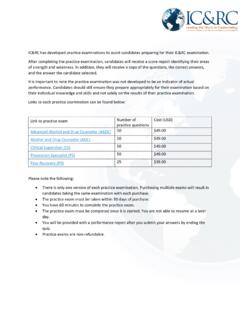
6 Scores are reported on a scale ranging from 200-800. You must receive a 500 to pass. You will have two hours to complete the exam. Listen to instructions from the exam administrator and read test instructions carefully. You will not be able to ask questions after the exam has started. Download the IC&RC Candidate Guide for the peer Recovery Examination for more information on exam administration, testing dates, rescheduling, cancelling, missed exams , exam rules and security, special accommodations, and scoring of exams . How to Prepare for the peer Recovery Specialist Certification Exam Even if you have been in the peer Recovery field for years, it is important to prepare for this exam. Start studying early, become very familiar with the contents of this Study Guide, and plan your test taking strategy. Everyone is different when it comes to test taking. Some prefer individual study while others require group study. Identify your personal preference on how to prepare for the examination.
7 Ask yourself, How do I study the best? Recall previous tests you have taken and decide what worked for you and what did not work for you in these situations. Below are study strategies, test taking techniques, and advice for the day before and day of the exam. Study Strategies You can prepare for the exam in multiple ways. This study guide is one way, but there are many additional ways to reinforce your mastery of the peer Recovery Specialist exam topics. Several suggestions are provided below. Mark your calendar. As soon as you choose an exam date, mark it on your calendar. Plan a study schedule based on the number of days until the exam. Test yourself. Take a practice test to find out what you know and what you need to study. Find a practice test that's similar to the one you'll be taking. Work on weak areas. Review subjects that you are weakest on. If certain types of questions give you problems, focus on understanding them better.
8 Make a daily study commitment. Block off some time each day to study. Creating a specific time to study helps with time management and establishes predictable study habits. RI peer Recovery Specialist Certification Exam Study Guide | Page 6 Create Study Checklists. Use your study guide to outline key points for each of the domain areas. Pay attention to lists, steps, or categories. Focus on the Key Terms. Understanding key terms throughout this study guide is important to mastering the exam; however don t limit yourself to just the key terms. Create flashcards. Create flashcards with key terms or concepts, and quiz yourself or have others quiz you. Study with others. Group studying can be helpful for practicing questions or for reviewing information that might be unclear. Understand your learning style. Some people learn best by reading, some learn by hearing, and others learn best by doing. You may learn best through a combination of these styles.
9 If a study strategy is not working for you, do not be afraid to try a different strategy. Find a system that works for you and stick with it. Test Taking Tips Going into a test with a good knowledge of basic test-taking techniques will help you do your best. Here is a sampling of common test-taking advice: Listen carefully to directions. Listen carefully to the test directions: How much time is available? How will the test be scored? What advice, if any, is given about when to randomly guess on multiple-choice test questions? Does the test administrator have any special instructions? Understand a question before answering it. Read questions carefully prior to answering. When in doubt, eliminate choices that you know are wrong, and then choose an answer from the remaining choices. The correct answer is always listed in multiple-choice exams . Review the choices. Read the question, try to think of an answer, and then look for it among the available answer choices.
10 If that doesn't work, at least eliminate the choices that appear to be wrong prior to guessing an answer. Do not overanalyze; if you think a question is a trick, you may be over thinking the question. Review your work. Review your answers. The test is not over until the time is up, so use any extra time to review your work. Stay as calm as you can. Stay calm and simply do the best job you can with the time available. Staying calm will make you more efficient while you are answering. A sample strategy for calming oneself is stretching and/or breathing deeply. RI peer Recovery Specialist Certification Exam Study Guide | Page 7 The Day Before and the Day of the Exam Before the Test Eat well. Good nutrition helps you to concentrate and perform your best. Sleep well. While it may be helpful to review your study materials the day before the exam, do not pull an all-nighter. Get plenty of rest, and set your alarm! Bring the right supplies.