Transcription of Malleus Maleficarum - szm.com
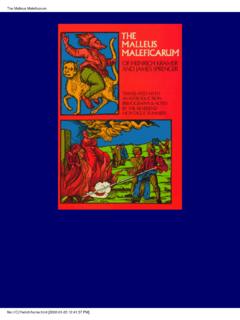
1 Malleus MaleficarumSome late medieval theologians, like the Dominican inquisitor Heinrich Kramer (Institoris), author of the Malleus Maleficarum (The Hammer of Witches, 1486), imagined witches to be members of a vast conspiracy directed against Christian society that was allowed by God to cause immense physical and spiritual hardship. The witches power, supported by the Devil with God s permission, was real. Witches therefore had to be physically eradicated, according to divine and secular law, by virtually any means, because exceptional crimes require exceptional measures. The Malleus was the result of Kramer s experience with witchcraft trials in his designated area as a papal inquisitor for Upper Germany ( , southwestern Germany, western Austria, Switzerland, and his homeland, Alsace).Title page of the 1669 edition of Heinrich Kramer s Malleus Maleficarum (The Hammer of Witches), 1486, the most notorious book on witchcraft.(Fortean Picture Library)Evidence survives from some of his trials in this region, particularly from 1482 to 1484.
2 Kramer s activities were generally not well received by the local authorities, who disliked his interference with their administration of justice, and the populace, who sometimes initially welcomed him, soon tired of his persecutory zeal. Annoyed by such resistance, Kramer obtained papal authorization for his inquisitorial rights over the prosecution of witchcraft from Innocent VIII (ruled 1484 1492) through the papal bull Summis desiderantes affectibus (Desiring with Supreme Ardor, 1484), which authorized formal inquisitions against witches in all German Church provinces. Now invested with carte blanche, Kramer decided to start a paradigmatic witch hunt. Innsbruck, capital of the duchy of Tyrol, was a significant place, since its Archduke Sigmund was a powerful Habsburg prince, ruling over a patchwork of territories stretching from northern Italy and southwestern Germany into Alsace (present-day eastern France). Innsbruck was Kramer s gateway to the Holy - 1 -Roman s Inquisition in Innsbruck, starting in July 1485, employed intimidation, brutal force, and unlimited torture; denied legal defense; and issued distorted reports of his interrogations: scandalous conduct, even by late-fifteenth-century legal standards.
3 Therefore, not only the relatives of the accused but also citizens of Innsbruck, together with the clergy, the Tyrolean nobility and eventually the local bishop, protested against his illegal procedures. Bishop Georg II Golser, successor of the philosopher Nicolaus of Cusa at the see of Brixen, appointed a commission to scrutinize Kramer s Inquisition. Despite desperate resistance from the inquisitor s side, the bishop stopped the persecution immediately, nullified its results and (after having secured the archduke s support), liberated all suspected is worth remembering that both the secular and ecclesiastical authorities of Tyrol decided to resist this papal inquisitor and that they successfully prevented a witch persecution within their jurisdiction. Kramer was branded a fanatic, and Bishop Golser (who called Kramer senile and crazy in his correspondence) even threatened him with force if he failed to leave his diocese voluntarily. The prince-bishops of Brixen never allowed a witch persecution in their territory, and, even more importantly, the Tyrolean government had learned a lasting lesson and subsequently suppressed any attempts by lower courts to launch witch hunts.
4 In short, the Innsbruck Inquisition was a crushing defeat for the papal failure at Innsbruck and his apocalyptic fears drove Kramer to develop his ideas further. Starting from his reports to Bishop Golser (Ammann 1911), he hastily systematized his notes into a lengthy manuscript. This papal inquisitor was among the first of his profession to recognize the importance of the printing revolution, and with this manuscript he tried to turn his defeat into victory by demonstrating the existence of witchcraft. Using his authority and experience, he urged the necessity of a campaign to eradicate witchcraft. The result was the Malleus confusion persists about the author, place of print, and date of print of this crucial publication on witchcraft. Even recently, scholars have claimed that the Malleus was at least coauthored by Jacob Sprenger (1437 1495). Only in 1519, decades after Sprenger s death, was he named as author on a front page, first in an edition by the Nuremberg (N rnberg) printer Friedrich Peypus.
5 Two generations later, in 1574, Giovanni Antonio Bertanus, a Venetian printer, even named Sprenger as its sole author. Later German and French printers adopted Bertanus s mistake. However, no contemporary evidence suggests that Sprenger had anything to do with the Malleus , or with witchcraft trials, or with executions of any kind as a result of inquisition author of the Malleus stated that forty-eight women had been burned as witches in the diocese of Constance; there is no reason to doubt this number, especially because he indicated that he himself had searched this diocese more than any other. All these remarks pointed directly to frater Henricus de Sletstat, or Heinrich Institoris, as Kramer often Latinized himself. The historian S nke Lorenz found a hitherto unknown letter of this inquisitor from 1484, announcing his arrival at Wolfegg, a Swabian castle of Count Johann von Waldburg-Trauchburg (ruled 1460 1505) close relatives to the ruling prince-bishop of Constance for the purpose of witch hunting.
6 Numerous documents survive concerning Kramer s inquisition in the Imperial City of Ravensburg, mentioned in the first (Speyer 1486) edition of the Malleus (fol. 44r). After his crushing failure at Innsbruck, Kramer turned his attention toward Alsace, particularly in the vicinity of his convent. The expulsion of the Jews from his hometown of S l stat should be placed in this context. In 1488 Kramer tried to incite witch hunts in the neighboring diocese of Trier; that year, thirty-five witches were burned in the nearby imperial city of Metz. In an expert opinion for the imperial city of Nuremberg, Bruder Heinrich Kramer Prediger Ordens boasted in October 1491 that more than 200 witches had been burned thus far due to his inquisitions, and in the same document he revealed his single authorship of the Malleus (Jerouschek 1991).Further actions of this inquisitor remain shrouded in darkness, and recent research suggests that his own superior may have silenced him.
7 Jacob Sprenger turned out to have been Kramer s most bitter - 2 -enemy. In complete contrast to the Alsatian fanatic, a maverick who managed to get into trouble wherever he went and who had developed into a wandering inquisitor and persecution specialist, Sprenger was a prominent figure among the observant reform wing of the Dominicans. He was appointed prior of the large Cologne convent, then leader of the Teutonic province; Sprenger was also an influential theologian, promoting veneration of the Virgin Mary and introducing rosary brotherhoods organized by friars and secular clergy for lay people. It seems likely that Sprenger was involuntarily included in both the papal bull of 1484 and the foreword of the Malleus in 1486. Wilson (1990, 130) doubted that Kramer tried deliberately to deceive the public and Sprenger, but this must have been the case. Sprenger had tried to suppress Kramer s activities in every possible way. He forbade the convents of his province to host him, he forbade Kramer to preach, and even tried to interfere directly in the affairs of Kramer s S l stat convent.
8 Not one single fact or incident associated Sprenger with witchcraft prosecutions, and he apparently managed to drive the author of the Malleus from his province. Kramer spent his final years in Italy and Moravia, where he died. Kramer successfully deceived many modern scholars with his misrepresentations and outright lies. But one need only read the surviving Innsbruck trial records (Ammann 1890) and compare them with his accounts of the Innsbruck inquisition in the Malleus to realize that Kramer was ready to use any deception that served his purpose. His career offers numerous examples, but this one seems sufficient (Segl 1988).As to date and place of print, a printer s account book (Geldner 1964) demonstrated that the Malleus was first printed in autumn 1486 in the imperial city of Speyer, by then a medium-size town on the Rhine with about 8,000 inhabitants. The printer was Peter Drach (ca. 1450 1504), who delivered the treatise against sorcerers to booksellers by December 1486.
9 The original text of the Malleus comprised 129 leaves (258 pages) in folio; given the usual production of a small printer (about 900 folio pages a day), Drach could have printed 150 copies a month. If the first edition was meant to have 300 copies, the manuscript must have been delivered to Drach by mid-October 1486, with more copies even earlier. Like many early books, it had no title page at that stage, so descriptions of the Malleus vary in the account book. The Malleus was called a treatise against sorceresses, or against sorcery, until Kramer added a foreword to the text, his apologia auctoris in malleum Maleficarum , around Easter 1487 (Behringer and Jerouschek in Kramer 2000, 22 31). Afterward, the book s title was fixed and appears regularly this way in the account book, even without the Malleus having a title promoted his publication in every possible way, notably by adding the papal bull of 1484 and a reference to its approval by the University of Cologne from April 1487.
10 The latter was at least partly a forgery, because two of its supposed authors (Thomas de Scotia and Johann von W rde) later denied any participation. These additions were not printed by Drach but by an immediate apprentice of Johannes Gutenberg at Mainz, Peter Sch ffer (ca. 1425 1503), with a separate pagination. These parts were probably added in late May 1487 and bound together with the existing main body of the text. Henceforth, the author s Apologia, the papal bull Summis desiderantes affectibus, and the Cologne Approbatio remained part of the Malleus . In early December 1486, when Speyer hosted a meeting of representatives of the imperial cities (St dtetag), and Emperor Frederick III (whom Kramer had insulted some years earlier, to the great displeasure of the Dominican order) was due to arrive, Kramer apparently traveled to the Burgundian capital at Brussels in order to obtain a privilege from King Maximilian I (1459 1519), the future emperor.