Transcription of NRDC: In Hot Water: Water Management …
1 July 2007In Hot WaterWater Management strategies to weather the Effects of global WarmingPrincipal AuthorsBarry Nelson Monty Schmitt Ronnie CohenNoushin KetabiNatural Resources defense CouncilRobert C. Wilkinson, Policy Program University of California, Santa BarbaraContributing EditorTheo SpencerNatural Resources defense CouncilForewordPatricia MulroySouthern Nevada Water AuthorityIn Hot Water : Water Management strategies to weather the Effects of global Warmingii natural Resources defense CouncilAbout NRDCThe natural Resources defense council is an international nonprofit environmental organization with more than million members and online activists. Since 1970, our lawyers, scientists, and other environmental specialists have worked to protect the world s natural resources, public health, and the environment.
2 NRDC has offices in New York City, Washington, , Los Angeles, San Francisco, the Midwest, and Beijing. Visit us at the Water Policy ProgramThe Water Policy Program at the Donald Bren School of Environmental Science and Management , University of California, Santa Barbara, advances the theory and practice of Water Management . Contact: AcknowledgmentsThe natural Resources defense council would like to thank the William and Flora Hewlett Foundation and Environment Now for supporting NRDC s work on the intersection of Water , energy, and climate issues. We wish to thank the individuals at Southern Nevada Water Authority and Desert Research Institute with whom we worked to hold the Urban Water Supplies and Climate Change in the West Conference in September 2005.
3 This report emerged from the discussions at that conference. Their partnership has been critical to this endeavor: Pat Mulroy, Kay Brothers, Allison Huntly, Jamie Poort, Southern Nevada Water Authority; John Warwick, Kelly Redmond, Desert Research report also received substantial input and review from a number of individuals. Their participation contributed to the quality of the report and its recommendations. We acknowledge that they may not necessarily endorse all of the report recommendations, which are solely those of particular, we wish to thank our peer reviewers: Steve Macaulay, California Urban Water Agencies; Martha Davis, Inland Empire Utility also wish to thank: Richard Palmer, University of Washington Climate Impacts Group; Dr.
4 Peter Gleick, The Pacific Institute; Lorna Stickel, Portland Water Bureau; Joan Kersnar, Seattle Public Utilities; Paul Fleming, Seattle Public Utilities; Stephen Saunders, The Rocky Mountain Climate Organization; Chips Barry, Denver Water ; Marc Waage, Denver Water ; Robert Steger, Denver Water ; Elizabeth Gardener, Denver Water ; Greg Fisher, Denver Water ; Doug Bennett, Southern Nevada Water Authority; Tom Maher, Southern Nevada Water Authority; Fatema Akhter, Los Angeles Department of Water and Power; Kevin Richards, East Bay Municipal Water District; Randy Kanouse, East Bay Municipal Water District; Brian Campbell, East Bay Municipal Water District; Doug Wallace, East Bay Municipal Water District; Jim Crowley, Santa Clara Valley Water District; Amy Fowler, Santa Clara Valley Water District; Otis Wollan, Placer County Water Agency; Liz Mansfield, El Dorado Irrigation District; Fran Spivy-Weber, Mono Lake Committee; Grace Chan, Metropolitan Water District; Brandon Goshi, Metropolitan Water District; Robert Meacher, Plumas County Supervisor.
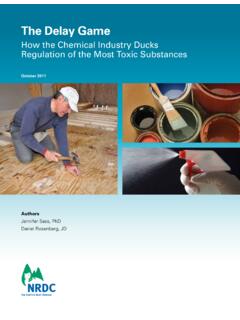
5 John Sheehan, Plumas Director of Communications: Phil GutisNRDC Director of Marketing and Operations: Alexandra KennaughNRDC Publications Manager: Lisa GoffrediProduction: Bonnie GreenfieldProduction Assistants: Harris Epstein, Crossley PinkstaffCover Design: Sue RossiCover Photo: Alamy 2007 by the natural Resources defense additional copies of this report, send $ plus $ shipping and handling to NRDC Reports Department, 40 West 20th Street, New York, NY 10011. California residents must add sales tax. Please make checks payable to NRDC in report is printed on paper that is 100 percent post-consumer recycled fiber, processed chlorine natural Resources defense CouncilTable of ContentsForeword ..ivExecutive Summary.
6 ViWater Management in a Changing Climate ..viHighlights of Efforts to Incorporate Climate Change into Water Management ..xChapter 1An Overview of Major Scientific Findings on Climate Change ..1 Chapter 2 How Climate Change Will Affect Western Water Supply and Management ..4 Climate Change Effects Will Reshape Water Supply in the West ..5 Climate Change Will Affect Flood Management ..10 Climate Change Will Affect Water Quality ..12 Climate Change Will Affect Aquatic Ecosystems ..13 Climate Change Will Affect Western Hydropower ..15 Chapter 3 The Water and Energy Connection ..17 Chapter 4A Guide for Water Managers: Designing a Comprehensive Response to Climate Change ..21 Vulnerability Analysis ..21 Response strategies for Dealing with Water Supply Impacts.
7 25 Response strategies for Addressing Other Water resource Impacts ..40 Prevention ..44 Public Outreach ..51 Chapter 5 Conclusions and Recommendations ..52 Conclusions ..52 Recommendations ..53 Additional Research Needs ..57 Appendix ACase Studies: Water Agency Action on Climate Change ..58 Appendix BDecoupling Population Growth and Water Use ..69 Endnotes ..74iv natural Resources defense CouncilForewordDuring the last century, long-range forecasts of popula-tion growth and Water demands in the West have often been underestimated. Add to this fact the reality that stable and reliable Water supplies in the West are, for the most part, already allocated. In this age of scarce Water supplies, the prospect of climate change should serve as a catalyst for paradigm shifts in the way we manage Water .
8 Long-term climate change is adding even more uncertainty to the already difficult task of Water resource planning and respond to the challenges posed by climate change, Water managers will need to reevaluate their assump-tions concerning storage and use of existing supplies, the amount of Water expected to be available in the future, and how scarce or limited supplies should be shared among competing interests. Continued scientific study and dialogue will be of paramount importance to this effort, not only in terms of providing data to help indi-vidual utilities manage their respective situations, but also The effects of global warming on the health of the planet has been a topic of discussion for decades. However, only recently have the potential impacts of climate change on western communities become a focus for Water resource scientists, planners, and managers.
9 In the American Southwest, the severe drought on the Colorado River that began in 2000 served as a wake-up call to Water utility managers regarding the possible implications of global warming . Those implications are facilitate the development of practical local, regional, and national this in mind, the natural Resources defense council , Desert Research Institute, and Southern Nevada Water Authority co-sponsored a 2005 conference entitled Urban Water Supplies and Climate Change in the West. The objectives of the conference were threefold: to edu-cate participants about the most recent studies of climate change and potential Water supply impacts; to increase understanding and facilitate dialogue between Water sci-entists and Water managers; and to discuss options for ad-dressing the potential impacts of climate change on Water supplies.
10 The presentations and discussion at that confer-ence led to this is clear that global warming is occurring, particu-larly in the West. In general, temperatures are increasing. Scientists predict that this will likely lead to more runoff from rain, less alpine snowpack, larger winter streamflows, and hotter, drier summers. Communities are likely to face In Hot Water : Water Management strategies to weather the Effects of global Warmingv natural Resources defense Councilmore flooding and more frequent drought. As the West experiences earlier snowmelts and warmer, rainier winters, rivers and streams will be altered. natural recharge to groundwater basins could decrease. To cope with these changes effectively, Water utilities will need to act quickly to develop diverse and flexible Water resource portfolios that will allow them to reduce demands and adapt their supplies to changing climatic and hydrological conditions.