Transcription of AP Calculus Review Position, Velocity, and Acceleration
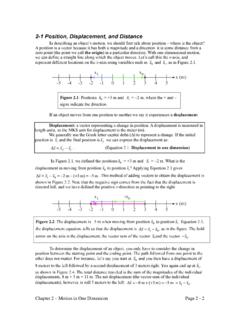
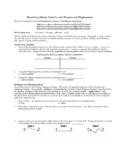
1 AP* Calculus Review position , velocity , and Acceleration Teacher Packet AP* is a trademark of the College Entrance Examination Board. The College Entrance Examination Board was not involved in the production of this material. Copyright 2008 Laying the Foundation , Inc., Dallas, TX. All rights reserved. Visit: Copyright 2008 Laying the Foundation , Inc., Dallas, TX. All rights reserved. Visit: position , velocity , and Acceleration Page 1 of 15 Session Notes Suppose an object is moving along a straight line, such as the x-axis, so that its position x, as a function of time t, on that line is given by ()yxt=. Average velocity of the object over the time interval tott t+ is given by ()()xttxtt+ , or change in positionchange in time. Instantaneous velocity of the object is the derivative of the position function ( )xt with respect to time. ( )( )vtx t = Speed is the absolute value of the velocity .
2 ().dxSpeedv tdt== Acceleration is the derivative of velocity with respect to time. ()()()atv tx t == ()(),()()vt dt xt cat dt vt c=+=+ Total distance traveled from time 12tttott==is given by 21()ttTDTv t dt= . Copyright 2008 Laying the Foundation , Inc., Dallas, TX. All rights reserved. Visit: position , velocity , and Acceleration Page 2 of 15 Speeding Up or Slowing Down If the velocity and Acceleration have the same sign (both positive or both negative), then speed is increasing. If an object s velocity is 40 miles per hour and the object accelerates 10 miles per hour per hour, the object is speeding up. If the velocity and Acceleration are opposite in sign (one is positive and the other is negative), then speed is decreasing. If an object s velocity is 40 miles per hour and the object accelerates 10 miles per hour per hour, the object is slowing down. Sign Convention: When the object is moving in the right direction or moving upward then the velocity is positive (Graph of velocity vs.)
3 Time is above the t axis). When the object is moving in the left direction or moving downward then the velocity is negative. A graph of velocity vs. time is shown below. tV123456780 02t<< ()(),va+ Object is slowing down 24t<< ()(),va Object is speeding up 46t<< ()(),va + Object is slowing down 68t<< ()(),va++ Object is speeding up Copyright 2008 Laying the Foundation , Inc., Dallas, TX. All rights reserved. Visit: position , velocity , and Acceleration Page 3 of 15 What you need to know about motion along the x-axis: When you Initially 0t= At rest ()0vt= At the origin ( ) 0xt= velocity is positive Particle is moving right (or up) velocity is negative Particle is moving left (or down) Average velocity (Given ( )xt) Change in position divided by change in time Average velocity (Given ( )vt) 1()bavt dtba (The average value of the velocity function.
4 Instantaneous velocity velocity at an exact moment Positive Acceleration velocity is increasing Negative Acceleration velocity is decreasing Speed ()vt Total Distance Traveled ()bavt dt Copyright 2008 Laying the Foundation , Inc., Dallas, TX. All rights reserved. Visit: position , velocity , and Acceleration Page 4 of 15 Multiple Choice 1. The velocity of a particle moving on a line at time t is 2356vt t=+. How many meters did the particle travel from t = 1 to t = 8? (A) 103 (B) 224 (C) 279 (D) 282 (E) 533 2. The position of the particle is given as ( ) cos(3 ) sin(4 )xttt= . Find the Acceleration at t = 0. (A) -9 (B) 0 (C) 1 (D) 2 (E) 16 Copyright 2008 Laying the Foundation , Inc., Dallas, TX. All rights reserved. Visit: position , velocity , and Acceleration Page 5 of 15 3.
5 A particle moves along the x-axis with Acceleration at any time t given as 2() 34 ++ If the particle s initial velocity is 10 and its initial position is 2, what is the position function? (A) 43212()31243xtttt=+++ (B) 43212()310 243xtttt t=++++ (C) 432() 310 2xtttt t=++++ (D) 432() 32xttt t=+++ (E) 43212()3243xtttt=+++ 4. If the position of an ant traveling along a horizontal path at time t is 231t+, what is the ant s average velocity from t = 1 to t = 6? (A) 121 (B) 6 (C) 1096 (D) 21 (E) 220 Copyright 2008 Laying the Foundation , Inc., Dallas, TX. All rights reserved. Visit: position , velocity , and Acceleration Page 6 of 15 The following information applies to problems 5, 6 and 7. A bottle rocket is shot upward from a 10 foot stand with velocity ( ) 50 . What is the position of the bottle rocket after 2 seconds?
6 (A) ft (B) ft (C) ft (D) ft (E) ft When will the bottle rocket hit the ground? (A) t = 0 (B) t = (C) t = (D) t = (E) t = After 3 seconds the rocket is (A) falling at an increasing rate (B) rising at an increasing rate (C) rising at a decreasing rate (D) falling at a decreasing rate (E) rising a constant rate Copyright 2008 Laying the Foundation , Inc., Dallas, TX. All rights reserved. Visit: position , velocity , and Acceleration Page 7 of 15 8. The position of the particle traveling along a straight line is 32()915 3xtt t t= ++. On the interval t = 0 to t = 10, when is the particle farthest to the left? (A) t = 0 (B) t = 1 (C) t = 3 (D) t = 5 (E) t = 10 Choose the integral expression that would result in the total distance traveled on the interval [0, 3] if the velocity is given by ( )6tvte=.
7 (A) ln 630ln6(6)(6)ttedt edt + (B) ln 603ln6(6)(6)ttedt edt (C) 3ln6ln 60(6)(6)ttedt edt (D) ln 630ln6(6)(6)ttedt edt (E) 30(6)tedt When two particles start at the origin with velocities () 4cosvtt= and () 4sinvtt=, how many times in the interval [0, 2 ] will their speeds be equal? (A) 2 (B) 3 (C) 4 (D) 5 (E) 6 Copyright 2008 Laying the Foundation , Inc., Dallas, TX. All rights reserved. Visit: position , velocity , and Acceleration Page 8 of 15 Free Response 1 No Calculator The graph given above is( )yvt=, the velocity of an object moving on a line over the time interval [0, 8].
8 At 0t= the position of the object is 5. (a) When is the object at rest? (b) Evaluate 61()vt dt . Explain the meaning of the result. (c) What is the position of the object at 5t=? (d) Find the total distance traveled over [0, 8]. (e) At 2t=, is the object speeding up or slowing down? Explain your answer. Copyright 2008 Laying the Foundation , Inc., Dallas, TX. All rights reserved. Visit: position , velocity , and Acceleration Page 9 of 15 Free Response 2 Calculator allowed The table represents data collected in an experiment on a new type of electric engine for a small neighborhood vehicle ( , one that is licensed for travel on roads with speed limits of 35 mph or less). The readings represent velocity , in miles per hour, taken in 15-minute intervals on a 2 hour trip. (a) What is the average Acceleration over [ , ]? Include units. (b) What is the meaning of 1()bavt dtba if a = and b = 2?
9 Include units in your answer. (c) Use a midpoint Riemann sum with four subintervals to approximate 20dt)t(v. (d) At the end of the two hours the vehicle is 35 miles from a source for recharging the battery. Assuming that the vehicle can travel 75 miles on a single charge, can the vehicle get back to the source (without being towed or pushed)? Explain your answer. t (hours) v (miles per hour) 0 0 1 2 Copyright 2008 Laying the Foundation , Inc., Dallas, TX.
10 All rights reserved. Visit: position , velocity , and Acceleration Page 10 of 15 Free Response 3 No Calculator Let 1()sin3vtt =+ represent the velocity of an object moving on a line. At t = 3 , the position is 4. (a) Write the Acceleration function. (b) Write the position function. (c) At 4t = is the object speeding up or slowing down? Explain your answer. (d) On the interval ,2 , what is the velocity when the Acceleration is 3? Copyright 2008 Laying the Foundation , Inc., Dallas, TX. All rights reserved. Visit: position , velocity , and Acceleration Page 11 of 15 KEY 1. D 2. A 3. B 4. D 5. E 6. E 7. C 8. D 9. C 10. C Copyright 2008 Laying the Foundation , Inc., Dallas, TX. All rights reserved. Visit: position , velocity , and Acceleration Page 12 of 15 Free Response 1 No Calculator The graph given above is()yvt=, the velocity of an object moving on a line over the time interval [0, 8].