Transcription of Published by The University of Vermont College of Medicine ...
1 Published by The University of Vermont College of Medicine Office of Primary care Spring 2011A Newsletter Dedicated to Those Who Deliver & Teach Primary CareInsideDemystifying Quality Improvement 4 Low Back Pain Management 10 Educational Loan Repayment Awards Now Tax Exempt 11 From the EditorIn this issue, we highlight several important facets of primary care practice: advance Directives, approaches to Quality Improvement, and the VT Academic Detailing Program s 2011 s 2010 VT Primary care Workforce Snapshot is complete and posted at The snapshot provides county, regional, and statewide data and reports a slight net gain in the primary care practitioner workforce from 2009 to 2010. However, there remains a persistent and pervasive workforce shortage throughout the state in Internal Medicine . The snapshot highlights some of the workforce pipeline development, recruitment, and retention activities underway that make a positive impact.
2 I am pleased to relate that under the Affordable care Act passed on March 23, 2010, debt repayment awards under the VT Educational Loan Repayment Program for Healthcare Professionals are treated as income tax exempt, retroactive to January 1, 2009. AHEC has advocated for this exemption for years to increase the value of each award and bring additional incentive for health care professionals to work in areas of greatest is an exciting and busy time of the year for AHEC because: applications are arriving for the regional MedQuest summer camps for high school students, interdisciplinary summer projects in geriatrics for current health professions students; loan repayment award recipients are being notified about their 2011 awards; and registration is taking place for our annual statewide Geriatrics Conference scheduled for April 12 in Montpelier. Finally, we salute a true friend of health care in VT with a remembrance of Houghton Freeman by Mimi Reardon, MD, Director of the Freeman Medical Scholars Program.
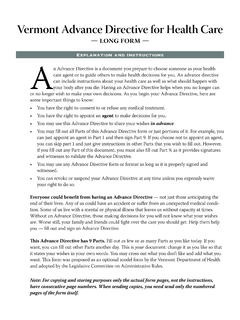
3 Elizabeth Cote, Director, uvm College of Medicine , Office of Primary care and ahec ProgramUnderstanding advance Directives and Do-Not-Resuscitate OrdersBy Robert Macauley, MD and Cindy Bruzzese, MPAFor nearly 25 years, the Vermont Ethics network (VEN) has been working to engage, educate and empower individuals, health care providers and policy-makers about ethical issues, values and choices in health and health care . Our efforts throughout Vermont have focused on building an extensive foundation of relationships and resources to support the integration of Vermonters values with the health care options available to them. One of VEN s first projects was the development of Taking Steps, a practical guide to making decisions about end-of-life care which includes the advance directive form most commonly used in Vermont . We have revised the guide and forms several times over the years to keep up with legislative developments, incorporating suggestions and feedback from patients and physicians.
4 The Neighbor to Neighbor project in the mid-1990s, the Journey s End project in the late 1990s, and the health care Values Study Circles in 2001 and 2002 saw VEN engaging Vermonters statewide in dialogue about their needs and values in health care . In more recent years, VEN has been a key player in creating and promoting the Vermont advance Directives Registry, an online database providing health care professionals with secure and immediate access to care choices when that information is most critically needed. From the landmark case of Karen Ann Quinlan in 1975, to the case of Nancy Cruzan in 1990, and most recently the well-publicized case of Terri Schiavo in 2005, we have learned the value and importance of advance care planning. All three of these cases painfully illustrated the difficulties that can arise when tragedy strikes and Medicine , ethics, law and family are unable to work together to meet the needs of patients who are unable to speak for themselves.
5 As a result, there has been a great deal of emphasis on advance Directives in recent years, and justifiably so. An advance directive (AD) is written by a patient and communicates his or her wishes about specific medical treatments, or who should make decisions if the patient can no longer do so. ADs help guide thoughtful decisions, but given their often ambiguous wording what is a reasonable prospect of recovery, and what are heroic measures ? they aren t very practical in emergency situations. That s why modern Medicine functions on the principle that patients receive maximal treatment, unless a physician authorizes some limitation. Yet, while most (though not all) physicians and nurses believe that an AD should be followed, barely half of ICU physicians in a recent survey actively inquired as to whether a patient had completed an AD, or even read it if the patient had. (DM Westphal and SA McKee, End-of-Life Decision Making in the Intensive care Unit: Physician and Nurse continued on page 2 Primarily Vermont2 Perspectives, American Journal of Medical Quality 2009; 24; 222.)
6 VEN s work in educating Vermonters about advance care planning, and removing obstacles to access of their advance Directives through the Vermont advance directive Registry, is critical in making sure that patients values are honored and their wishes are the course of our efforts to build bridges between patients and health care professionals, VEN has become increasingly aware that there continues to be confusion about an advance directive and a Do-Not-Resuscitate (DNR) Order. What many patients and physicians don t realize is that there is a huge difference between these two: all medical personnel must honor a DNR order, but some (paramedics, for example) don t have the time or authority to interpret an AD. Patients may feel that their advance care planning is done once they ve completed an AD, but if they re sure that they would not want a specific procedure (like CPR), they need to take one more step: talk to their doctor, who can complete a DNR order.
7 Vermont s version of a DNR order is the COLST form which stands for Clinician Orders for Life Sustaining Treatment and can be found on the VEN website. This form not only addresses CPR, but also intubation, antibiotics, feeding tubes, and hospital transfer. Unlike an advance directive , the COLST form is specific and unambiguous: either CPR should be performed, or it should not. Perhaps most importantly, all medical personnel are legally obligated to respect a COLST of the challenges of the COLST form is that it is one of the best kept secrets in Vermont . Many physicians even those involved in end-of-life care aren t aware of its existence, and instead rely on the older, more general DNR Order forms. VEN is taking on the critical task of increasing awareness of the COLST form among both patients and health care professionals, as part of our ongoing mission to empower patients with knowledge and control over their health care decisions.
8 For more information about the Vermont Ethics network and to obtain copies of our Taking Steps booklet, the Vermont advance directive for health care Form and/or the COLST form, visit our website at , or call us at (802)828-2909. Primarily Vermont is Published by The University of Vermont College of Medicine Office of Primary care , sponsor of the Vermont ahec Program ( ). Editor: Elizabeth Cote, Director, uvm College of Medicine Office of Primary care and ahec Program, uhc Campus, Arnold 5, 1 South Prospect Street, Burlington, vt 05401, (802)656-2179, Associate Editor: Laurie Loveland, 2011 The University of Vermont . All rights reserved. Reproduction prohibited without Remembrance of Houghton FreemanB y M i l d r e d A . R e a r d o n , M D , M A C P, P r o g r a m D i r e c t o r o f t h e F r e e m a n M e d i c a l S c h o l a r s P r o g r a m , UVM College of MedicineHoughton FreemanWe are saddened by the recent death of Houghton Freeman, our friend and benefactor.
9 Mr. Freeman was born in Peking, China, in 1921, the son of Professor Mansfield Freeman and his wife, Mary Houghton. He was a graduate of the Shanghai American School and of Wesleyan University in Middletown, CT. He became President of American International Underwriters Corporation of Japan in 1956. In 1983, he was elected President and Chief Operating Officer of American International Group (AIG) in New York City. Upon his retirement in 1993, he remained an honorary director of AIG. Houghton Freeman started the Freeman Foundation in memory of his father who was a distinguished scholar of Chinese philosophy. The Foundation is dedicated to strengthening the bonds of understanding between the United States and the nations of East Asia. It has assisted in the fields of education, international relief, the environment and land conservation. Mr. Freeman served as Chairman of the Freeman Foundation which he directed with his wife, Doreen, and son Graeme until Houghton s death in December, 2010 in Stowe, Vermont .
10 The Freeman family has deep roots in Vermont and the Foundation has been incredibly generous in assisting many projects in Vermont focusing primarily on education and conservation. With assistance from the Freeman Foundation, the College of Medicine established the Freeman Medical Scholars Program which has resulted in a significant increase in physicians serving Vermonters, now and for years to come because of the Freeman Medical Scholarships, the Freeman Educational Loan Repayment Program and the Freeman Foundation Legacy Medical Scholarship Program. The University of Vermont has also benefited from the Freeman Foundation support of its Freeman Nurse Scholars Program and its Asian studies program. I have been so deeply impressed by his and Doreen s manner of being. Although financially very resourceful, Mr. Freeman was so extremely down to earth and, to his last days, concentrating on his work and doing it well.