Transcription of Atlas 8620H Case Hardening Steel Bar 8620H
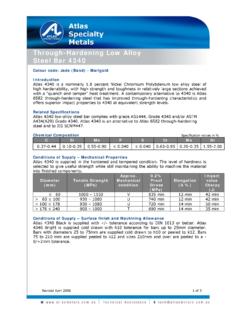
1 Revised April 2006 1 of 3 case Hardening Steel Bar 8620H Colour code: Red (Band) - White Introduction Atlas 8620H is a low Nickel Chromium Molybdenum case Hardening Steel of medium hardenability used principally for relatively lightly stressed components. Atlas 8620H can be carburised and subsequently hardened by a quenching and tempering operation. The H designation of 8620H indicates guaranteed hardenability according to the hardenability diagram on the following page. Related Specifications Atlas 8620H complies with AS1444 Grade 8620H and/or ASTM A29 Grade 8620. Alternatively Atlas 8620H can be supplied as Euronorm grade 20 NiCrMo2-2+HH (Material Number under EN 10084). Chemical Composition Specification values in % Grade C Si Mn P S Cr Ni Mo 8620H Conditions of Supply Normally supplied in the annealed condition with hardness max 212 HB, with typical hardness being in the range 170-200 HB.
2 Bars are cold finished (peeled) and supplied to k12 tolerance for all bar diameters. All bars are ultrasonically inspected (according to AS1065 level 2 for material procured by Atlas as of ) Heat Treatments Treatment Temperature Range ( C) Cooling Carburising 880 - 960 Oil (water), hot quench 160-250 C, Salt bath 580-650 C, case Hardening box, Air* Intermediate annealing 630 - 650 Air, Furnace Core Hardening 860 900 Oil (water), hot quench 160-250 C* case Hardening 780 820 Oil (water), hot quench 160-250 C* Tempering 150 - 200 Air * the choice of cooling medium depends on the desired final properties and geometry of the section to be case hardened and the effect of the cooling medium, given the hardenability of the Steel . Atlas 8620H Revised April 2006 2 of 3 Atlas Specialty Metals case Hardening Steel Bar 8620H After final machining, heat in carburising atmosphere (blank carburise) to 880 to 960 C and hold for sufficient time at temperature to produce the required case depth.
3 The time at temperature during the blank carburising process determines the depth of case achieved. After completion of blank carburisation treatment, re-heat to 860-900 C, hold until uniform and then quench in oil as rapidly as practical. A refining treatment is necessary to improve the structure of the case and its hardness. Heat slowly to 780-820 C, hold until uniform and then quench in oil. Single quench treatment may also be possible where components are quenched directly from 820 to 840 C. Minimum tempering time is 1 hour, but a tempering period of 1 hour per 25mm of section is recommended. If the Steel is to be direct hardened, in general, a carburising temperature of 950 C should not be exceeded. After case Hardening a typical case hardness of 61 HRC can be achieved. Mechanical Properties after case Hardening The following table shows the typical mechanical properties achievable in the core of a test section after carburizing, Hardening and tempering.
4 Diameter (mm) Yield Strength (MPa) Tensile Strength (MPa) Elongation (A%) Impact Value DVM (J) 11 785 min 980 1270 9 min 41 min 30 590 min 780 1080 10 min 41 min 63 490 min 690 930 11 min -- Hardenability Diagram Hardness limits for Jominy test EN 10084 specification for 20 NiCrMo2-2+HH ( ) 15 20 25 30 35 40 45 50 0 3 5 7 9 11 13 15 20 25303540 distance from quenched end (mm)Rockwell hardness (HRC) maxminHardness limits for Jominy testAS 1444 requirement for 8620H15202530354045500 3579 11 13 15 20 25 30 35 40distance from quenched end (mm)Rockwell hardness (HRC)maxmin Revised April 2006 3 of 3 Atlas Specialty Metals case Hardening Steel Bar 8620H Welding Pre-heat welding area to 250-450 C and maintain this temperature while welding with a low hydrogen electrode.
5 Cool at a maximum rate of 100 C per hour. Weld before carburising. Applications Small diameter gear parts exposed to low-medium stress. Typical components include gears, planet wheels, drive pinions, shafts. Disclaimer Whilst every effort has been made to ensure accuracy of the information in this Datasheet, Atlas Specialty Metals accepts no liability for damages arising from its use.