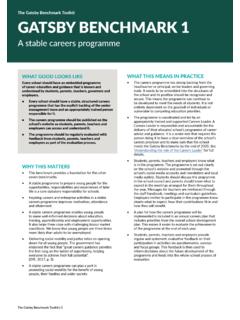
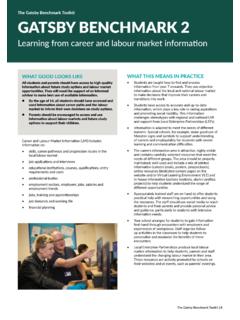
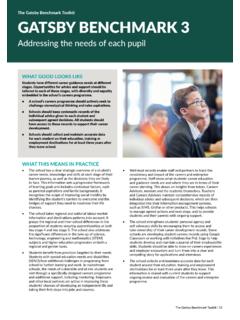
Transcription of The Gatsby Benchmark Toolkit GATSBY …
1 The GATSBY Benchmark Toolkit | 16 The GATSBY Benchmark ToolkitGATSBY Benchmark 4 Linking curriculum learning to careersWHAT GOO D LOOKS LIKEAll teachers link curriculum learning with careers. Science, technology, engineering and mathematics (STEM) subject teachers highlight the relevance of STEM subjects for a wide range of future career paths. By the age of 14, every student has had the opportunity to learn how the different STEM subjects help people to gain entry to a wide range of careers. All subject teachers emphasise the importance of succeeding in English and maths. WHAT THIS MEANS IN PRACTICE The school adopts a strategic approach to linking curriculum learning to careers and develops a coherent rationale for embedding careers in subject learning. This is not about making a subject more popular. It is about making subjects more relatable and relevant to everyday and working life. Real-life contexts and examples from the world of work can make subjects easier to understand and help students feel more engaged in their learning.
2 Above all, linking curriculum learning to careers can boost achievement and help students to progress. Students are less likely to drop out if they know about opportunities for further study and how the subject can be combined with others to give access to different pathways. Each department or faculty produces schemes of work and lesson plans which show how career-relevant learning will be embedded in their teaching. They use a variety of approaches, with some schemes of work setting up dedicated careers-related units or modules at the beginning or end of courses. They devise lessons that include career-related learning, inserts, activities and a plenary. Their planning also makes clear how career-related subject learning will be assessed and, where appropriate, accredited. Teachers are confident at talking about careers related to their subject matter and understand the routes, pathways and the skills in demand from employers, this might include CPD for subject teachers and the opportunity to visit relevant industries.
3 Subject teachers will understand the school process to access potential employers or alumni and regularly look to increase contact and develop relationships with key local and national employers. Creating industry-focused work streams for students is another way of emulating industry within the curriculum. Solving or addressing a real-life problem or project can develop a whole range of employability skills such as communication and team working. Students involved in previous years can become mentors to new cohorts of students and develop their skills even further. These projects can bring numerous subjects, including maths, English and science, to life. They illustrate how each subject helps prepare the students for working life. The school recognises that the reach of subject teaching is far greater than what can be achieved through a limited amount of careers education sessions. These distinct careers education sessions can be used to pull together and complement everything learned in subjects, encounters with employers and experiences of workplaces to help students understand the skills and knowledge they are developing and the impact this has on their futures.
4 The three main ways of delivering careers in the curriculum are: Providing career learning as a subject in its own right: in this approach careers content is delivered as a discrete curriculum, careers education or as part of PSHE. Incorporating career learning within other subjects: In this approach careers content is delivered through subjects, personal financial planning skills taught in maths, self-presentation skills taught in English. Ideally this approach both provides career learning and enhances the subject learning by showing how a mathematical technique is used in the real world and bring employers into the classroom. Organising career learning through co-curriculum activities ( enrichment activities strongly connected to the formal curriculum: In this approach careers content is delivered through informal and voluntary learning activities which have a strong connection to the curriculum STEM clubs to build on student s interest in science, technology, engineering and maths.)
5 STEM subjects science, technology, engineering and maths have received the most support in this area. We can learn a lot from the initiatives to promote careers in STEM through career-relevant subject teaching. The health of our economy depends on the skills and experience and knowledge that our young people develop whilst in education to ensure they can meet the minimum expectations of employers and successfully transition into work. All subject teachers should emphasise the importance of succeeding in English and maths. Science subject teachers should highlight the relevance of science for a wide range of future career paths. For this reason, linking curriculum learning to careers is relevant to the work of all GATSBY Benchmark Toolkit | 17 The GATSBY Benchmark ToolkitGATSBY Benchmark 4 Linking curriculum learning to careersWHY THIS MATTERS Subject teachers are highly influential students are 18 times more likely to be motivated to learn if their teachers know their hopes and dreams.
6 Students feel more engaged in their learning when they perceive the relevance of what they are studying to their own and other people s lives. Students are given the opportunity to develop their career thinking and to acquire important career management and employability skills. Students become more aspirational, understanding that perceived barriers can be overcome and that there are numerous pathways to TIPS FOR SCHOOLS1. The GATSBY report acknowledges that this Benchmark is aspirational. Identify the subject areas or teachers that can pilot this work and use their success to bring other teachers and curriculum subjects on board. 2. Refer to our report, Careers in the curriculum, what works? , for guidance on the range of interventions which allow students to encounter career learning as part of their everyday school curriculum. 3. Schools often report initial inertia from teachers in linking curriculum learning to careers because of their existing priorities and workloads.
7 However, once they get going, they quickly become creative, resourceful and energetic. 4. Take up the offer of Enterprise Advisers and Enterprise Coordinators who are keen to work with you in linking curriculum learning to careers. 5. Consult with your Enterprise Coordinator to find inspiration in various case studies and resources highlighting good practice, such as those from the GATSBY or Forum Talent Potential websites. 6. Encourage teachers who have moved into teaching from other jobs to make their previous experience and expertise available to students, try to build a positive culture of applied learning. 7. Identify curriculum hotspots by scanning national curriculum subject specifications and spotting opportunities to develop careers-related content. 8. Avoid overloading career-relevant lessons with too many learning objectives and be aware of the danger of choosing contexts that over-complicate subject learning.
8 9. Take advantage of any collaborative arrangements, such as the school s membership with a consortium or multi-academy trust, to develop careers in the curriculum approaches jointly. We will be bringing out more resources to support linking careers to curriculum learning in due course. TOP TIPS FOR EMPLOYERS1. Meet with heads of curriculum that relate to your industry and network to understand how you might help to bring their specific modules to life. Visit the education, training and skills section of to find out what you need to know about the curriculum. Sign up for email alerts to stay well- informed. 2. Ask your Enterprise Coordinator for relevant reports or resources to provide examples of best practice. 3. Take up invitations to participate in activities and events at options time. Students and their parents are particularly receptive to messages about careers around this time. Students choose subjects they will study up to age 16 in year 8 or 9 early in the spring term.
9 Post-16 options are chosen towards the end of the summer term in year 10 and the first part of the autumn term in year 11. The key period for post-18 options is the second half of the summer term in year 12 and the autumn term in year 13. 4. Work with subject teachers to develop problem-based challenges. These will show how the perspectives, methods and skills developed through subjects are used in working life to solve real problems. 5. Volunteer as a presenter, adviser or judge to help the school or college run curriculum enrichment activities, such as STEM clubs, Young Enterprise, Dragons Den and Apprentice of the Year competitions. 6. Actively look for colleagues and individuals in your network that would be relatable role models and inspiring speakers to students and teachers within your school7. Get in touch with your professional body to find out what resources they have developed to support careers in the curriculum.
10 The GATSBY Benchmark Toolkit | 18 The GATSBY Benchmark ToolkitGATSBY Benchmark 4 Linking curriculum learning to careersEXAMPLES OF SCHOOLS LINKING CURRICULUM LEARNING TO CAREERSE xample 1 Tomorrow s Engineers is a programme that promotes the vital role of engineers and engineering to society through coordinated schools outreach and careers inspiration activities. Led by EngineeringUK and the engineering community. Tomorrow s Engineers have designed careers resources for students between 11 and 14 that support the national curriculum, cover regional variations and promote the range of routes into engineering. A school in Suffolk is working on a STEM-related project, which gives students hands-on experience in the real world as part of the curriculum. The impact on girls is especially notable, with 45% reporting they know a lot about engineering, compared to 16% in the UK overall. Example 2 Year 11 students at an 11-16 school in the east of England take part in mock job interviews for their GCSE English speaking and listening assessment.