Transcription of DURALAC JOINTING COMPOUND - Llewellyn Ryland
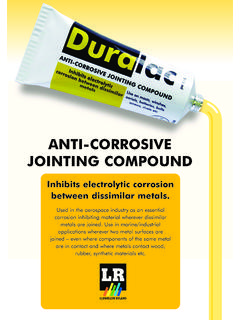
1 1. IDENTIFICATION OF THE SUBSTANCE / PREPARATION AND OF THE COMPANY PRODUCT NAME: DURALAC JOINTING COMPOUND MANUFACTURER / SUPPLIER: Llewellyn Ryland Ltd. ADDRESS: Haden Street, Birmingham B12 9DB, United Kingdom. TELEPHONE : +44 (0) 121 440 2284 FAX: +44 (0) 121 440 0281 (BUSINESS & EMERGENCY) E-MAIL: INTENDED USE: As an anti-corrosive JOINTING COMPOUND for use between joints of dissimilar metals. 2. COMPOSITION / INFORMATION ON INGREDIENTS HAZARDOUS INGREDIENTS CAS NO. CLASSIFICATION % Barium chromate 10294-40-3 Xn (R20/22) 20 - 30 White spirit 64742-82-1 Xn, N (R10, R65, R52/53) 15 - 25 3. HAZARDS IDENTIFICATION Flammable Harmful by inhalation and if swallowed 4.
2 FIRST AID MEASURES INHALATION: In extreme cases, move the exposed person to fresh air. Keep warm and at rest and obtain medical attention. INGESTION: DO NOT INDUCE VOMITING. Give milk or water (not if person is unconscious) and obtain prompt medical attention. SKIN: Promptly wash affected area with soap and water. Remove contaminated clothing and wash before re-use. EYES: Hold eyes open for at least 15 minutes under running water and obtain medical attention. DURALAC JOINTING COMPOUND PAGE 2 OF 4 5. FIRE-FIGHTING MEASURES SUITABLE EXTINGUISHING MEDIA: Dry chemical, CO2, foam, sand and water spray. NOT TO BE USED: Water jet. SPECIAL FIRE-FIGHTING PROCEDURES: Material is flammable and may explode in a fire. Cool containers exposed to flames from the side with water until well after the fire has been extinguished. Do not allow run-off from fire-fighting to enter drains or water courses. SPECIAL PROTECTIVE EQUIPMENT: Suitable breathing apparatus may be required.
3 HAZARDOUS COMBUSTION PRODUCTS: Oxides of carbon and partially oxidised organic fragments of the product s main components may be produced. 6. ACCIDENTAL RELEASE MEASURES PERSONAL PRECAUTIONS: Remove all sources of ignition. Wear suitable protective clothing and avoid inhaling vapours. Provide adequate ventilation and evacuate non-essential personnel. ENVIRONMENTAL PRECAUTIONS: Confine spill. Do not allow product to enter sewers, rivers or open water. CLEAN-UP METHODS: Contain and absorb with inert material and shovel to disposal. The absorbed waste will contain solvent residues and will be flammable. Store in a well-ventilated area. Inform authorities if large amounts are involved. 7. HANDLING AND STORAGE HANDLING PRECAUTIONS: Use with care and avoid spillage. Do not eat, drink or smoke. Avoid eye and skin contact and the inhalation of vapours. STORAGE PRECAUTIONS: Store in a cool, dry, well-ventilated area.
4 Keep in tightly-closed, clearly-labelled containers. Isolate from sources of heat and ignition. 8. EXPOSURE CONTROLS AND PERSONAL PROTECTION OCCUPATIONAL EXPOSURE LIMITS: White spirit; occupational exposure limit: 550 mg/m3 (long term exposure, 8 hours) (Calculated in EH40 by reciprocal calculation from OES values of white spirit constituents) INHALATION: Local exhaust ventilation is recommended and suitable respiratory protection may be required for the use of large quantities of this SKIN: Chemically-resistant gloves should be worn when handling this material. Skin contact should be avoided. EYES: Eye or face protection is recommended where a risk of splashing exists. INDUSTRIAL HYGIENE: High standards of industrial hygiene are required for the use of this material. 9. PHYSICAL AND CHEMICAL PROPERTIES PHYSICAL FORM: Liquid COLOUR: Yellow ODOUR: Organic solvent SPECIFIC GRAVITY: - g/cm3 (@ 25 oC) POUR POINT: <0 oC BOILING POINT: >150 oC (white spirit) pH: Not applicable MISCIBILITY WITH WATER: Immiscible VAPOUR PRESSURE: Not determined VAPOUR DENSITY: > air AUTO-IGNITION TEMPERATURE: 232oC (white spirit) EXPLOSIVE PROPERTIES: lower vol% (white spirit) upper vol% FLASH POINT: Approximately 40oC (closed cup method) DURALAC JOINTING COMPOUND PAGE 3 OF 4 10.
5 STABILITY AND REACTIVITY CHEMICAL STABILITY: Stable under recommended handling and storage conditions. CONDITIONS TO AVOID: Sources of heat and ignition. MATERIALS TO AVOID: Oxidising agents, strong acids and strong alkalis. HAZARDOUS DECOMPOSITION PRODUCTS: Carbon dioxide, carbon monoxide, oxides of nitrogen and smoke may be produced if material is exposed to high temperatures. 11. TOXICOLOGICAL INFORMATION The following toxicological assessment is based on a knowledge of the toxicity of the product s components INHALATION: High concentrations of vapour are irritating to the respiratory tract and the eyes and may cause headaches, dizziness, anaesthesia and other CNS effects. INGESTION: Ingestion of large quantities of this material may cause nausea and sickness. Small amounts of liquid aspirated during ingestion or vomiting may cause lung damage. SKIN: Frequent or prolonged exposure may cause skin irritation and may lead to dermatitis.
6 EYES: May cause irritation to the eyes. CHRONIC EFFECTS: Repeated or prolonged exposure to vapours may lead to chronic upper respiratory irritation. 12. ECOLOGICAL INFORMATION MOBILITY: Mobile liquid. Contains volatile components. Insoluble in water. PERSISTENCE AND DEGRADABILITY: Slightly biodegradable. BIOACCUMULATIVE POTENTIAL: Not determined. ECOTOXICITY: Certain components within the product are designated as being harmful to aquatic organisms. Spills may form a film on water surfaces which may impair oxygen transfer and cause physical damage to organisms. Designated as a marine pollutant. 13. DISPOSAL CONSIDERATIONS Disposal must be in accordance with local and national legislation PRODUCT: Material should be removed by approved waste contractors. EMPTY PACKAGING: Empty packages may contain flammable and harmful residues and should be disposed of in a manner acceptable to local authorities. 14. TRANSPORT INFORMATION CLASSIFICATION FOR TRANSPORT: FLAMMABLE LIQUID.
7 PROPER SHIPPING NAME: PAINT-RELATED MATERIAL. UN NO: 1263 PACKING GROUP: III ROAD / RAIL (ADR / RID) CLASS: 3, 31o (c) AIR (ICAO / IATA) CLASS: 3 SEA (IMO / IMDG) CLASS: MARINE POLLUTANT: Yes 15. REGULATORY INFORMATION CLASSIFICATION FOR SUPPLY: HARMFUL. RISK PHRASES: R10 Flammable. R20/22 Harmful by inhalation and if swallowed. SAFETY PHRASES: S43 In case of fire use dry chemical, CO2, foam, sand or water spray (not water jet). S51 Use only in well-ventilated areas STATUTORY INSTRUMENTS: Health & Safety at Work etc. Act 1974. Chemicals (Hazards, Information & Packaging) Regulations (As amended) 1999. Control of Substances Hazardous to Health Regulations 1999. Environmental Protection Act 1990. 16. OTHER INFORMATION SDS REF: DURALAC ISSUE NO: 3 (Feb 2004) REPLACES ISSUE: Dated Nov 2000 ISSUED IN ACCORDANCE WITH EU DIRECTIVE 91/155/EEC, as amended by 2001/58/EC. Note: Where this product is used in applications other than those specified by Llewellyn Ryland Ltd.
8 , no responsibility can be accepted for loss or damage incurred. The following references (available from the HSE) provide further information on specific aspects: HS(G) 51 Storage of flammable liquids in containers. HS(G) 140 The safe use and handling of flammable liquids. L5 General COSHH approved code of practice. EH 40 Occupational exposure limits. Disposal must be in accordance with local and national legislation PRODUCT: Material should be removed by approved waste contractors. DURALAC JOINTING COMPOUND PAGE 4 OF 4