Transcription of GROUP 4 HERBICIDE Shredder™ 2,4-D LV4 - CDMS …
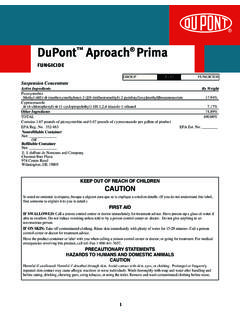
1 Page 1 of 12 Shredder 2,4-D LV4 ACTIVE INGREDIENT: 2-ethylhexyl ester of 2,4-dichlorophenoxyacetic acid* .. OTHER INGREDIENTS:** .. *Isomer Specific by AOAC Method No. (13th edition) 1980 * 2,4-Dichlorophenoxyacetic acid equivalent **Contains petroleum distillates. Contains lbs. of 2,4-Dichlorophenoxyacetic acid per gallon. KEEP OUT OF REACH OF CHILDREN CAUTION PRECAUTIONARY STATEMENTS HAZARDS TO HUMANS AND DOMESTIC ANIMALS CAUTION Harmful if swallowed. Causes moderate eye irritation. Harmful if absorbed through skin. Avoid contact with eyes, skin, or clothing. Prolonged or frequently repeated skin contact may cause allergic reaction in some individuals.
2 FIRST AID IF SWALLOWED: Call a poison control center or doctor immediately for treatment advice. Do not give ANY liquid to the person. Do not induce vomiting unless told to by a poison control center or doctor. Do not give anything by mouth to an unconscious person. IF IN EYES: Hold eyelids open and rinse slowly and gently with water for 15-20 minutes. Remove contact lenses, if present, after the first 5 minutes; then continue rinsing. Call a poison control center or doctor for treatment advice. IF ON SKIN: Take off contaminated clothing. Rinse skin immediately with plenty of water for 15-20 minutes. Call a poison control center or doctor for treatment advice. IF INHALED: Move person to fresh air.
3 If person is not breathing, call 911 or an ambulance, then give artificial respiration, preferably mouth-to-mouth if possible. Call a poison control center or doctor for further treatment advice. NOTE TO PHYSICIAN: Contains petroleum distillate vomiting may cause aspiration hazard. Have the product container or label with you when calling a poison control center or doctor or going for treatment. For additional information in case of medical emergency call toll free 1-877-424-7452. Personal Protective Equipment: All mixers, loaders, applicators, flaggers, and other handlers must wear: - Long-sleeved shirt and long pants. - Chemical-resistant gloves made of neoprene, nitrile rubber, barrier laminate, or viton when applying with any handheld nozzle or equipment, mixing or loading, cleaning up spills or equipment, or otherwise exposed to the concentrate.
4 - Chemical-resistant apron when mixing or loading, cleaning up spills or equipment, or otherwise exposes to the concentrate. - Shoes plus socks. See engineering controls for additional requirements. Follow manufacturer's instructions for cleaning or maintaining PPE. If no such instructions for washables exist, use detergent and hot water. Keep and wash PPE separately from other laundry. EPA Reg. No. 1381-102 EPA Est. No. 70989-IA-1 Distributed by: Winfield Solutions, LLC NET CONTENTS 2-1/2 GALLONS Box 64589, St. Paul, MN 55164-0089 1/0622/5 Engineering controls statement: (STATEMENT TO BE ADDED WHEN CONTAINER SIZE IS 5 GALLONS OR MORE) GROUP 4 HERBICIDE Page 2 of 12 Do not pour product from this container.
5 A mechanical system (pump and probe or spigot) must be used in transferring the contents of this container. If the contents of a non-refillable pesticide container are emptied, the probe must be rinsed before removal. If the mechanical system is used in a manner that meets the requirements listed in the Worker Protection Standard (WPS) for agricultural pesticides [40 CFR (d) (4-6)], the handler PPE requirements may be reduced or modified as specified in the WPS. Pilots must use an enclosed cockpit that meets the requirements listed in the Worker Protection Standard (WPS) for agricultural pesticides [40 CFR (d) (6)]. When handlers use closed systems, enclosed cabs, or aircraft, in a manner that meets the requirements listed in the Worker Protection Standard (WPS) for agricultural pesticides [40 CFR (d) (4-6)], the handler PPE requirements may be reduced or modified as specified in the WPS.
6 USER SAFETY RECOMMENDATIONS Users should: - Wash hands before eating, drinking, chewing gum, using tobacco, or using the toilet. - Remove clothing/PPE immediately if pesticide gets inside. Then wash thoroughly and put on clean clothing. - Remove PPE immediately after handling this product. Wash the outside of gloves before removing. As soon as possible, wash thoroughly and change into clean clothing. ENVIRONMENTAL HAZARDS This product may be toxic to fish and aquatic invertebrates. Do not apply directly to water, to areas where surface water is present, or to intertidal areas below mean high water mark. Drift and runoff may be hazardous to aquatic invertebrates in water adjacent to treated areas.
7 Drift or runoff may adversely affect non-target plants. Do not contaminate water when disposing of equipment washwaters or rinsate. This chemical has properties and characteristics associated with chemicals detected in groundwater. The use of this chemical in areas where soils are permeable, particularly where the water table is shallow, may result in groundwater contamination. Application around a cistern or well may result in contamination of drinking water or groundwater. Most cases of groundwater contamination involving phenoxy herbicides such as 2,4-D have been associated with mixing/loading and disposal sites. Caution should be exercised when handling 2,4-D pesticides at such sites to prevent contamination of groundwater supplies.
8 Use of closed systems for mixing and transferring this pesticide will reduce the probability of spills. Placement of the mixing/loading equipment on an impervious pad to contain spills will help prevent groundwater contamination. Use care to avoid spray contact or drift to susceptible plants such as beans and other legumes, cotton, flowers, grapes, ornamentals, vegetables, and other plants. Do not permit spray mist containing this product to drift onto them, since even very small quantities of the spray, which may not be visible, can cause severe injury during both growing and dormant periods. PHYSICAL CHEMICAL HAZARDS Do not mix or allow coming into contact with oxidizing agents.
9 Chemical reaction may occur. DIRECTIONS FOR USE It is a violation of Federal Law to use this product in a manner inconsistent with its labeling. Do not apply this product in a way that will contact workers or other persons, either directly or through drift. Only protected handlers may be in the area during application. For any requirements specific to your State or Tribe, consult the agency responsible for pesticide application. AGRICULTURAL USE REQUIREMENTS Use this product only in accordance with its labeling and with the Worker Protection Standard, 40 CFR Part 170. This Standard contains requirements for the protection of agricultural workers on farms, forests, nurseries, and greenhouses and handlers of agricultural pesticides.
10 It contains requirements for training, decontamination, notification, and emergency assistance. It also contains specific instructions and exceptions pertaining to the statements on this label about personal protective equipment (PPE) and restricted-entry interval. The requirements of this box apply only to uses of this product that are covered by the Worker Protection Standard. Do not enter or allow worker entry into treated areas during the restricted-entry interval (REI) of 12 hours. PPE required for early entry to treated areas this is permitted under the Worker Protection Standard and that involves contact with anything that has been treated, such as plants, soil, or water is: - Coveralls.