Transcription of Coordinate Geometry for Transformations – Free Worksheet!
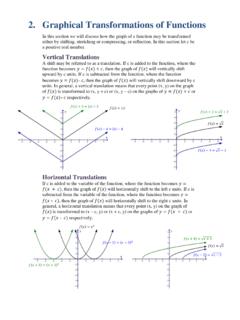
1 1 Coordinate Geometry for Transformations free Worksheet! (As promised on p. 117 of Girls Get Curves) Remember the good ol Coordinate plane? Plotting points and lines, and all that good stuff? I know how dearly you ve missed it. Well, it s easy to do precise Transformations when we do them on the Coordinate plane, because we know exactly where everyone is, and where they re going! Let s say we wanted to slide the below triangle !CATto the right 8 units and down 2 units. Then every point of the shape would need to make that move,1 right? If the three vertex points of !CATare C( 3, 7), A( 5, 4) and T( 3, 4), we just add 8 to each x-value that ll move the points to the right 8 spots on the grid and subtract 2 from each y-value that ll move em all down 2 spots on the grid. 1 All we have to do is move all vertex points of our shapes, and then connect the lines.
2 2 Ta-da! Successfully translated. In other words, we ve taken each vertex (x, y), and changed it like this: (x + 8, y 2). Make sense? When we do the translation correctly, the shape should be congruent to the original shape it ll just be in a different spot! There are lots of ways to do congruence Transformations on the Coordinate plane, but there are a few particularly popular ones, and it s nice to be familiar with them. Here they are: 3 SHORTCUT ALERT Use these shortcuts to make Transformations on the grid a snap! Translation: Each point moves a units in the x- direction and b units in the y- direction: (x, y) (x + a, y + b)2 Reflection across the x-axis: Each x-value stays the same, and each y-value becomes the opposite of what it was: (x, y) (x, y) Reflection across the y-axis: Each y-value stays the same, and each x-value becomes the opposite of what it was: (x, y) ( x, y) Reflection across the line y = x: The x- and y-values switch spots!
3 (x, y) (y, x) Rotation about the origin: Each x- and y-value becomes the opposite of what it was: (x, y) ( x, y) This stuff makes more sense when see it in 2 Remember, a and b could be negative, and adding a negative is the same as subtraction. To review this really important concept, check out chapter 1 in Hot X: Algebra Exposed, especially pp. 6-8. 4 Siamese Triplets?! Let s try some of this Coordinate transformation stuff for ourselves. This cat face (not counting the eyes and nose) vertex points are ( 5, 1), ( 5, 5), ( 4, 4), ( 2, 4), ( 1, 5), ( 1, 1). We ll do two different Transformations on this shape, resulting in three identical (congruent) kitties. We ll do a reflection (flip) and a translation (glide)!3 Reflection across x-axis: (x, y) (x, y) The x-values all stay the same; the y-values (the heights) all become the negative of what they were: Old cat s cat s pts ( 5, 1) ( 5, 1) ( 5, 5) ( 5, 5) ( 4, 4) ( 4, 4) ( 2, 4) ( 2, 4) ( 1, 5) ( 1, 5) ( 1, 1) ( 1, 1) Translation down 2 units, and to the right 6 units: (x, y) (x + 6, y 2) Every point gets moved down and to the right: Old cat s cat s pts ( 5, 1) ( 5 + 6, 1 2) = (1, 1) ( 5, 5) ( 5 + 6, 5 2) = (1, 3) ( 4, 4) ( 4 + 6, 4 2) = (2, 2) ( 2, 4) ( 2 + 6, 4 2) = (4, 2) ( 1, 5) ( 1 + 6, 5 2) = (5, 3) ( 1, 1) ( 1 + 6, 1 2) = (5, 1) 3 Note: this is not a composition of Transformations .
4 We re just doing two different Transformations that happen to be on the same graph . 5 The columns above might remind you of something: functions. Remember our good ol sausage factories4? We take inputs, put em in the sausage factory (function), and we get ouputs. Here, instead of single numbers, the inputs are the points (both the x- and the y- values) from the original shape, and the outputs are the points (both the x- and the y- values) of the image. And instead of an equation for a line, the function is the transformation itself. Here are the new cat faces (with our new Coordinate points), graphed below: If the x-axis is the surface of a pond or a lake, then it looks to me like the kitty first saw herself in the water s reflection, and then decided to have a little sip! 4 To review functions (and sausage factories) check out chapter 17 in Kiss My math .
5 6 Oh hey, speaking of ponds and lakes, let s practice this stuff by moving a scalene triangle fish5 around on the grid, shall we? DOING THE math The scalene triangle fish to the right is defined by the three points (1, 2), (1, 3), and (4, 5). Perform Transformations on this shape based on the rules given. I ll do the first one for you. Part a: List the new coordinates . Part b: Draw the new graph (eyes and fins optional!), along with the original fish. Part c. Describe the transformation . 1. Transform: (x, y) (y, x) Working out the solution: We don t have to remember from the shortcuts which transformation this is; we can just apply this rule and see what the new coordinates will be and discover it! Looks like we re just supposed to the spots of x & y, and we get: (1, 2) (2, 1); (1, 3) (3, 1); (4, 5) (5, 4). Done with part a!
6 Next, let s plot these points (2, 1), (1, 3), and (5, 4) and see what we get. 5 Get it? Scalene, like scales on a fish? I know, I m sooo clever, right? 7 Hm, it doesn t look like a translation (glide), and we couldn t have gotten to the new fish s spot by putting our fish on a bicycle wheel, so it s not a rotation. The fish seems to be looking in the mirror! So it s a reflection. But which mirror? The mirror created by the line y = x! Answer: a. (2, 1), (1, 3), and (5, 4) b. (see graph above) c. It s a reflection across the line y = x. 2. Transform the fish: (x, y) (x + 3, y 6) 3. Transform the fish: (x, y) ( x, y) 4. Transform the fish: (x, y) (x, y) 5. Transform the fish: (x, y) ( x, y) 6. Transform the fish: (x, y) (y, x) 7. Transform the fish: (x, y) ( x, y + 2) 8 In the above exercises, #6 and #7 are examples of how we can put two Transformations together to make a whole new transformation a composition of Transformations just like we saw on p.
7 117 of Girls Get Curves. Answer Key and Solution Guide: 2. We start out with a fish whose coordinates are (1, 2), (1, 3), and (4, 5), right? And now we re supposed to find the new coordinates using this rule: (x, y) (x + 3, y 6), so we ll get: (x, y) (x + 3, y 6): (1, 2) (1 + 3, 2 6) = (4, 4) (1, 3) (1 + 3, 3 6) = (4, 3) (4, 5) (4 + 3, 5 6) = (7, 1) Now let s plot the points and draw our new fish! 9 Hm, how do we describe this transformation ? Well, it s still facing the same way as before it just glided over and down. Yep it s a translation! (We also could have noticed this from the Shortcut Alert on p. 2 of this worksheet.) Answer: Part a. (4, 4), (4, 3) and (7, 1) Part b. See above graph Part c. It s a translation 3. Okay, so we ll find the new coordinates using this rule: (x, y) ( x, y), so we get: (x, y) ( x, y): (1, 2) ( 1, 2) (1, 3) ( 1, 3) (4, 5) ( 4, 5) 10.
8 And we plot three new points to find out where our fish has gone How do we describe this transformation ? Well, notice that the y-axis is like a mirror, and the fish is being reflected in it. Yep! It s a reflection across the y-axis. (We also could have noticed this from the Shortcut Alert on p. 2 of this worksheet.) Part a. ( 1, 2), ( 1, 3), ( 4, 5) Part b. See above graph Part c. It s a reflection across the y-axis 4. We ll find this fish s new coordinates using this rule: (x, y) (x, y) and get: (x, y) (x, y) (1, 2) (1, 2) (1, 3) (1, 3) (4, 5) (4, 5) ..and now we ll plot three new points to find our new fish! 11 And how do we describe this transformation ? This time, the x-axis is like the mirror that the fish is being reflected in, so it s a reflection across the x-axis. (We also could have noticed this from the Shortcut Alert on p.)
9 2 of this worksheet.) Part a. (1, 2), (1, 3), (4, 5) Part b. See above graph Part c. it s a reflection across the x-axis 12 5. Let s find our fish s new coordinates using this rule: (x, y) ( x, y) and we get: (x, y) ( x, y) (1, 2) ( 1, 2) (1, 3) ( 1, 3) (4, 5) ( 4, 5) ..and now we ll plot three new points to find our new fish! How do we describe this transformation ? Imagine that the origin (0, 0) is the center of a bicycle wheel that we rotate 180 . Then you can see that our new fish is just the old fish, rotated about the origin so this transformation is a rotation about the origin. (We also could have noticed this from the Shortcut Alert on p. 2 of this worksheet.) 13 Part a. ( 1, 2), ( 1, 3), ( 4, 5) Part b. See above graph Part c. it s a rotation about the origin 6. Let s find our fish s new coordinates using this rule: (x, y) (y, x).
10 So first we switch the x and y spots, and then we make the second Coordinate negative, so we get: (x, y) (y, x) (1, 2) (2, 1) (1, 3) (3, 1) (4, 5) (5, 4) ..and now we ll plot three new points to find our new fish! 14 How do we describe this transformation ? Well there are a few ways this type of transformation isn t listed in the Shortcut Alert. One way to get from the original to the new fish, we could rotate it clockwise approx. 90 , and then glide it down and to the right. Or we could do the gliding down/right first, and then rotate it clockwise. Part a. (2, 1), (3, 1), (5, 4) Part b. See above graph Part c. glide then rotate, or rotate then glide 7. Let s find our fish s new coordinates using this rule: (x, y) ( x, y + 2) (x, y) ( x, y +2) (1, 2) ( 1, 2 + 2) ( 1, 4) (1, 3) ( 1, 3 + 2) ( 1, 5) (4, 5) ( 4, 5 + 2) ( 4, 7) And now we ll plot these points and see where the fish ends up this 15 How can we describe this transformation ?