Transcription of New ENGLISH FILE Elementary - oup.hu
1 2and theCommon European Frameworkof ReferenceNewENGLISH FILEE lementaryKaren LudlowIntroduction Oxford University Press1 INTRODUCTIONWhat is this booklet for?The aim of this booklet is to give a clear and simpleintroduction to the Common European Framework ofReference, and to show how it works withNew EnglishFile. This document is not a summary of the CommonEuropean Framework of Reference (CEF), which is anextremely comprehensive and detailed document of over250 pages. This introduction highlights points ofparticular interest, and if detailed information is required,teachers are advised to consult the original document. The main body of this document maps each Student sBook unit of New ENGLISH File Elementary ,Pre-Intermediate, and Intermediateand refers to thecompetences detailed in the do we need a Common EuropeanFramework?
2 The Council of Europe, an organization that includesnearly 50 European countries, began to develop theCommon European Framework in 1991. One of the mainpurposes of the Council of Europe is to promote a sharedEuropean identity, while recognizing the importance ofdifferent cultures. The promotion of language teachingand learning plays a central role in this mission. Peoplewithin Europe, and indeed throughout the world, need tobe able to understand each other. The Council of Europetherefore wishes to encourage people to learn languagesand develop their ability to communicate with peoplefrom other countries and cultures. What is the CEF? What are its aims?The CEF is a carefully developed descriptive has often closely linked educational and social aimsincluding: to encourage the development of language skills, sothat people can work together more effectively.
3 To encourage the development of inter-culturalawareness and plurilingualism . to examine and define what we can dowith a language. to help us compare the language levels of individuals inan accurate and impartial way, across differentcountries, educational systems, ages, and cultures. to encourage learner autonomy and lifelong learning. to promote a coherent approach to language teaching not by imposing a system of its own, but byencouraging the sharing of are the CEF levels?There are six global levels in the CEF what these levelsreflect is shown in the table on the following these levels are a very large number ofcompetences which make up a person s language ability these are defined by descriptors .The CEF says that teachers shouldn t feel that they have touse these levels in their teaching situations. They areintended to be common reference points.
4 It is alsoimportant to remember that these levels are purelydescriptive, and that they don t necessarily correspond to ayear of study, or to 100 hours of study, for has different aims and learns at different speeds,in different environments, and in different ways. The CEFis careful to point out that the levels are not linear thatis, the time needed to move from A1to A2may not be thesame as that needed to move from B1to B2, or C1to C2,and progress from level to level may slow down as aperson moves up the levels. The CEF recommends extreme caution in trying to calculate or predict howlong it will take to move from one CEF level to the do the CEF levels correspond to NewEnglish File?New ENGLISH File Elementaryis A1leading into to the Cambridge ESOL KET exam, whichwe d anticipate most students being able to takesuccessfully around one-third of the way through NewEnglish File Pre-Intermediate.
5 Stronger students could takeKET at the end ofNew ENGLISH File ENGLISH File Pre-Intermediatebriefly revises A2beforecovering approximately half of the competences requiredfor ENGLISH File Intermediate, covers the competencesrequired for B1, and introduces some of the competencesof B2. Students who have successfully completed NewEnglish File Intermediateare typically ready to sit theCambridge PET does the CEF say about teachingand learning?nTeaching Here are some of the things that the CEF says aboutteaching and the teacher s role: The CEF doesn t promote a particular languageteaching methodology. It suggests that the methodsteachers use should be appropriate to the teachingcontext and the social context. It recognizes thateffective teaching depends on lots of variables, and thatthere s a huge range of possible teaching methods andmaterials.
6 It recognizes that teachers have to think on their feetand be flexible and responsive to their students needs. It suggests that teachers need to understand why they redoing what they do, and help to define their learners objectives, and it acknowledges that experience isextremely valuable in helping them do this. It suggests that teachers should help students as muchas they can to develop both their language knowledgeand their ability to learn (in class and on their own).2 Introduction Oxford University PressThese points offer a reassuring indication that the CEFdoesn t set out to change teachers and the way they encourages a focus on communicative ability (the endresult) rather than knowing language , but it isn t a newmethodology or a new approach to teaching, and itdoesn t introduce new syllabus elements. It doesn t tellyou what to do but that s a good thing.
7 It allows for asmany different teaching styles as there have always been,and it s not trying to make everyone teach the same thingsin the same way. We think there are two key points forteachers: The CEF focuses on the end result of teaching if youkeep this end in mind too, and if you cover acomprehensive language syllabus and include activework on the four skills, then you don t need to makeradical changes to your teaching practices. You need not only to teach but also to help your studentsdevelop as autonomous learners partly to improvetheir current language learning skills, and partly tohelp them throughout their language learning real strength of the CEF for students is that it focuseson the positive on what they can do, not on what theycan t do. All levels of performance from A1upwards arevalued, and students should feel positive about thegrowing list of things that they know they can are some of the things the CEF says about learningand the learner s role: Language teaching needs to be learner-centred because it is ultimately the learner who has to do thelearning.
8 Learners need to take more responsibility for planningand carrying out their own learning. They sometimestend to be reactive (they do what the teacher tellsthem to do) but they need to be autonomous, and tostudy effectively on their own ..so they need to learn to learn and to be madeaware of the ways they can do statements stress that language learning isultimately in the hands of the learner, and that we need tohelp students not only by teaching them, but also byencouraging them to learn New ENGLISH File compatible with theCEF?Yes, definitely. The CEF focuses on using language in real,communicative contexts, and so does New ENGLISH CEF encourages the development of the ability to dothings in a foreign language, not just to know about thatlanguage, and this is an aim we all share thoughstudents also need to know about a language in order tofunction successfully in that language.
9 As the CEF says, .. a language learner has to acquire both form andmeaning . For example, an A1descriptor might be canunderstand simple directions . In order to do this,students need to know lexical items (left, right, straighton, first, second, third), grammatical elements such asimperatives (take the .., turn ..), fixed phrases (youcan t miss it), and probably be able to ask for ENGLISH Fileteaches the language and skills thatstudents will need in order to develop their range ofcommunicative are some examples of how New ENGLISH File fits withthe aims of the CEF: The Grammar,Vocabulary, and Pronunciationsyllabus gives students the linguistic competences theyneed to be able to communicate successfully. Regular receptive and productive workon the fourskills every lesson has speaking activities, and everyFile has listening, reading, and writing emphasiseswhat student s do with ENGLISH .
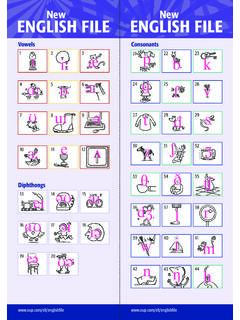
10 Clear lesson aimsare given for each lesson, so learnersknow what the lesson objectives are. The Practical Englishlessons are based on situations inwhich learners may find themselves these all focus onlanguage use for real, concrete purposes, and thedivision of language into You hear and You say helpsto develop both the receptive and productivecompetences of learners. The What can you do? pages at the end of every Fileask students to see what they can achieve with languagethey have studied a strong focus on the end result . The ENGLISH FilePronunciation pictureshelp studentsto work on pronunciation autonomously, and to usedictionaries more effectively. The Workbook,MultiROM, and student s websiteallgive students extra practice and learning resources. Workbook Studyideas give tips for using dictionariesand remembering new words (and theirpronunciation).