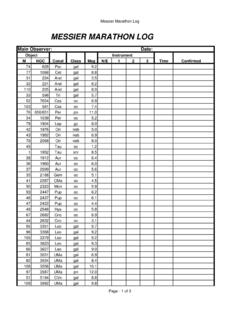
Transcription of IFAS Messier Observing Challenge - iasindy.org
1 IIRISHRISH F FEDERATIONEDERATION OFOF A ASTRONOMICALSTRONOMICAL S SOCIETIESOCIETIESTTHEHEMMESSIERESSIER O OBJECTSBJECTSOOBSERVINGBSERVING C CHALLENGEHALLENGEHHANDBOOKANDBOOK ANDAND L LOGBOOKOGBOOKI rish Federation Of Astronomical Societies IFAS TTHEHE O OBSERVINGBSERVING C CERTIFICATESERTIFICATES W WORKINGORKING G GROUPROUPW orking under the Irish Federation Of Astronomical SocietiesShane Culleton Irish Astronomical SocietySouth Dublin Astronomical SocietyJohn Flannery Irish Astronomical SocietySouth Dublin Astronomical SocietySeanie Morris Tullamore Astronomical SocietyRonan Newman Galway Astronomy ClubMichael O Connell Shannonside Astronomy ClubTullamore Astronomical SocietyAlbert White Irish Astronomical SocietySouth Dublin Astronomical SocietyOOBSERVINGBSERVING P PROGRAMMEROGRAMME R REGULATIONSEGULATIONS1)To take part in the Observation challenges Programme you must be a member of one of themember clubs or societies of the IFAS.
2 Check out the list of clubs and links to their websites at theIFAS webpage, , or on the following page of this )Observations must be made after the 18th September )You must either post or hand this Handbook to the Observations Secretary who will then verifyyour recordings. Your Handbook must be received at least 28 days before the star party at whichyou wish to receive your )Duplicate observations must be made for each Observing Challenge . If, for example, you observeM31, the Andromeda Galaxy for the Messier Objects Observing Challenge , you cannot use thesame observation for the Binocular Sky Observation )Please remember that the people involved in this project are volunteers who are giving their timefreely to run and maintain this programme. The purpose behind the Observation CertificatesProgramme is to encourage better, more systematic, and more organised observation of the nightsky. These rules are there to help the programme run smoothly and should not be seen as restrictiveor harsh.
3 We re just trying to be PERSON OR ORGANISATION PROFITS FINANCIALLY FROM THIS OBSERVATION challenges PROGRAMME. THE COST OF THESE HANDBOOKS IS TO STRICTLY COVER THEIR PRINTING AND Messier Objects Observing Challenge2 Irish Federation Of Astronomical Societies IFAS The Messier Objects Observing Challenge3 Irish Federation Of Astronomical Societies IFAS CCONTENTSONTENTS PPAGEAGEI ntroduction 5 IFAS The Irish Federation of Astronomical Societies 5 The Observing Certificates Program 5 Certificates & Awards 6 The Deep Sky 6 Globular Clusters 7 Open Clusters 7 Galaxies 7 Planetary Nebulae 7 Emission Nebulae 8 Reflection Nebulae 8 Dark Nebulae 8 Supernovae Remnants 8 Charles Messier 9 The Messier Catalogue10 The Messier Marathon11 Observing Log11 Personal Details11 Completing the Log
4 Sheets12 The Messier Objects Log Sheets16 AAPPENDICESPPENDICESA ppendix AThe Virgo Cluster Navigation Guide126 Appendix BSketching - A Beginners Guide127 Appendix CRecommended Reading & Reviews129 Appendix DThe Messier Objects Catalogue130 The Messier Objects Observing Challenge4 Irish Federation Of Astronomical Societies IFAS IINTRODUCTIONNTRODUCTIONW elcome to the Irish Federation of Astronomical Societies Messier Objects ObservingChallenge. This Challenge is designed to introduce you to 110 of the most wonderful showpieceobjects in the night sky. This handbook consists of a beginners guide to the deep sky and anintroduction to the most famous catalogue of deep sky objects The Messier Catalogue. It is hopedthat this guide will provide a reference point for all Irish astronomers to start their exploration of thenight sky as they begin their personal quest to observe and understand the beauty of the sky , The Irish Federation of Astronomical Societies, is the national organisation ofparticipating amateur astronomy cubs in Ireland, North and South.
5 The aim of the Federation is topromote the interests and development of amateur astronomical societies in Ireland. IFAS is proud tosupport this initiative to encourage Irish astronomers to observe the Messier catalogue and is honouredto officially record and reward those who document their observations in accordance with theguidelines as discussed list of participating clubs, the IFAS constitution and an onlinediscussion forum can be found at O OBSERVINGBSERVING C CHALLENGESHALLENGES P PROGRAMROGRAMWe all like to be rewarded and it s nice to have ones achievements recognised. TheObserving challenges Program is neither a competition nor a test and shouldn t be looked on like is simply a way to encourage you to observe and to become a better observer. Although successfulcompletion of the program will result in the presentation of a certificate, it is hoped that the real awardwill be the participation and learning gained in undertaking this exercise.
6 This booklet provides you with all of the necessary information to complete this part of theObserving challenges Programme. Contained within are concise descriptions of what it is you arelooking at, as well as clear instructions on how to locate these objects. Other booklets of theObserving challenges Programme are available and introduce the observer to such diverse topics asthe Moon, our Solar System, Double Stars and the Binocular Sky. We encourage people who engagein the Messier Objects Observation Challenge to take part in the other challenges and to become wellrounded visitors to the night sky. If at any stage you find yourself getting stuck or just needing advice,please feel free to log onto the IFAS website and check out the bulletin board. There, you will findhundreds of Irish astronomers who will be more than happy to help you out or just offer a word Messier Objects Observing Challenge5 Irish Federation Of Astronomical Societies IFAS CCERTIFICATESERTIFICATES ANDAND A AWARDSWARDST here are three levels of award available for the Messier Objects Observing levels, and their requirements are listed below;Bronze StandardObserve 50 Messier ObjectsSketch 15 Messier ObjectsSilver StandardObserve 75 Messier ObjectsSketch 25 Messier ObjectsGold StandardObserve 100 Messier ObjectsSketch 50 Messier ObjectsThese may be any Messier objects, in any order.
7 The observations may also be cumulativeenabling the observer to obtain all three certificates over a period of time. You will only need oneHandbook to complete the requirements for all three certificates. Please note also that you do not needto observe all of the Messier objects for the Gold Certificate, just 100 of Messier Observing Secretary is: Michael O address: may submit your handbook in person to the Messier Observing Secretary at any of theIFAS star parties. Alternarively, you may contact the Observing secretary by e-mail and submit yourhandbook via your observations have been verified, your certificate will be presented to you ateither the Whirlpool Star Party, COSMOS or the Galway Star Party and this Handbook will bereturned to you. If you prefer, your certificate will be posted to you along with this Handbook. Yourname and club will also be listed in the relevant section of the IFAS website.
8 If you prefer to remainanonymous, please indicate accordingly and just your club name will be listed. Remember though thatthe Certificate is not the ultimate prize on offer here; becoming familiar with the great range of objectsin the Messier Catalogue is the real prize. Best of luck, clear skies, and enjoy the D DEEPEEP S SKYKYThe expression Deep Sky or Deep Sky Objects is used to describe diffuse objectswhich appear in the night sky. To the human eye, stars appear to have light emitting from a pointsource and, with the aid of a telescope, planets in our solar system reflect light from an apparentlysmall disc. However deep sky objects (DSOs) usually appear significantly bigger and their shape andstructure are often evident with the aid of optical equipment and sometimes even to the naked are 3 basic types of deep sky objects; galaxies, nebulae and star clusters. However, this can beThe Messier Objects Observing Challenge6 Irish Federation Of Astronomical Societies IFAS further broken down again to reveal a total of 8 types of deep sky objects, each of which are describedbelow;GGLOBULARLOBULAR C CLUSTERSLUSTERSG lobular clusters are tightly knit groups of stars all gravitationally bound to each groups may consist of anything from ten thousand to millions of stars and are usually all ofapproximately of the same age.
9 They can vary in size from tens of light years across to hundreds oflight years in diameter. Globular clusters can be found randomly scattered within our own galaxy. Anexample of a globular cluster is M13 in C CLUSTERSLUSTERSOpen clusters are basically smaller less congested clusters of stars. They are usually onlygravitationally bound for a short length of time before they scatter and become loose individual are also all of a similar age and chemical composition as they usually form from the samecondensed nebula, just like the globular clusters. However, they are usually found in the plane of ourown galaxy. An example of an open cluster is M35 in than our Universe being filled with randomly scattered stars, they tend to stay ingroups of several million called galaxies. Galaxies form from huge regions of gas colliding with eachother to form one condensed gravitationally-bound mass. Due to the large quantities of mass, thegalaxy starts to rotate.
10 Meanwhile within the galaxy, clusters of stars are born creating the illuminatedspiral arms we traditionally associate with galaxies. Our own galaxy, the Milky Way, is estimated tohold 250,000 million stars and is thought to be 100,000 light years in diameter!PPLANETARYLANETARY N NEBULAEEBULAEWhen stars like our own Sun get old, the nuclear processes within their core start to star s core has at that stage burnt up all its hydrogen. This causes the star to slowly contract,which reduces the star s temperature. This contraction pulls some hydrogen-rich material within thestar to fall into the core, causing it to start new hydrogen-fuelled nuclear reactions resulting in anincrease in temperature and a re-expansion of the star. After a while the recent influx of hydrogen intothe core is all burnt out and the cycles repeats. This cyclic pulsating effect can cause the star s outerlayers to blow off, forming a shell around the star.