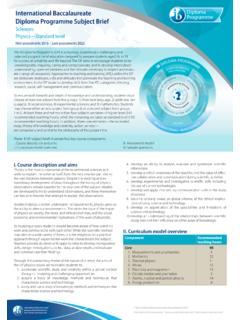
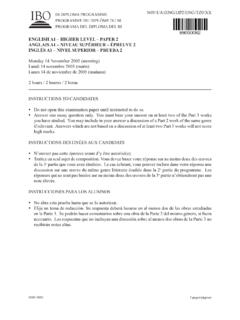
Transcription of International Baccalaureate Diploma Programme Subject Brief
1 The IB Diploma Programme (DP) is a rigorous, academically challenging and balanced Programme of education designed to prepare students aged 16 to 19 for success at university and life beyond. The DP aims to encourage students to be knowledgeable, inquiring, caring and compassionate, and to develop intercultural understanding, open-mindedness and the attitudes necessary to respect and evaluate a range of viewpoints. To ensure both breadth and depth of knowledge and understanding, students must choose at least one Subject from five groups: 1) their best language, 2) additional language(s), 3) social sciences, 4) experimental sciences, and 5) mathematics . Students may choose either an arts Subject from group 6, or a second Subject from groups 1 to 5. At least three and not more than four subjects are taken at higher level (240 recommended teaching hours), while the remaining are taken at standard level (150 recommended teaching hours).
2 In addition, three core elements the extended essay, theory of knowledge and creativity, action, service are compulsory and central to the philosophy of the Programme . These IB DP Subject briefs illustrate four key course Course description and aimsII. Curriculum model overviewIII. Assessment modelIV. Sample questionsInternational Baccalaureate Diploma Programme Subject Brief mathematics : mathematics Standard levelFirst assessments 2014 Last assessments 2020 International Baccalaureate Organization 2014 International Baccalaureate | Baccalaur at International | Bachillerato Internacional I. Course description and aimsThe IB DP mathematics standard level (SL) course focuses on introducing important mathematical concepts through the development of mathe-matical techniques. The intention is to introduce students to these con-cepts in a comprehensible and coherent way, rather than insisting on the mathematical rigour required for mathematics HL.
3 Students should, wherever possible, apply the mathematical knowledge they have ac-quired to solve realistic problems set in an appropriate internally assessed exploration offers students the opportunity for developing independence in their mathematical learning. Students are encouraged to take a considered approach to various mathematical ac-tivities and to explore different mathematical ideas. The exploration also allows students to work without the time constraints of a written exam-ination and to develop the skills they need for communicating mathe-matical aims of all mathematics courses in group 5 are to enable students to: enjoy mathematics , and develop an appreciation of the elegance and power of mathematics develop an understanding of the principles and nature of mathematics communicate clearly and confidently in a variety of contexts develop logical, critical and creative thinking, and patience and persistence in problem-solving employ and refine their powers of abstraction and generalization apply and transfer skills to alternative situations, to other areas of knowledge and to future developments appreciate how developments in technology and mathematics have influenced each other appreciate the moral.
4 Social and ethical implications arising from the work of mathematicians and the applications of mathematics appreciate the International dimension in mathematics through an awareness of the universality of mathematics and its multicultural and historical perspectives appreciate the contribution of mathematics to other disciplines, and as a particular area of knowledge in the TOK Curriculum model overviewComponentRecommended teaching hoursTopic 1 Algebra9 Topic 2 Functions and equations24 Topic 3 Circular functions and trigonometry16 Topic 4 Vectors16 About the IB: For over 40 years the IB has built a reputation for high-quality, challenging programmes of education that develop internationally minded young people who are well prepared for the challenges of life in the 21st century and able to contribute to creating a better, more peaceful further information on the IB Diploma Programme , visit: Complete Subject guides can be accessed through the IB Online Curriculum Center (OCC), the IB university and government official system, or purchased through the IB store: learn more about how the IB Diploma Programme prepares students for success at university, visit: or email: Topic 5 Statistics and probability35 Topic 6 Calculus40 Mathematical explorationInternal assessment in mathematics SL is an indi-vidual exploration.
5 This is a piece of written work that involves investigating an area of Assessment modelHaving followed the mathematics standard level course, students will be expected to demonstrate the following. Knowledge and understanding: recall, select and use their knowl-edge of mathematical facts, concepts and techniques in a variety of familiar and unfamiliar contexts. Problem-solving: recall, select and use their knowledge of mathe-matical skills, results and models in both real and abstract contexts to solve problems. Communication and interpretation: transform common realistic contexts into mathematics ; comment on the context; sketch or draw mathematical diagrams, graphs or constructions both on pa-per and using technology; record methods, solutions and conclu-sions using standardized notation. Technology: use technology, accurately, appropriately and effi-ciently both to explore new ideas and to solve problems.
6 Reasoning: construct mathematical arguments through use of pre-cise statements, logical deduction and inference, and by the ma-nipulation of mathematical expressions. Inquiry approaches: investigate unfamiliar situations, both abstract and real-world, involving organizing and analysing information, making conjectures, drawing conclusions and testing their at a glanceType of assessmentFormat of assessmentTime (hours)Weighting of final grade (%)External380 Paper 1(non-calcu-lator)Section A: Compulsory short-response questions based on the whole B: Compulsory ex-tended-response questions based on the whole 2(graphical display calculator required)Section A: Compulsory short-response questions based on the whole B: Compulsory ex-tended-response questions based on the whole explorationInternal assessment in math-ematics SL is an individual exploration.
7 This is a piece of written work that involves investigating an area of Sample questions A data set has a mean of 20 and a standard deviation of ) Each value in the data set has 10 added to it. Write down the value ofi. the new mean;ii. the new standard ) Each value in the original data set is multiplied by Write down the value of the new mean. ii. Find the value of the new variance. Given that f(x) = 1/x, answer the ) Find the first four derivatives of f (x).B) Write an expression for f(n)in terms of x and n.