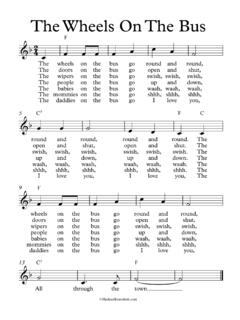
Transcription of round and round . . . and of “The Wheels on the Bus” in ...
1 LESSON pLaN activity V monos! Let s Go!by Ren Colato La nezillustrated by Joe Cepeda The Wheels on the Bus takes on a new, bilingual identity as children sing in both English and Spanish about the exciting sounds made by all sorts of vehicles motorcycles, fire trucks, airplanes and more!inside this guide! Four activities with correlations to the Common Core State Standards A two-page lesson plan for use with children in preschool through grade three Plus sheet music for The Wheels on the Bus with text in both English and SpanishCommon CorE ConnECTionS1. What is an adaptation of a story? Discuss different versions of books that you have read. (Ex., Cinderella; Gingerbread Man; City Mouse, Country Mouse; Baa, Baa, Black Sheep.) ,42. Sing the traditional The Wheels on the Bus song. Write down each verse. ( Wheels on the bus, horn on the bus, wipers on the bus, door, children, mother) Compare and contrast the traditional version with the adaptation, V manos!
2 Let s Go! ,33. Have students write the sound for each part of the story: Wheels on the bus, engine on the train, horn on the truck, motor on the motorcycle, siren on the ambulance, alarm on the fire truck, horn on the tricycle and the airplane in the sky. / Write your own part of the song using a mode of transportation. The on the goes , , . Create a class book. ,7,8 Guide written by Marla Conn, reading/literacy specialist and educational consultantIllustration copyright 2015 by Joe CepedaAges 3 6 978-0-8234-3442-8 E-book availableCMY J C JK3 rd ProofV monos Let s Go!$ Wheels on the bus go round and round ..andLas ruedas del bus ruedan y their window on the bus, a girl and a boy see a fire truck that goes woo-ooo-ooo, also known as a cami n de bomberos uuuah uuuah uuuah. They see a train, an ambulance and an airplane too! With this rollicking adaptation of The Wheels on the Bus, young people can sing out the names of their favorite vehicles and the sounds they make in both English and Spanish.
3 VROOM VROOM! BRUUM BRUUM!A HOLIDAY HOUSE BOOK0306 ReinforcedColato La nez / Cepeda V monos! Let s Go! Holiday HouseRen Colato La nez is the author of Se or Pancho Had a Rancho, illustrated by Elwood Smith, and other picture books in Spanish and English. He lives in California, where he teaches a bilingual kindergarten class. Through his work as both an author and an educator, he hopes to help all children develop positive self-images. Joe Cepeda is an award-winning illustrator of more than twenty books for children, including Swing Sisters: The Story of the International Sweethearts of Rhythm, by Karen Deans. He lives in Southern California with his wife and their House, Madison AvenueNew York, New York in ChinaEANAn adaptation of The Wheels on the Bus in English and Spanishillustrated by Joe Cepedaby Ren Colato La nezLESSON pLaNr e p r o d u ci b l V monos! Let s Go!by Ren Colato La nezillustrated by Joe CepedaIn this fun adaptation of The Wheels on the Bus, students will read and sing about their favorite vehicles in both English and : Compare and contrast versions of the same book written by different authors; sequence events; learn literary devices, including figurative language, onomatopoeia and vocabulary; recognize English/ Spanish translations; make connections between the words and illustrations as they appear; identify changes from the beginning to the end of the reading Level: JGrade Level: 1interest level: Pre-K 2 Common Core Strands in This Guide:reading Literature: , 2, 3, 4, 5, 6, 7, 9, 10 , 2, 3, 4, 5, 6, 7, 9reading Foundational Skills: , 2, 3, 4 , 3, 4 Writing: , 3, 5, 7, 8 Speaking and Listening: , 2, 3, 4, 5, 6 Language: , 2, 4, 5, 6 BEForE rEADinG1.
4 Discuss what the cover illustration and title tell us about what we are going to Ask students to look at the cover illustration and predict what the story is going to be Read the title to the group. Discuss the words in Spanish ( V monos!) and English (Let s Go!). What is an adaptation?4. Read the names of the author and illustrator. Discuss the role of Show the students two versions of a story they are familiar with: Cinderella; Baa, Baa, Black Sheep; City Mouse, Country Mouse; etc. Explain that the main idea of the story is the same, but details have been changed. Discuss Have students guess the song/story that this book is adapted from. 7. Discuss the stanzas in the Wheels on the Bus song. Write responses on the board in sequence. Ex.) Wheels on the bus, wipers on the bus, doors on the bus, horn on the bus, children on the bus, mom on the bus .. Answers may Sing The Wheels on the Bus with the Ask students to identify the sound words from the song.
5 Chart the words. (Beep, honk, swoosh, etc.)10. Ask students why these words are important in the song. Tell the students that this literary device is called Take a picture walk through the book. Have students identify the vehicles in the story. Create a vocabulary list. (Ex., bus, train, truck, motorcycle, ambulance, fire truck, tricycle, airplane) Have students identify the beginning sound of each word in the list. Write tr on the board. Discuss the sound and find the words that begin with tr. How do we tell these words apart if they have the same beginning sound? Discuss J C JK3 rd ProofV monos Let s Go!$ Wheels on the bus go round and round ..andLas ruedas del bus ruedan y their window on the bus, a girl and a boy see a fire truck that goes woo-ooo-ooo, also known as a cami n de bomberos uuuah uuuah uuuah. They see a train, an ambulance and an airplane too! With this rollicking adaptation of The Wheels on the Bus, young people can sing out the names of their favorite vehicles and the sounds they make in both English and Spanish.
6 VROOM VROOM! BRUUM BRUUM!A HOLIDAY HOUSE BOOK0306 ReinforcedColato La nez / Cepeda V monos! Let s Go! Holiday HouseRen Colato La nez is the author of Se or Pancho Had a Rancho, illustrated by Elwood Smith, and other picture books in Spanish and English. He lives in California, where he teaches a bilingual kindergarten class. Through his work as both an author and an educator, he hopes to help all children develop positive self-images. Joe Cepeda is an award-winning illustrator of more than twenty books for children, including Swing Sisters: The Story of the International Sweethearts of Rhythm, by Karen Deans. He lives in Southern California with his wife and their House, Madison AvenueNew York, New York in ChinaEANAn adaptation of The Wheels on the Bus in English and Spanishillustrated by Joe Cepedaby Ren Colato La nezHC: 978-0-8234-3442-8 E-book availabler e p r o d u ci b l As you look through the book, discuss the English and Spanish text.
7 Find the vocabulary words above in English and Spanish. Write the Spanish word for each on the Read/sing to compare and contrast two versions of The Wheels on the Bus. DUrinG rEADinG1. Read/sing the book together with the class as you point to the words (English text).2. Ask the students to reread the book (English text) silently as they point to the words. 3. As you reread the book together, have students find the matching English and Spanish Chart the words. 5. Find the repeated lines in the How do the illustrations contribute to the meaning of the story? How do the pictures help you understand what is happening in the story?7. Discuss the point of view of the story. The children are in the bus watching the vehicles go by as they ride to Discuss the connections between the words and the illustrations. (Ex., The boy and girl are waving hello ; the railroad crossing is a detail that lets me know there is a train.)9. Identify how the setting changes at the end of the story.
8 (They are in the park.)10. Record the students singing the song on the last page of the rEADinG1. Compare and contrast two versions of The Wheels on the Bus based on: Point of view Characters Setting Structure Events2. How did the book change from the beginning to the end of the story? (In the beginning the children were riding on the bus, and at the end they were on a ride at the park.)3. If the bus was driving down a different road in a different place, how would the story change? Create another version of The Wheels on the Bus as a Check the English/Spanish words you found as a class with the glossary in the back of the book. Add words as needed. Create an English/Spanish dictionary with the words from the story. Draw pictures to represent each word and put them in alphabetical Describe words in the story that appeal to the senses. Find the words that you can hear. (Ex., Choo choo, honk honk, vroom vroom, nee naw nee naw, woo-ooo-ooo woo-ooo-ooo, toot toot, zoom zoom, bruum bruum, creak) In small groups, think of more sound words.
9 Write down the sounds you hear and draw a picture for each. Share with the class. (Ex., The telephone goes ring, ring. The water goes drip, drip.)6. Retell the story in your own words. 7. Use the book to find the correct noun from the story. The motorcycle has a . The bus has . The train has an . The truck and the tricycle both have a . The ambulance has a . The fire truck has an . Illustration copyright 2015 by Joe CepedaAT copyright 2015 by Joe arrangement of V monos! Let s Go! copyright 2015 by Holiday House, from V monos! Let s Go! by Ren Colato La nez, illustrated by Joe Cepeda All Rights Reserv