Transcription of Lesson on the Structure of the Atom - E3T
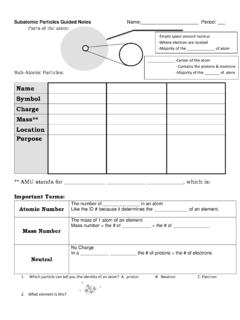
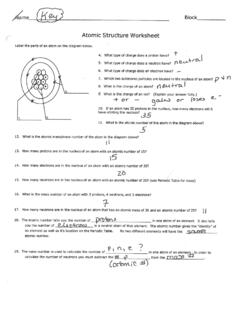
1 Macomb ISD E3T Team Universal Design for Learning S. Hardin, M. Klein, M. Staskowski, C. Wozniak 2007 Lesson on the Structure of the Atom The following Lesson would be part of a larger chemistry unit on the atomic model and the periodic table of the elements. Learning outcomes below are from the new 2006 Michigan Content Expectations for Science. Content Expectations Electrons, protons, and neutrons are parts of the atom and have measurable properties, including mass and, in the case of protons and electrons, charge.
2 The nuclei of atoms are composed of protons and neutrons. A kind of force that is only evident at nuclear distances holds the particles of the nucleus together against the electrical repulsion between the protons. Identify the location, relative mass, and charge for electrons, protons, and neutrons. Describe the atom as mostly empty space with an extremely small, dense nucleus consisting of the protons and neutrons and an electron cloud surrounding the nucleus. Recognize that protons repel each other and that a strong force needs to be present to keep the nucleus intact.
3 A neutral atom of any element will contain the same number of protons and electrons. Ions are charged particles with an unequal number of protons and electrons. Isotopes are atoms of the same element with different numbers of neutrons and essentially the same chemical and physical properties. List the number of protons, neutrons, and electrons for any given ion or isotope. Recognize that an element always contains the same number of protons. Big Idea All matter is made up of three universal particles. (Higher understanding advances this concept to be six fundamental particles) Enduring Understandings/Theme for the Unit If the building blocks of the universe are all the same, then it is simply the organization of these universal particles that makes all the difference.
4 Macomb ISD E3T Team Universal Design for Learning S. Hardin, M. Klein, M. Staskowski, C. Wozniak 2007 Essential Questions What is matter? If the atom is mostly space, why can I sit on a chair? If positive protons repel each other, why does the nucleus stay together? How many different ways are there to organize subatomic particles? Key Knowledge Terms and Vocabulary Protons Neutrons Electrons Ions Isotopes Quarks Charge Atom Molecule Element Nucleus Students will be able to: Draw models of the elements Determine charge on various atoms and ions Analyze element data on the periodic table Student Assessment Students will create a model of one element from the periodic table.
5 This model can be created in a variety of ways and the selection of medium will be left up to each student. A detailed explanation must accompany the model and include characteristic data regarding the element. Additional information on this performance assessment can be found on the website. Macomb ISD E3T Team Universal Design for Learning S. Hardin, M. Klein, M. Staskowski, C. Wozniak 2007 Online Resources Tom Lehrer Song (Song about the elements found in the periodic table) Various Interactive Periodic Tables of the Elements Instructions on Reading the Periodic Table Basic Interactive Tables with Clickable Links to Information on Each Element Tables with Unique Element Features or Graphics Structure of the Atom Sites Beginner A very simple visual with text of one element, carbon.
6 Good place to start if confused. This page describes and shows the basics of the atom ~acarpi/ **Interactive atom building site Intermediate **Information on Structure of the atom and an interactive atom builder. Older retro video on the atom. (About 15 minutes) Advanced A complete PowerPoint primer on the Structure of the atom. A very complete look at many aspects of the atom. Glossary of Scientific Terms An online glossary of science vocabulary. #PLesson Outline Structure of the Atom Lesson Engagement 1) Coin exploration activity (5-10 min) a.
7 Students explore various US and Canadian coins using magnets, electrical circuits and various liquids. b. Allow minimal class discussion, but ask directed questions looking for similarities and differences between coins. c. All coins are metal and will conduct electricity, but Canadian coins are magnetic and US coins are not. The US Mint uses primarily zinc cores where Canada uses nickel. Zinc is not magnetic and nickel is magnetic. 2) Tom Lehrer Elements Song (Online Resource) a. Play song for whole class b. Engage in discussion as to what the song is referring to Co-Teaching Notesc.
8 Pose questions to class, leading to the discussion of elements Exploration Begin diagram of atom on the white board. Add notes to the diagram about the big ideas as they are covered in the Lesson . Interject questions for clarification of big ideas or comment to highlight them within the ) Introduce Periodic Table of the Elements (Online Resource) a. Very brief exploration of how the elements are arranged. b. Possible leading questions i. What elements might the various symbols represent? ii. What is the number on the top? Any pattern with that number? iii. Is water on the table?
9 Why or why not? 4) Sticky Note Atom Activity a. Distribute three different colored post-it notes randomly to the students. Each student should have at least one and the colors should be fairly evenly represented. Colors represent protons, neutrons and electrons. Interject questions when it appears students need a slower pace. b. Prepare a white board for the sticky notes (with a key for which colors are protons, neutrons and electrons) and ask them to come up and place their notes where they think they should be. c. Do sticky note atom for one element as whole group. Macomb ISD E3T Team Universal Design for Learning S.
10 Hardin, M. Klein, M. Staskowski, C. Wozniak 2007 List vocabulary important to the Lesson as the come up. Repeat definitions discussed conversationally. Ask about definitions not clearly defined. d. Develop Structure rules during class demo i. Protons and neutrons in center ii. Protons spaced by neutrons, protons as far as possible iii. As much space as possible to electrons iv. Same number of protons and electrons for neutral atom Add to class vocabulary list. Interject brief discussion v.