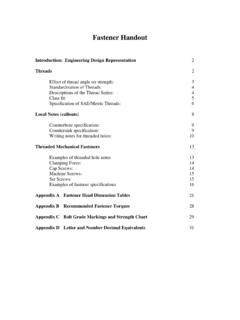
Transcription of Table of Contents - VBGrowSmart
1 Table of Contents Acknowledgements 4 Executive Summary 5 1. Investing in Effective Teacher-Child Interactions in Early Care 10 and Education Programs 2. The Classroom Assessment Scoring System: An Overview 12 Development of the class as an Assessment Tool 12 Development of Aligned Professional Development Supports 13 Organization of the class 14 Research Findings on the class 16 3. Improving Teacher-Child Interactions: Designing a Coordinated 20 Approach Steps for the Effective Use of the class 20 Coordinating Evaluation/Monitoring and Professional Development Efforts 22 Case Study: The Head Start class Initiative 26 4.
2 Evaluation and Monitoring: Measuring the Quality of 29 Teacher-Child Interactions Step 1: Planning and Decision Making 30 Step 2: Developing Infrastructure 35 Step 3: Implementation Data Collection 38 Step 4: Assessment and Knowledge Utilization 41 Case Study: Virginia s Star Quality Initiative 43 5. Professional Development: Helping Teachers and Programs Use 45 More Effective Interactions with Children Step 1: Planning and Decision Making 46 Step 2: Developing Infrastructure 46 class Implementation Guide 2 Case Study: Minnesota s Center for Early Education and Development 52 Step 3: Implementation of Professional Development Opportunities 55 Step 4: Assessment and Knowledge Utilization 55 Case Study: The San Diego County PFA Demonstration Project 57 6.
3 Other Important Considerations 59 Dual Language Learners 59 Special Education Settings 60 Issues of Cultural Sensitivity 62 Use of the class in Family Child Care Settings 62 7. Important Principles for Effective Implementation of the class 63 References 65 Appendix: List of Questions and Page Numbers 67 class Implementation Guide 3 Acknowledgements This report was funded through a grant from the Picower Foundation.
4 We are exceptionally grateful for the support of Barbara Picower and Elena Lopez. The report was prepared though a collaboration of the Center for Advanced Study of Teaching and Learning (CASTL), a research center at the University of Virginia, and Teachstone, a nonprofit organization dedicated to providing information, training, and technical assistance for researchers, educators, and others interested in using the class to increase children s social and academic development. We also appreciate Stacie Goffin s important contributions; she is a leading expert in early childhood education policy, and her knowledge and expertise were invaluable. This report is the culmination of a series of CASTL meetings with state and local leaders in early childhood education working to integrate the class into systems for professional development and evaluation.
5 Our broad goal was to work with these leaders to ensure that integration of the class into these different systems produced the intended outcomes higher quality interactions between teachers and children and, ultimately, more positive social and learning outcomes for young children. State and local leaders shared important lessons from their efforts, which are highlighted throughout this report. Participants included: Laura Brock, Sherry M. Cleary, Jan Dorman, Kathy Glazer, Vicki Hawley, Gera Jacobs, Jacqueline Jones, Allison Landy, Karen LaParo, M. Elena Lopez, Jana Martella, Patricia McMahon, Sara Mead, Penny Milburn, Eileen Nelson, Claire Norwood, Michele Palermo, Robert Pianta, Karen Pucciarelli, Colleen Rathgeb, Julie Shuell, Gayle Stuber, and Deb Zapalik. We are particularly thankful to staff in San Diego, Minnesota, Virginia, and the Office of Head Start who allowed us to share their class -based work with others through the case studies that are included as part of this report.
6 Vicki Hawley and Jana Martella went above and beyond by providing detailed feedback and suggestions on an earlier version of this report. We also are grateful for the thoughtful feedback provided by Robert Pianta, Marla Muntner, and Megan Stuhlman. For further information on the class , visit or contact Teachstone at 434-293-3909. class Implementation Guide 4 Executive Summary In this report we discuss the ways in which the Classroom Assessment Scoring System ( class : Pianta, La Paro, & Hamre, 2008) can help states, counties, districts, and programs take steps toward improving the quality of early childhood education (ECE) teachers interactions with children. First, an overview of the class is presented. Then, a conceptual framework is introduced that can guide states and others in systematically using the class and creating a coordinated approach for improving teacher-child interactions.
7 The report also provides answers to practical questions about how best to implement and coordinate use of the class as part of program quality improvement and evaluation and monitoring systems. The report concludes with a brief discussion of other important issues, such as use of the class in settings with diverse populations of children. What does the class Measure? The class focuses on the quality of classroom interactional processes. This differs from other measurement tools that focus on the content of the physical environment, available materials, or a specific curriculum. For class , the physical environment (including materials) and curriculum matter in the context of how teachers put them to use in their interactions with children. The class is organized to assess three broad domains of interactions among teachers and children: Emotional Support, Classroom Organization, and Instructional Support.
8 Each domain includes several dimensions. Collectively, these eleven dimensions assess the extent to which teachers are effectively supporting children s development, both social and academic. class Implementation Guide 5 What does research using the class tell us about ECE program quality? Research using the class provides compelling evidence about the nature of teacher-child interactions in ECE settings and the ways in which these interactions promote children s social and academic development. Four overarching conclusions have emerged from the research: Effective teacher-child interactions are an active and crucial ingredient for children s social and academic development. Children in ECE settings are not consistently exposed to effective teacher-child interactions. To maximize the impact for children, quality improvement efforts need to focus explicitly on teacher-child interactions.
9 Carefully designed and implemented professional development support can improve the quality of teacher-child interactions. How can the class be used to improve early childhood education programs? Increasingly, teachers and programs are being held accountable for the quality of interactions they provide to young children. The fairness and effectiveness of accountability policies depends on ensuring that demands are aligned with systems that prepare teachers and programs to meet these expectations. Teacher professional preparation and development is essential in this effort. This alignment is not commonly observed in states, however. In particular, ECE teachers typically are not provided with the training and support needed, either pre-service or in-service, to provide effective social and instructional interactions.
10 The class provides one possible tool to address this need. The class provides both an assessment of effective teacher-child interactions and a set of resources for enhancing the quality of these interactions. As a result, it provides a common language and stable thread that can be woven among efforts to assess teacher effectiveness (monitoring and evaluation) and ensure teachers have the knowledge and skills to promote children s social development and academic learning (professional development). Four steps should be followed to guide use of the class in these efforts, each of which is considered in detail throughout this report: 1. Planning and Decision Making 2. Infrastructure Development 3. Implementation 4. Assessment and Knowledge Utilization When working to coordinate monitoring and evaluation with professional development, the same four steps are used in a recursive model.