Transcription of TOP SECRET ENDURO TIPS - MidwestEnduros.com
1 TOP SECRET ENDURO tips Sneaky things you should know if you want to win By Pete Denison These are tips I learned and developed from racing and working with the top riders in the sport. I've spent 20 years racing on the club circuit, and five years on the national circuit as computer programmer and timekeeping coach for Steve Hatch and Kelby Pepper. We won the national title in '94, and came damn close in '93 and '95. When we were racing nationals, I never would have told these tips to anybody, but since I'm off of the circuit now I can let the cat out of the bag. (I guess I still have a few more, but they're the illegal tips , and I'll never admit to knowing any of those!)
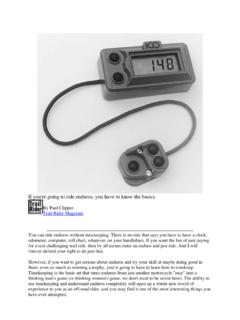
2 Since my company, A-Loop Offroad, makes the Pacemaker P3 ENDURO computer, any of the references I give below to timekeeping equipment is going to shamelessly plug the P3. If you don't have a P3, that's fine; most every one of these tips will apply even if you're using an ICO instrument or just a clock and odometer. Remember above all that it's not what equipment you're using that will win the ENDURO , it's how much THINKING you do. Very few people in history have won enduros without trying. If you can do it, great; if not, here's some of what I consider the most important things to remember when you have a score card on your front fender.
3 At the check, scan for flags: green means stop! Know the two kinds of checks. At the SECRET check red/white diagonal flag, only minutes are recorded; and at the emergency (tiebreaker) check, green/white diagonal flag, minutes and seconds are recorded. If you are roughly on time, meaning that you're not way behind and riding in the berserko mode, when you first see a check, quickly scan for the flags. There should be two flags visible, usually they are behind a cooler or a fat lady, though. Learn not to look at your instruments right away; scan for flags first, but scan quickly, just the once-over.
4 If you see a green flag, or cannot see any flag, then assume it's an emergency check. Check your diff-time display; if you're more than one minute late, blast in. If you're in your minute, switch your attention to the clock (see next tip). Watch the clock at green flag checks Your diff-time display is only as accurate as your odometer at any given point on the course, but your clock, theoretically, should match the check clock exactly. So when you are entering an emergency check, and you've checked your diff-time to make sure that you're inside your minute, switch your attention to the clock display.
5 The clock will always be a more accurate way of telling your exact time than the +/- diff-time display, when you are entering a checkpoint. Every check is the start of a 3 mile moto There is a three mile free zone after every checkpoint (in AMA rules). Although many times the club will put a reset after the check to eat up this free zone and allow them more possible check locations, you should treat every check as the start of a three mile free zone. Go as fast as possible (still conserving a little energy for the rest of the race), and get through the free zone at your maximum trail pace, in case this is the beginning of a special test or points taking, section.
6 Verbal reinforcement of 3 mile free zone To help you remember the end distance of the free zone, reinforce it audibly. For example, if the check is at miles then the free zone lasts until miles. At the check, while the crew is marking your card, look for the mileage at that check, which is required by rule to be posted somewhere. Add 3 miles to this distance, and then say it out loud, " !". verbally reinforcing this makes it easier for you to remember when your head is full of numbers. Then go like hell, and train yourself not to look down at your instrument until you think you're almost at the end of the free zone.
7 Three miles at 24 mph is minutes, so that gives you an idea of about how long to moto before taking your eyes off of the trail. The new P3 has two methods of keeping track of free zones: you can mark a check location with a key-press, and black bars appear between display segments that denote the free zone, these disappear after 3 miles. There is also an audible alarm that alerts you to an upcoming possible check, and it is silenced when the free zone bars are visible. Know when NOT to timekeep Beginners timekeep all day, but pros know when they are safe inside a free zone, where they can go all out, and when they are not in a free zone and subject to a check.
8 Know the rule book. Free zones are two miles before a known control, three miles after a known, or any SECRET or emergency check. If you're inside a free zone, why are you looking at your instruments? Quick quiz: every ENDURO has at least one known control. Do you know where it is? (The start). What is "Riding Possibles" Riding possibles is an advanced timekeeping technique, made somewhat obsolete by the latest generation of timekeeping computers. Since the rules only allow checks to be placed at the conjunction of a whole minute and an even tenth, there is a limit to where checks can be placed.
9 You can calculate, or the Jart Chart can show, the exact location of allowable (possible) checks. Pro riders that have no trouble keeping pace at almost any speed average, in effect will treat the space between possible checks as mini-free zones, and roost between them, slowing when they approach the next possible location. They are basically riding very hot (early). The advantage is that it may give them a few seconds lead if the trail suddenly turns way too difficult for the speed average (a points taking section). The danger is that they will be caught early, and get a big penalty. If you ever hear of Davis or Hawkins burning a check, it's not because they were napping, it's because they were riding possibles and got caught.
10 For the average club "A" rider, there are more points to be lost by burning a check early, than there are seconds to be gained by riding early on possibles. Also, since modern computers are so accurate with respect to your diff-time seconds fast/slow, a better trick than riding possibles is to keep 10-15 seconds early into the next minute at all times. You can always scrub that amount of time by trials riding if a check appears. This does almost the same thing as riding possibles, but you don't need the razor sharp alertness of the factory pro. Riding actuals, not possibles Inspect the route sheet carefully the night before the race.