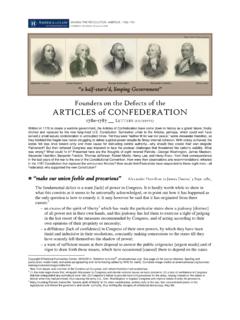
Transcription of The Articles of Confederation: Safeguarding English ...
1 1 "The Articles of confederation : Safeguarding English Liberties" Dr. Guy Chet (UNT) Glossary: Revolutionary era: the early 1760s to early 1780s (from the end of the French & Indian War, when tensions between Parliament & American assemblies intensified, to the end the Revolutionary War, in 1783). Salutary/benign neglect: the traditional construction (that is, constitution) of the British Empire (before the Revolutionary era), in which the central government did not involve itself directly in local governance in the colonies.
2 Instead, local governments established themselves as the primary force in provincial governance. Following independence, this governmental structure will be referred to as states rights. First British Empire: the British Empire before American independence. This was a New-World settler empire, characterized by British settlers governing themselves. By contrast, the Second British Empire (the 19th- & 20th-century empire, with provinces in Asia, Australia, & Africa, as well as the Americas) was more conventionally imperial, with predominantly non-British subjects governed by Britain.
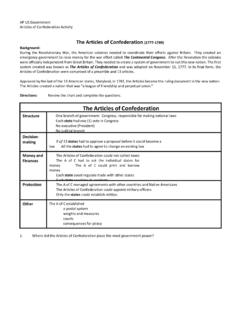
3 Articles of confederation summary: * Establishes the name of the confederation : The United States of America." * "Each state retains its sovereignty, freedom, and independence, and every power, jurisdiction, and right, which is not by this confederation expressly delegated." * The United States of America is a firm league of friendship rather than a sovereign government among independent and sovereign states, for their common defense, the security of their liberties, and their mutual and general welfare.
4 * To better [..] secure and perpetuate mutual friendship and intercourse among the people of the different States in this union," it establishes equal treatment and freedom of movement for the free inhabitants of each state to pass unhindered between the states, excluding "paupers, vagabonds, and fugitives from justice." * Allocates a single vote in the Congress of the confederation to each state delegation (a delegation of between two and seven members, appointed by state legislatures; members were term-limited, serving no more than three out of any six years).
5 * Only the central government is allowed to conduct foreign political or commercial relations and to declare war. No state or official may accept foreign gifts or titles, and granting any title of nobility is forbidden to all. States are restrained from forming sub-national groups. No state may tax or interfere with treaty stipulations already proposed. No state may engage in war, without permission of Congress, unless invaded or that is imminent on the frontier; no state may maintain a peace-time standing army or navy, unless infested by pirates, but every State is required to keep ready, a well-regulated (meaning well trained), disciplined, and equipped militia, with sufficient public stores.
6 * Whenever an army is raised for common defense, colonels and military ranks below colonel will be named by the state legislatures. * Expenditures by the USA will be paid by funds raised by state legislatures. * The confederation accepts war debts incurred by Congress before the ratification of the Articles . * The Articles are perpetual, and can only be altered by approval of Congress, with ratification by all the state legislatures. 2 "The Articles of confederation : Safeguarding English Liberties" Dr.
7 Guy Chet (UNT) Abstract US History textbooks provide a view of colonial and Revolutionary history from the perspective of the early-national period. Looking back at the Revolution from the nineteenth and twentieth centuries, they paint the Revolution as a product of long incremental cultural change in America; a process by which uniquely American circumstances ethnic diversity, slavery, economic and demographic dynamism, and other effects of expanding frontiers produced uniquely American traits in the colonists.
8 This process of Americanization gradually differentiated and alienated Americans from their compatriots and government across the Atlantic. Specialists on the colonial era, by contrast, are generally more skeptical regarding Americanization and the alleged cultural divide between provincials and Britons; they are more likely to see the Atlantic as a cultural bridge than a barrier. Colonialists thus tend to view the Revolution as an event that reflected the settlers' English identity and beliefs, rather than as the national event it became retrospectively, in the late-eighteenth and nineteenth centuries.
9 Within this framework, the Revolution emerges as not as a tax revolt or war for national liberation, but as a constitutional crisis, in which rebels saw themselves not as advocates for change, but as reversing the clock to restore the old order.


![How does the Constitution fix the problems of [Read-Only]](/cache/preview/e/2/0/0/5/2/b/c/thumb-e20052bc43a34061661c152e09c57e7d.jpg)