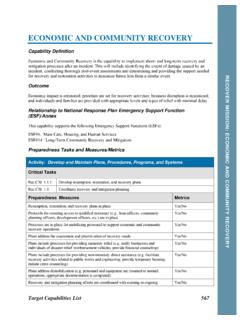
Transcription of ESF14-Long Term Community Recovery EMERGENCY …
1 Planning Team Support Agency Coffeyville Public Works Independence Public Works Montgomery County Public WorksMONTGOMERY COUNTY, KANSAS EMERGENCY OPERATIONS PLANESF14- long Term Community Recovery1/15/2009 3:03:51 PMPage 1 of 11 EMERGENCY Support Function (ESF) #14 addresses long -term disaster Recovery issues. Specifically, it discusses: lEconomic assessment, protection and restoration lCommunity Recovery operations lMitigation analysis and program implementation lCoordination with the private sector lCoordination with State and Federal agencies providing assistance For the purpose of this ESF, Recovery activities are addressed based on one of two situations, pre-Stafford Act assistance and post-Stafford Act assistance. Stafford Act assistance refers to any assistance available under the Robert T. Stafford Disaster Relief and EMERGENCY Assistance Act, Public Law 93-288 as amended. This assistance, which is requested through the Department of Homeland Security (DHS), Federal EMERGENCY Management Agency (FEMA), includes but is not limited to fire management assistance, EMERGENCY declaration assistance and/or major disaster declaration assistance.
2 This ESF Annex is designed to provide a flexible organizational structure capable of meeting the varied requirements of many EMERGENCY scenarios with the potential to require activation of the Montgomery County EMERGENCY Operations Center (EOC) and implementation of the MCEOP. ESF #14 is a functional annex to the MCEOP and to the extent possible, information contained in other sections of the EOP will not be repeated in this document. long -term Community Recovery and mitigation efforts are forward-looking and market-based, focusing on permanent restoration of infrastructure, housing, and the local economy, with attention to mitigation of future impacts of a similar nature, when #14 applies to all agencies and organizations with assigned EMERGENCY responsibilities in the MCEOP. Requests for federal disaster assistance will be predicated on the requirements outlined in the Robert T. Stafford Disaster Relief and EMERGENCY Assistance Act (Public Law 93-288). General In general, the Recovery operation begins once conditions in the disaster area stabilize and the immediate danger posed by an event has passed.
3 Disaster- Recovery operations require coordination at all levels of government, often supplemented by the efforts of volunteer organizations and private industry, and are conducted in accordance with established plans and procedures for administering disaster relief programs. The ESF #14 Coordinator and supporting agencies will work to determine the need to develop and implement Community Recovery and economic stabilization strategies. Consideration should be given to augmenting or PurposeScopePoliciesConcept of OperationsESF14- long Term Community Recovery 1/15/2009 3:03:51 PMPage 2 of 11expanding existing programs to meet disaster needs. Organization When an EMERGENCY occurs, the Montgomery County EOC will be activated to coordinate response and Recovery activities. Appropriate staff will report to the Montgomery County EOC and other locations as requested, and respond as directed in the MCEOP and in supporting guidelines, procedures and checklists. Following a major disaster, substantial government assistance will be required to return the Community to normal.
4 Damage Assessment Types Timely and thorough disaster assessments will allow the County to: lPrioritize response operations lRequest mutual aid lAlleviate human suffering lManage resources lMinimize Recovery time lDocument the need for State and/or Federal assistance lMitigate against future disasters lPlan for long term Recovery activities Any of the hazards identified in the County Multi-Hazard Risk Analysis and Vulnerability Study could cause extensive public and private property damage creating a need for disaster assessments. The Montgomery County EOC will monitor, collect, process and maintain disaster assessment information reported from the field. Additional information may come from EMERGENCY repair crews, other County or City employees, business and industry, private citizens and/or the media. Rapid Assessments In most cases, a rapid assessment will be completed within a few hours of the incident, while detailed assessments may take days or weeks. As additional information becomes available updates will be made to the County EOC and passed on through EMERGENCY management to KDEM.
5 A rapid assessment is a quick evaluation of what has happened and used to help prioritize response activities, allocate resources and determine the need for outside assistance. During rapid assessments, emphasis will be placed on collecting and organizing information in a manner that will facilitate timely decision-making. This will allow both field personnel and the EOC to: lMake informed operational decisions regarding public safety lSet response priorities lAllocate resources and personnel to the areas of greatest need lIdentify trends, issues and potential problem areas lPlan for ongoing operations It is anticipated that most rapid assessment information will be forwarded to the EOC from the field the by phone and radio. I n most cases, enough rapid assessment information will come from first responders already in the field. But if the situation dictates, personnel may be deployed specifically to conduct damage assessments and to report ESF14-Long Term Community Recovery 1/15/2009 3:03:51 PMPage 3 of 11information to the EOC as quickly as possible.
6 If the nature of the incident dictates, rapid assessments will include structural safety evaluations to determine building integrity and ensure the safety of EMERGENCY responders. This type of technical guidance will be provided to first responders as long as necessary. If necessary, rapid assessments will also include safety inspections of critical facilities and infrastructure, such as hospitals, the EOC, potential shelters, evacuation routes, and others as needed. Rapid assessments will also include utility safety checks for electric hazards and combustible gas. The structural integrity of EMERGENCY shelters and other EMERGENCY facilities will be determined by inspections by the fire departments and the Montgomery County Code Enforcement department. Based on information gathered during the rapid assessment phase, the EOC damage assessment team will decide when and where to conduct detailed disaster assessments. Both rapid and detailed disaster assessments will consider private property damage ( , losses by persons and damage to residences and small businesses), as well as public damage ( , damage to infrastructure, including but not limited to roads, bridges, utilities, government facilities and private not-for-profit entities.)
7 The rapid assessment will include information regarding the: lArea or jurisdiction affected lKnown injuries lKnown fatalities lCritical facilities damaged or destroyed lEvacuations lCounty EMERGENCY declared lMutual aid activated lAny state or federal resources anticipated Montgomery County will work closely with the Kansas Division of EMERGENCY Management (KDEM) throughout the disaster assessment process. The County Disaster Assessment Teams and the County EOC will use disaster assessment forms consistent with those developed by KDEM to ensure a standard reporting method is used and that all damage assessment activities are conducted in accordance with State and Federal requirements. These forms are available within the EOC. In most cases, the American Red Cross (ARC) will also conduct assessments to determine the immediate needs of people affected by the disaster. The County will work closely with the ARC to share assessment information. Depending on the event, the ARC and members of the private sector may partner with the County to conduct joint disaster assessments.
8 In rare cases, the scope and magnitude of the event may dictate an expedited disaster assessment to gather enough information to justify a request for a major disaster declaration. If a Federal declaration is made before detailed disaster assessments are conducted, the detailed damage assessment will become a part of the ongoing Recovery process. Detailed Disaster Assessment A detailed disaster assessment is needed to document the magnitude of public and private damage for planning Recovery activities and to justify the need for State and Federal assistance. A detailed disaster assessment is also necessary to meet the information needs of the public, elected officials and the media. During detailed disaster assessments, emphasis will be placed on collecting and organizing information in a manner ESF14-Long Term Community Recovery 1/15/2009 3:03:51 PMPage 4 of 11that will allow the EOC to: lEvaluate the overall total scope, magnitude and impact of the incident lPrioritize Recovery activities lPlan for ongoing Recovery and restoration activities lProject the total costs of long -term Recovery lDocument the need for supplemental assistance Detailed disaster assessments will generally begin following the completion of response activities to protect life and property or will be completed as additional disaster assessment information becomes available.
9 Depending on the magnitude of the disaster, a detailed disaster assessment could last for days or even weeks. The Incident Commander in consultation with the EOC Team will decide when the situation allows for detailed disaster assessments. The County's Damage Assessment Team will contact, organize, brief and deploy detailed damage assessment field teams. In most cases, field assessment teams will be deployed to the damaged areas to gather information and report it to the EOC for analysis and reporting. In addition to field assessments, it may be necessary for the EOC to assign personnel to estimate projected disaster costs to determine the need for State and Federal assistance. For example, the total cost of a large debris removal and disposal operation may be projected based on formulas applied to data already gathered from the field. Detailed assessments will include information regarding the: lNumber of persons affected in disaster area lNumber of persons evacuated lNumber of shelters open lNumber of persons in shelter lNumber of confirmed injured lNumber of confirmed fatalities lNumber of confirmed missing persons lNumber of homes and businesses with damage - Destroyed - Major - Minor - Affected - Uninsured loss lNumber of homes in flood plain lNumber of acres burned lNumber of critical care facilities damaged - Hospitals - Assisted living facilities lNumber of municipally or county owned facilities - Fire, police, city hall, schools - Road, bridge, infrastructure damage - Road closures ESF14-Long Term Community Recovery 1/15/2009 3:03:51 PMPage 5 of 11lUtility damage - Power - Water - County declaration issued There are two types of detailed assessments.
10 Private Property lDetailed assessments on homes, apartment dwellings and businesses are needed to document the extent of damage to individuals, families and business. lThe number of private property damage assessment teams and team members required will be based on the scope and magnitude of the damage. Depending on the magnitude, the Kansas Assessment Team may be deployed by KDEM to conduct this assessment and placard buildings to indicate if they are safe to enter. The ESF #14 Coordinator will work with ESF #15 (Public Information and External Communications) Coordinator to ensure information regarding the meanings of inspection tags and markings are made available to the public. lIn addition to documenting the locations and extent of damage, the private property damage assessment teams should attempt to determine the socio-economic impact of the disaster on the affected Community . For example, the loss of a major business or industry that creates a temporary unemployment situation.