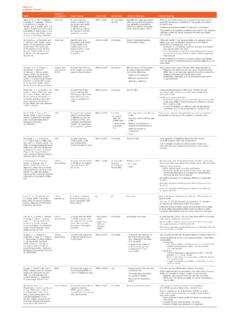
Transcription of A Framework for Assessing Effects of the Food System
1 For more information visit Framework for Assessing Effects of the Food System The food supply chain is deeply interconnected with human and environmental health, as well as social and economic systems. Decisions about food policies and practices, therefore, can have unintended impacts both positive and negative. To arrive at a decision for which the benefits outweigh the risks, decision makers must carefully consider a broad range of Effects and interactions across the health, environmental, social, and economic domains. To aid in this complex analytical process, the Institute of Medicine and the National Research Council convened an expert committee to develop a Framework to assist in food and agriculture decision making.
2 The committee s report, A Framework for Assessing Effects of the Food System , sponsored by The JPB Foundation, presents guiding principles and practical steps to help stakeholders weigh tradeoffs and choose policies that integrate benefits and risks across various of the Food SystemThe food System functions through a supply chain of producers, proces-sors, and distributors that delivers food to consumers; consumers, in turn, send signals back up the chain about what and how much to produce. This process provides the population with a varied, relatively inexpensive, and plentiful supply of food.
3 The supply chain is connected to the global food System and operates within a diverse and ever-changing array of economic, biophysical, social, and institutional contexts. A myriad of actors ( , farmers, processors, policy makers, and consumers) makes decisions that shape the food System every day. These actors have diverse goals that include improving health, protecting the environment, and increasing productivity. To arrive at a decision for which the benefits outweigh the risks, decision makers must carefully consider a broad range of Effects and interactions across the health, environmental, social, and economic BRIEF JANUARY 20152 Decisions that affect one part of the food sys-tem, however, may have unexpected consequences beyond their original intent, in both the United States and abroad.
4 Changes may impact the envi-ronment (including Effects on biodiversity, water, soil, air, and climate), human health (such as diet-related chronic disease risk), and society (includ-ing Effects on food accessibility and affordability, land use, employment, labor conditions, and local economies). At the same time, decision makers adapt as the food System changes. In short, the food System is complex and adaptive that is, composed of many different pieces whose interactions drive behavior in ways that cannot easily be understood by considering any one component separately. Studies to inform food and agricultural decisions, therefore, require an analytical approach and methodologies capa-ble of considering the full range of key interac-tions, adaptations, and other features of complex Framework for Assessing Decisions The committee proposes a Framework to serve as a tool for decision makers, researchers, and other stakeholders to examine the breadth of possible outcomes.
5 The Framework can help identify unin-tended Effects ; promote transparency among stake-holders; improve communication and understand-ing of differing values and perspectives among scientists, policy makers, and other stakeholders; and decrease the likelihood that results of a policy analysis might be misinterpreted. The Framework begins with six steps common to any comprehensive assessment: 1. Identify the problem What is the goal of the assessment?2. Define the scope of the assessment What are the time, budgetary, and other limitations? What are the elements of the food System to be analyzed? What are its boundaries ( , a particular food commodity, time, or geo-graphic area)?
6 What are the knowledge gaps, and how can results from existing studies be utilized?3. Identify the scenarios What are the poten-tial new policies or practices that should be considered?4. Conduct the analysis What are the data needs, and which analytic tools are most appropriate?5. Synthesize the results What are the impacts and tradeoffs across health, environmental, social, and economic domains, and how can they be compared?6. Report the findings Who are the key stake-holders to inform? Next, the committee presents four principles that should guide each step of the analysis:1.
7 Consider Effects across the full food System : Assessments should consider positive and negative outcomes along the full supply chain and across all relevant domains and Address all domains and dimensions of Effects : Within each domain, four dimensions of Effects quantity, quality, distribution, and resilience measure how much the food System provides, where and to whom it goes, and how sustainably it can do so. Judg-ments about the relative importance of these dimensions for any particular assessment may vary by Account for System dynamics and complexi-ties: Given the tendency of complex inter-actions to trigger dynamic repercussions, assessments should, to the extent feasible, account for Effects across time, space, and populations and should acknowledge the potential role of underlying drivers and inter-acting pathways.
8 While the scope limitations may preclude a specific study from complete consideration of all Effects and drivers, it is important for any study to define its bound-aries and assumptions. It is also important that the team of assessors has appropriate expertise and resources. 3outcome in one area of the food System can have a range of consequences in other domains. These consequences may be substantial and out of pro-portion to the change in the originating domain. Studies that consider the entire food supply chain and address multiple domains and dimen-sions of Effects can help identify these important outcomes and tradeoffs tradeoffs that could be missed in more narrowly focused assessments.
9 However, the committee notes that such compre-hensive studies are rare in the current literature. Data and methodologies for Assessing the food System come from both public and private initiatives. Both are critically important, but lack of public access to data collected by industry can be a major challenge for researchers. The committee concludes that engaging a wide variety of stakeholders throughout the assessment can promote the sharing of data and best practices, avoid conflicts of interest, ensure equitable participation, and address public con-cerns about transparency.
10 Finally, the committee finds that System -wide approaches will be needed to meet challenges to the food System in the 21st century, including antibiotic and pesticide resistance; chemical con-tamination of air and water; soil erosion and deg-radation; water deficits; and diet-related chronic disease, obesity, and domestic and global hunger and malnutrition and food safety. To develop robust solutions for these challenges, it will be important not only to identify the Effects of the current System but also to understand the driv-ers of those Effects including human behavior, market dynamics, and policy issues.