Transcription of Shoulder Arthroscopic Rotator Cuff Repair FAQ - tcomn.com
1 Shoulder Arthroscopic Rotator cuff Repair FAQ Ryan W. Hess, MD Q: WHAT IS ACCOMPLISHED DURING THE PROCEDURE? Shoulder arthroscopy is a proceure in which small incisions are made around the Shoulder and a camera and small tools are inserted in and around the Shoulder joint. The Shoulder joint is similar to a golf ball sitting on a golf tee. Attached to the golf ball are a group of 4 tendons which are collectively called the Rotator cuff . In some patients, a portion of the Rotator cuff attachment to the bone becomes torn, so rather than being attached to the bone, a part of the tendon is pulled back from its attachment to the ball. This area can range from very small to very large (including nearly the entire Rotator cuff ). In some cases, the Rotator cuff is only torn part of the way through the tendon (this is called a partial tear). The majority of these tears can be successfully treated without surgery, but some may occasionally continue to cause pain and/or dysfunction of the Shoulder , and surgery may be necessary.
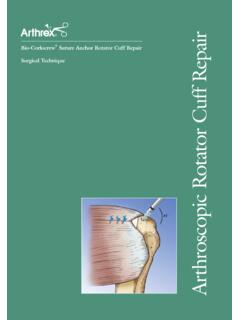
2 During surgery, small anchors are placed in the bone of the golf ball . These anchors have stitches attached to them which are carefully passed through the torn Rotator cuff tendon and tied down in order to Repair the Rotator cuff back to the bone. The number of anchors used depends on the extent of the tearing of the Rotator cuff . A typical labral Repair ranges from 2-4 anchors. In some cases, more or fewer anchors are required. There are often additional procedures that are performed at the same time as Rotator cuff Repair . These differ from patient to patient, but may include: o Subacromial decompression- This is a procedure that includes removal of a bone spur that can contribute to injury to the Rotator cuff . o Debridement- This is a procedure where unhealthy tissue inside the Shoulder is removed with the use of a shaver or other tools. o Biceps tenotomy- This is a procedure that is performed when there is damage to the biceps tendon.
3 A tenotomy is when the tendon is cut near its attachment to the rim of the socket and allowed to pull back and heal in the front of the Shoulder over time. o Biceps tenodesis- This is a similar procedure to biceps tenotomy, but the tendon is attached to the arm bone at the front of the Shoulder with an anchor or anchors. The decision regarding when to perform tenotomy and when to perform tenodesis is complex and controversial. In general, Dr. Hess peforms tenodesis in younger, active patients and tenotomy in older, less active patients. Most studies show very little functional difference between patients who have had a biceps tenotomy and those who have had a biceps tenodeisis. Q: HOW DOES THE SURGEON SEE AND PERFORM WORK IN THE Shoulder ? Surgeons use a small camera (called an arthroscope) and small tools to work inside the Shoulder . The camera and tools are inserted through small incisions around the Shoulder .
4 Various tools are used to complete the operation. The location of incisions will vary depending on the specifics of the surgery. The arthroscope is used to perform work inside the Shoulder including reparing the Rotator cuff , examining the rest of the Shoulder for any damage, and performing any additional repairs or procedures if needed. Sometimes, with certain injuries, additional incisions will be needed. On occasion, some parts of the surgery may be performed with the arthroscope, while other parts may be performed open . Q: WILL I NEED TO STAY OVERNIGHT AFTER SURGERY? No. Shoulder arthroscopy is typically performed as an outpatient surgery. You will arrive approximately - 2 hours prior to your procedure. Typically, you will be able to return home about two hours after your surgery is over. Please ensure someone comes with you to surgery who will be available to drive you home.
5 If you are a minor, your parent / legal guardian must be present the day of your surgery. Q: HOW LONG DOES THE SURGERY TAKE? Approximately 60-90 minutes. Surgery time may vary slightly based on the complexity of your injury and procedures required. Dr. Hess will spend the required time to ensure any identified reasons for your symptoms are addressed. In addition to the Rotator cuff Repair , sometimes other procedures are needed including removal of small pieces of bone or cartilage, procedures to address damage to surrounding structures, or correct damage to other areas of the Shoulder . These additional procedures will add time to the surgery. Q: ARE THERE RISKS INVOLVED WITH HAVING SURGERY? Yes. Every medical procedure has certain risks. Some risks are present with any surgery, including those associated with anesthesia (heart attack, stroke, respiratory distress or failure), and some are more specific to the procedure being performed.
6 Risks of Arthroscopic Rotator cuff Repair include, but may not be limited to: infection, damage to blood vessels or nerves (causing numbness, tingling, burning, or weakness), blood clots (deep vein thrombosis or pulmonary embolus), stiffness of the Shoulder (which can require additional surgery in some cases), iatrogenic injury (injury to structures caused by surgery), scarring, and residual pain or discomfort. There is also the possibility that the repaired Rotator cuff can re-tear. This risk varies depending on a number of different factors. It is possible that additional surgery may be recommended/needed if the Rotator cuff does not heal correctly or re-tears. Some complications after surgery are uncommon and can t be predicted in advance. Q: WILL I NEED TO USE A SLING AFTER SURGERY? Yes. A particular type of sling is typically recommended (and provided in clinic prior to surgery) for protection for approximately 4-6 weeks after surgery.
7 Dr. Hess recommends that you wear the sling at all times after surgery. You are encouraged to come out of the sling several times per day and move the elbow/hand/wrist to prevent them from becoming stiff. You may remove the sling to shower according to your post-op instruction sheet. The sling is a good reminder for you to be careful with the Shoulder after surgery. It is also a signal to those around you to be careful, so it is especially important to wear your sling at work/school and in crowds. You will not be allowed to lift any significant weight (nothing more than 2-5 pounds) with the surgical arm for approximately 4-6 weeks after surgery. You may use the arm to perform some basic activities of daily living such as eating, hygiene and working at a computer. Q: HOW LONG IS THE RECOVERY AFTER Shoulder Arthroscopic Rotator cuff Repair ? This depends on how we define recovery . Also, every individual patient s recovery is different, and may require more or less time than expected.
8 Most patients will need to wear their sling for approximately 4-6 weeks after surgery. Most patients can return to sedentary work around 1-2 weeks after surgery. More strenuous work may require more time to return, with the specific time to return depeding on the duties of your job. With strenuous jobs, it can take 4-6 months or more to return. Many patients are able to return to limited or light duty 1-2 weeks after surgery. Most patients return to sports activity around 6 months after surgery Return to sports activities takes time. Muscles must gradually learn to adapt to different forces around the Shoulder . This should not be rushed. Q: WILL PHYSICAL THERAPY BE NEEDED AFTER Shoulder Arthroscopic Rotator cuff Repair ? Physical therapy is HIGHLY recommended after Shoulder Arthroscopic Rotator cuff Repair , as there are many important things to monitor and consider during recovery.
9 Dr. Hess has a specific rehab protocols for Rotator cuff repairs. These include: o Type 1: Most aggressive protocol. This is reserved for small tears with good quality tissue in young, healthy patients. Therapy begins 2 weeks after surgery. o Type 2: Most common protocol. This protocol is for moderate size tears with good quality tissue. Therapy begins 4 weeks after surgery. o Type 3: Most conservative protocol. This protocol is for large tears and/or tears with concerns about healing potential. Therapy begins 6 weeks after surgery. Prior to formal therapy beginning, you should make sure to spend some time working on elbow/wrist/hand range of motion each day. The start of therapy is delayed a few weeks after surgery in order to allow the repaired tissue to begin to heal prior to starting to stretch out the Shoulder with therapy. Therapy begins with simple stretching exercises and progresses to more aggressive stretching and strengthening exercises as the recovery progresses.
10 The duration of physical therapy will be different for each patient, but will typically last several months, with progressive activities and exercises prescribed as you recover. Initially, the visits are twice per week. This may change over the course of your recovery. It is important to remember that not everyone recovers from this surgery at the same rate. Some people recover their Shoulder range of motion and strength quickly, while for others it takes longer. This is normal, as everyone forms heals differently. It is important not to get frustrated if therapy is progressing slower than you would like. It is also important to perform your prescribed exercises at home on days when you do not attend physical therapy. The assessment of the physical therapist is a very important consideration when deciding if it is okay to return to sports/work activities. Q: WHAT MEDICATIONS WILL PRESCRIBED AFTER SURGERY?