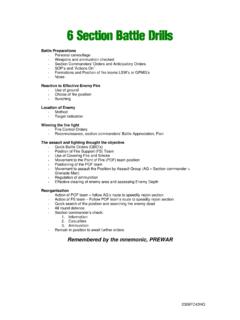
Transcription of A TACTICS MANUAL FOR AIRSOFTERS - The Milsim Perspective
1 A TACTICS MANUAL FOR AIRSOFTERS DERIVED FROM THE UNITED STATES ARMY RANGER HANDBOOK Edited 2010 By Dirtpro TABLE OF CONTENTS CHAPTER 1 LEADERSHIP 1-1. PRINCIPLES 1-2. DUTIES, RESPONSIBILITIES, AND ACTIONS 1-3. ASSUMPTION OF COMMAND CHAPTER 2 OPERATIONS 2-1. TROOP-LEADING PROCEDURES 2-2. COMBAT INTELLIGENCE CHAPTER 3 MOVEMENT 3-1. TECHNIQUES 3-2. MOVEMENT IN LIMITED VISIBILITY CONDITIONS 3-3. DANGER AREAS CHAPTER 4 PATROLS 4-1. PRINCIPLES 4-2. PLANNING 4-3. RECONNAISSANCE PATROLS 4-4. COMBAT PATROLS 4-5. SUPPORTING TASKS 4-6. MOVEMENT TO CONTACT CHAPTER 5 battle drills section I. INTRODUCTION 5-1. DEFINITION 5-2. FORMAT section II. DRILLS 1. REACT TO CONTACT 2. BREAK CONTACT 3. REACT TO AMBUSH 4. KNOCK OUT BUNKERS 5. ENTER BUILDING/CLEAR ROOM 6. ENTER/CLEAR A TRENCH 7. REACT TO INDIRECT FIRE CHAPTER 6 EVASION 6-1. EVASION CHAPTER 7 RANGER URBAN OPERATIONS 7-1.
2 TYPES 7-2. PRINCIPLES 7-3. METT-TC 7-4. CLOSE QUARTERS COMBAT 7-5. REHEARSALS 7-6. TIPS FOR MARKING BUILDINGS AND ROOMS CHAPTER 8 VEHICLE CONVOY OPERATIONS 8-1. PLANNING CONSIDERATIONS 8-2. FIVE PHASES OF TRUCK MOVEMENT 8-3. CONVOY TECHNIQUES REACT TO AMBUSH (NEAR) REACT TO AMBUSH (FAR) CONVOY FORCED TO STOP (METHOD 1) CONVOY FORCED TO STOP (METHOD 2) BREAK CONTACT GLOSSARY APPENDIX A - RESOURCES REACT TO INDIRECT FIRE REACT TO CONTACT REACT TO NEAR AMBUSH REACT TO FAR AMBUSH BREAK CONTACT FORMATIONS AND ORDER OF MOVEMENT LINKUP LINEAR DANGER AREA LARGE OPEN DANGER AREA CROSSING A SMALL OPEN AREA SQUAD ATTACK RAID BOARDS MIDDLE (ACTIONS ON OBJECTIVE) AMBUSH BOARDS (HQ through ASSAULT) APPENDIX B - QUICK REFERENCE CARDS INFANTRY LEADER'S REFERENCE CARD STANDARD RANGE CARD, PDF STANDARD RANGE CARD, FPL STANDARD RANGE CARE, BLANK Chapter 1 LEADERSHIP Leadership, the most essential element of combat power, gives purpose, direction, and motivation in combat.
3 The leader balances and maximizes maneuver, firepower, and protection against the enemy. This chapter discusses how he does this by exploring the principles of leadership (BE, KNOW, DO); the duties, responsibilities, and actions of an effective leader and the leader's assumption of command. Abbreviations and terms in this chapter: ACE Ammunition, Casualty, and Equipment FRAGO Fragmentary Order FIRE TEAM Team Leader, Rifleman, Grenadier, Automatic Rifleman HQ Headquarters METT-TC Mission, Enemy, Terrain (and weather), Troops (and support) available, Time available, Civil considerations OP Observation Post ORP Objective Rally Point PIR Priority Intelligence Requirements PL Platoon Leader PLATOON 3 Squads, 1 Weapons Squad, Platoon Leader, First Sergeant, Platoon Sergeant PSG Platoon Sergeant SALUTE Size, Activity, Location, Unit/Uniform, Time, and Equipment SL Squad Leader SOP Standard Operating Procedures SQUAD 2 Fire Teams, Squad Leader TL Fire Team Leader 1-1.
4 PRINCIPLES. The principles of leadership are BE, KNOW, and DO. a. BE Technically and tactically proficient Able to accomplish to standard all tasks required for the wartime mission. Courageous, committed, and candid. A leader with integrity. b. KNOW Yourself, and the strengths and weaknesses in your character, knowledge, and skills. Seek continual self improvement, that is, develop your strengths and work to overcome your weaknesses. Your Operators, and look out for their well-being by training them for the rigors of combat, taking care of their physical and safety needs, and disciplining and rewarding them. c. DO-- Seek responsibility and take responsibility for your actions; exercise initiative; demonstrate resourcefulness; and take advantage of opportunities on the battlefield that will lead to you to victory; accept fair criticism, and take corrective actions for your mistakes.
5 Assess situations rapidly, make sound and timely decisions, gather essential information, announce decisions in time for Operators to react, and consider the short- and long-term effects of your decision. Set the example by serving as a role model for your Operators. Set high but attainable standards; be willing do what you require of your Operators; and share dangers and hardships with them. Keep your subordinates informed to help them make decisions and execute plans within your intent, encourage initiative, improve teamwork, and enhance morale. Develop a sense of responsibility in subordinates. Delegate to show you trust them. This makes them want more responsibility. Ensure the Operators understand the task; supervise them, and ensure they accomplish it. Operators need to know what you expect: when and what you want them to do, and to what standard. Know your unit's capabilities and limitations, and employ them accordingly.
6 1-2. DUTIES, RESPONSIBILITIES, AND ACTIONS. To complete all assigned tasks, every Operators in the patrol must do his job. Each must accomplish his specific duties and responsibilities and be a part of the team. a. SQUAD LEADER (SL) Is responsible for what the squad does or fails to do. He is a tactical leader who leads by example. (1) DUTIES Keeps the PL and PSG informed on status of squad. Submits ACE report to PSG. (2) ACTIONS THROUGHOUT THE MISSION Obtains status report from team leaders and submits reports to the PL and PSG. Makes a recommendation to the PL/PSG when problems are observed. Delegates priority task to team leaders, and supervises their accomplishment IAW squad leader s guidance. Uses initiative in the absence of orders. Follows the PL s plan and makes recommendations. (3) ACTIONS DURING MOVEMENT AND HALTS Ensures heavy equipment is rotated among members and difficult duties are shared.
7 Notifies PL of the status of the squad. Maintains proper movement techniques while monitoring route, pace, and direction. Ensures the squad maintains security throughout the movement and at halts. Prevents breaks in contact with the platoon or HQ Ensures subordinate leaders are disseminating information, assigning sectors of fire, and checking personnel. (4) ACTION IN THE OBJECTIVE AREA Ensures special equipment has been prepared for actions at the objective. Maintains positive control of squad during the execution of the mission. Positions key weapons systems during and after assault on the objective. Obtains status reports from team leaders and reports status to PL. (5) ACTIONS IN THE PATROL BASE Ensures patrol base is occupied according to the plan. Ensures that his sector of the patrol base is covered by interlocking fires; makes final adjustments, if necessary.
8 Sends out LP or OPs in front of assigned sector. (METT-TC dependent). Ensures priorities of work are being accomplished, and reports accomplished priorities to the PL and PSG. Adheres to time schedule. Ensures personnel know the alert and evacuation plans, and the locations of key leaders, OPs, and the alternate patrol base. b. WEAPONS SQUAD LEADER Is responsible for all that the weapons squad does or fails to do. His duties are the same as those of the squad leader. Also, he controls the machine guns in support of the patrol's mission. He advises the PL on employment of his squad. (1) DUTIES Supervises machine gun teams to ensure they follow priorities of work. Assists PL in planning. Positions at halts and danger areas and according to the patrol SOP any machine guns not attached to squads. Submits ACE report to PSG. Designates sectors of fire, principal direction of fire and secondary sectors of fire for all guns.
9 Gives fire commands to achieve maximum effectiveness of firepower: Shifts fires. Corrects windage or elevation to increase accuracy. Alternates firing guns. Controls rates of fire and fire distribution. Knows locations of assault and security elements, and prevents fratricide. Reports to the PL. c. TEAM LEADER (TL) Controls the movement of his fire team and the rate and placement of fire. To do this, leads from the front and uses the proper commands and signals. Maintains accountability of his Operators. Ensures his Operators maintain unit standards in all areas, and are knowledgeable of their tasks and the operation. The following checklist outlines specific duties and responsibilities of team leaders during mission planning and execution. The TL leads by example: (1) ACTION IN THE ORP Assists in the occupation of the ORP. Helps supervise, establish, and maintain security.
10 Supervises the final preparation of Operators, weapons, and equipment in the ORP in accordance with the SL's guidance. Assists in control of personnel departing and entering the ORP. Reorganizes perimeter after the reconnaissance party departs. Maintains communication with higher headquarters. Upon return of reconnaissance party, helps reorganize personnel; ensures accountability of all personnel. Disseminates PIR to his team. Performs additional tasks assigned by the SL. (2) ACTIONS IN THE PATROL BASE Inspects the perimeter to ensure team has interlocking sectors of fire. Enforces the priority of work and ensures it is properly accomplished. Performs additional tasks assigned by the SL and assists him in every way possible. d. MEDIC Is responsible to get to and carry out the field or game required procedure to heal friendly Operators. Despite his status as a Medic, he is primarily a rifleman and must contribute to the unit as such while performing his other duties.