Transcription of Table of Contents Workers Compensation Examiner Training ...
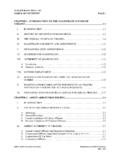
1 Table of Contents Workers Compensation Examiner Training Manual Workers Compensation Definition 3 Who is 5 Conditions 6 Compensability 7, 8, 9 Injuries covered by 10 How state provides coverage .. 11 Statutory 12 Org 13, 1 4 Process and Procedures for handling 15, 1 6 Supervisor Roles ..17 Workers Compensation Coordinators Roles .. 18, 19 Workers Compensation Examiner , 2 1, 2 2 Types of Claims ..23 Claim - 28 3 point - 31 Recorded Statements ..32 - 34 3- day waiting period .. 35 - 39 Benefits .. 40 Medical ..41, 42 IME ..43, 44 Bill paying .. 45 - 54 TTD .. 55 Forms 13a and 13 ..56-61 Benefits for Job Related Injury .. 62, 63 TPD defined ..64, 65 TPD worksheet ..66, 67 PPD ..68 - 71 WKC-16 ..72-74 PTD ..75, 76 LOEC .. 77 Death ..78 Mileage .. 79, 80 Mental/Psychological/Stress Claims ..81 - 84 Unique Claims ..85 Hearing Loss .. 86 Lymes/Tick Bites .. 87 TB ..88, 89 MRSA .. 90 - 92 Hepatitis A, B, C and HIV.
2 93 - 95 Reserving ..96 - 100 Claim Management Services ..101, 102 Referring claim to Vendor .. 103 At Litigation Process ..105 - 108 Answer to Application .. 109 Subrogation ..110, 111 Third party Distribution From .. 112 Subrogation Checklist .. 113, 114 DWD requirements and reporting ..115 - 119 Statute of Limitations .. 120 Fraud ..121 - 126 Custom Letters .. 127 - 129 Terms to know .. 130 - 137 Resources used to create this manual: DWD Website: DOA Website: Chapter 102; Workers Compensation Act This manual was created by Laura Ellingson, Workers Compensation Program Manager Department of Administration, Bureau of State Risk Management February 2017 G:\Risk Management\ worker 's Compensation Program\Claims Procedures\MANUAL 2 What is Workers Compensation ? Workers Compensation covers the medical expenses and lost income of employees if they are hurt in the course of doing work-related activities in accordance with Chapter 102.
3 worker 's Compensation Brief History Before 1911, the only recourse to a worker who was injured in the course of his or her employment was to sue his or her employer in a civil or tort action, which was the same remedy available to a person injured under other circumstances. The tort remedy, however, had a major problem: it required the worker to prove that the injury occurred because the employer was negligent. In tort actions the employer had three almost unbeatable common law defenses: (1) that the worker was also negligent, (2) that the worker knew of the dangers involved and assumed the risk, or (3) that the injury occurred because of the negligence of a fellow employee. Under this system it was very difficult for Workers to recover against their employers. If they won, however, there were no dollar limits on what a jury could award. It is noted that after 1905 judges and juries in Wisconsin began returning verdicts more favorable to injured Workers .
4 This growing trend in tort litigation began to make employers nervous because they believed that as time went on more and more injured Workers would get more and more favorable verdicts. Thus for this reason, among others, many employers became increasingly open to the idea of eliminating tort litigation by adopting some sort of worker s Compensation program. In 1911, Wisconsin adopted a Workmen s Compensation Act. This remedy is essentially a no-fault system under which a worker no longer has to prove negligence on the part of the employer, and the employer s three common law defenses are eliminated. The intent of the law was to require an employer to promptly and accurately compensate a worker for any injury suffered on the job, regardless of the existence of any fault or whose it might be. In return, the WC Act limited the amount of money that a worker could recover. Thus, Workers are only entitled to (1) certain wage loss benefits, (2) the cost of medical treatment, (3) certain disability payments and (4) payments for vocational rehabilitation retraining.
5 Under the pre-WC Act tort system, Workers had been able to recover for pain and suffering, loss of enjoyment of life and other damages that a jury might award. This is no longer possible under the WC Act. 3 Since 1911 the WC Act has undergone numerous changes and refinements. However, the main values have not only remained intact but have also been strengthened. One of those values is universal coverage. Nearly all employers in Wisconsin are covered, including both public and private employers. The only employee exceptions to the WC Act insurance requirement are domestic servants, some farm employees, volunteers (including volunteers of non-profit organizations that receive money or other things of value totaling not more than $ per week) and religious sect members that qualify and are certified for an exemption. In addition there are a few classes of Workers who are covered by federal laws instead of the WC Act. 4 WHO IS COVERED BY THE worker 'S Compensation LAW?
6 All employees working for an employer (other than farmers) with three or more Workers are protected immediately by the worker 's Compensation Act. Employers with fewer than three Workers come under the law if they pay wages of $500 or more in any quarter of a calendar year. Their Workers are covered 10 days after the end of that quarter. Farm Workers are covered if the farm employer has six or more employees on 20 or more days in a calendar year. Nearly all Workers in Wisconsin are covered. This includes both public and private employers. Nearly all private and public employees in Wisconsin are covered under the Act, including employees who are family members (except for farmers in some cases), minors, part-time employees and corporate officers. There are a few classes of Workers who are covered by federal laws and are not covered by the Act. Employees of the federal government (such as postal Workers , employees at a veteran's administration hospital, or members of the armed forces) are covered by federal laws.
7 People who work on interstate railroads are covered by the Federal Employers Liability Act. Seamen on navigable waters are covered by the Merchant Marine Act of 1920, and people loading and unloading vessels are covered by the Longshoremen s and Harbor worker s Compensation Act. The only employee exceptions to the Act s insurance requirement are: (1) domestic servants, (2) any person whose employment is not in the trade, business, profession or occupation of the employer, (3) some farm employees, (4) volunteers, including volunteers of non-profit organizations that receive money or other things of value totaling not more than $ per week, (5) religious sect members that qualify and are certified for an exemption, (6) employees of Native American tribal enterprises (including casinos), unless the tribe elects to waive its sovereign immunity and voluntarily become subject to the Act. Virtually all other Workers and employers are subject to the Act 5 Section provides that liability for worker s Compensation shall exist under the Act only where the following conditions occur: the employee sustains an the time of the injury, both the employee and the employer aresubject to the provisions of the Act.
8 The time of the injury, the employee is performing service growingout of and incidental to his or her employee s injury has not been self accident or disease that causes the employee s injury arises out ofhis/her must be a hazard specific to the employment present.**Most important thing to remember: The injury has to arise out of employment and the employee has to be in the course of employment. not compensable?? INJURY DEFINED To become entitled to worker s Compensation benefits, an employee must sustain an injury defined in section (2) of the Wisconsin Workers Compensation Act. Injury defined: mental or physical harm to an employee caused by accident or disease. Some injuries caused by mental stress without trauma are excluded. ACCIDENTAL INJURY An injury is a fortuitous event, unexpected and unforeseen by the injured person. OCCUPATIONAL DISEASE Broadly defined, occupational diseases a mental or physical harm resulting from occupational exposure, but that is not as sudden or traumatic as to fir within the definition of an accident.
9 Example: 1. Carpal tunnel syndrome as a result of continual typing. 2. Hearing loss as a result of repeated exposure to loud machinery. 3. Cancer as a result of exposure to asbestos. The date of injury for an occupational disease is the date of disability or, the last day of work for the last employer that caused the disability. PERSONAL COMFORT DOCTRINE An employee who is on a coffee break, lunch break, smoke break, going to the washroom, getting a drink of water, or fresh is held not to have deviated from employment if he or she is on the employer s premises. The extent of departure has to be reasonable. FIGHTS An employee who deliberately engages in a fight with a co-employee has stepped out of the course of employment. 7 HORSEPLAY Employees participating in horseplay may still be compensated for injuries depending on the following factors: extent & seriousness of the completeness of the deviation ( whether it was.)
10 Abandonment of duty.) extent to which the practice of horseplay had become an acceptedpart of the employment, and extent to which the nature of employment may be expected toinclude some horseplay. GOING AND COMING An employee is in the course of employment when going to and coming from his or her employment in the ordinary and usual way WHILE ON THE EMPLOYER S PREMISES. PARKING LOT An employer s designated parking lot has been considered part of the premises. An employee is considered to be in the course of employment while taking a direct route between and employer s designated parking lot and the premises if he or she is going in the ordinary and usual way. If a direct route is not taken, the employee may be considered not to be in the course of employment, when while he or she is in the parking lot. TRAVELING EMPLOYEE An employee whose employment requires travel is deemed to be performing service in the course of employment at all times while on a trip, except when engaged in a deviation for purely private and personal purposed.