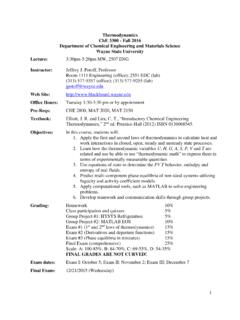
Transcription of SYLLABUS Smart Sensors Technology ECE 6570 Fall 2011
1 SYLLABUS Smart Sensors Technology I - College of Engineering - Fall 2011 No: ECE 6570/BME 6470/PHY 6570 Title: Smart sensor Technology I: Design Credits 4 WSU Catalog Description: Prereq: degree in engineering or science. Introduction to various types of Sensors and the design of basic circuit building blocks. sensor Portion: Weeks 1-16 9/1/11-12/21/11 Lecture Meeting Time & Location: Location: 3517 EDC (Engineering Bldg) Time: 3:30-5:20, Wednesday and Friday Office Hours: Monday and Wednesday 2:30PM-3:30PM Goals: This course is divided into two main categories (1) theoretical understanding of various physical phenomenon behind the operation of different types of Sensors and microsystems, (2) designing of Sensors with appropriate electronic interface as a complete system.
2 Various types of Sensors discussed during this course are magnetic, optical, bio, chemical, radiation, electrical and mechanical etc. In general the students are introduced to the current Technology of Sensors : electronic, photonic, microfluidics and new materials. The emphasis on the integration of electronics with Sensors to provide a Smart transducer or a system on a chip with multiple integrated devices. Learning Objectives: At the end of this course, students will be able to: 1. Select the right sensor for a given application. 2. Design basic circuit building blocks. 3.
3 Simulate, synthesize, and layout a complete sensor or sensor system, MEMS device or microsystem ready for fabrication tools. Textbook or Manual: Handouts posted on the Web 1. Handbook of Modern Sensors , 2nd Ed. By Jacob Fraden (Optional), 2. Semiconductor Sensors , Edited by S. M. Sze (Optional) Reference Text: none SYLLABUS Smart Sensors Technology I - College of Engineering - Fall 2011 Prerequisites by Topic: none Corequisites by Topic: none Topics: Week Date TOPIC 1 9/7/11 Principles of Sensing, Classification and Terminology of Sensors , Measurands.
4 Some basic discussion about electric field, potential, capacitance, resistance etc. 2 9/9/11 Acoustic and Magnetic Sensors 3 9/16/11 Mechanical Sensors 4 10/5/11 Radiation and Thermal Sensors 5 10/5/11 Chemical and Biosensors 6 10/12/11 Electronic Interface and Integrated Sensors /Design Projects/ Wireless integration 7 10/19/11 In class Exam (10/23/05) 8 10/26/11 (Lec) Electronics interfacing overview and Technology design rules 9 11/2/11 Introduction to Microsystems 10 11/9/11 MEMS microsystem components 11 11/16/11 Microfluitics microsystem components 12 11/30/11 (Microfluidics Continued microsystem components 13 11/30/11 Electronic/wireless integration 14 12/7/11 Putting it all together- system design 15 12/14/11 Final Exam 16 12/16/11 Design Report Due Assessment Methods: Midterm Exam: Exam will cover material from weeks 1-6 (25%) will take place on Friday, Oct.)
5 21st during class. Group Project: Presentation and report on December 7, 2011 (Wednesday) in rm 3517 50% ) Final Exam: December 14, 2011 ((25%) Grading Scale: A A- B+ B B- C+ C F >=90 >=85 >=80 >=75 >=70 >=65 >=60 <55 SYLLABUS Smart Sensors Technology I - College of Engineering - Fall 2011 Deferred Grades A grade of "I" will only be assigned if a student IS NOT currently failing the course and if there is NOT a substantial amount of work to be completed.
6 An "I" grade MUST be made up within one year of assignment of the grade. Assignment of an I grade will be at the sole discretion of the instructor. Attendance: You will be expected to attend class and participate in discussions regarding lectures by the instructor and your classmates. In order to do this, you should read the papers given to you prior to attending class. This will include handouts and reference lists or review articles as well as the papers written by your classmates. Blackboard Blackboard will be used throughout the course for communication among students and with the instructor.
7 Feel free to post both private and common questions. Written assignments will be turned in and distributed to other students via Blackboard. In order to use the system, you must log on through PipeLine. Please activate your Wayne email address, forwarding it to your standard email if you wish. This will be the address with which the class communicates with you. Withdrawal Policy The last day to drop any class with a tuition refund is the end of the second week of classes. The last day to withdraw from the class, without a notation of W on the transcript, is the end of the fourth week of classes.
8 All drop/add activity during the first 4 weeks should be done through Pipeline. Between the end of the fourth and fifth weeks, withdrawals require the permission of the instructor and must be submitted on a Drop/Add form to the Registrar s Office. It is the policy of the College of Engineering not to allow withdrawals from courses after the end of the 5th week except under exceptional circumstances. Failing a class is not an acceptable excuse for withdrawal after the 5th week. Withdrawals after this time require the permission of the Associate Dean for Academic Affairs.
9 Policy on Cheating It is the policy of the Electrical and Computer, Biomedical Engineering Programs that any instance of cheating will result in a grade of F for the course. Cheating is defined by the University as intentionally using or attempting to use, or intentionally providing or attempting to provide, unauthorized materials, information, or assistance in any academic exercise. This includes any group efforts on assignments or exams unless specifically approved by the professor for that assignment/exam. Evidence of fabrication or plagiarism, as defined by the University in its brochure Academic Integrity, will also result in downgrading for the course.
10 Please refer to the Expectations for Citation in Biomedical Engineering handout (attached and available on the web) and to the Departmental recommended book on scientific writing, for guidance. STUDENTS WHO CHEAT ON ANY ASSIGNMENT OR DURING ANY EXAMINATION WILL BE ASSIGNED A FAILING GRADE FOR THE COURSE. Therefore avoid all appearance of improper behavior! Students who witness cheating should report the incident to the instructor as soon as possible. Students are also welcome to discuss any concerns related to cheating with the instructor.