Transcription of STRING MUSIC CURRICULUM - Arlington Public Schools
1 1 STRING MUSIC CURRICULUM Arlington Public Schools Arts Education 2009 2 This STRING CURRICULUM was developed by: Serena Everett Gene Pohl Estelle Roth Kristin Snyder Carol Erion August 2008 3 GRADE 4-5 VBODA LEVEL I essential ELEMENTS BOOK 1 BASIC SKILLS Students will begin instruction on a STRING instrument of their choice. Instruction begins grade 4 and continues until the skill levels are mastered. Students will demonstrate proper care of the instrument, basic positions, tone production, fingerings, and will count, read, and perform the beginning level of MUSIC being studied.
2 Teachers will use available standard method books to deliver instruction with limited ensemble work. PERFORMANCE Demonstrate correct posture and playing position. 1. standing and sitting posture 2. consistently correct instrument position 3. left-hand shape 4. consistently correct bow hold a. thumb between frog and grip b. thumb opposite middle finger c. forefinger, middle, and ring fingers draped over bow d. pinkie and thumb rounded and on their tips The student will consistently produce tones that are clear, free of tension, sustained, and unwavering in pitch: 1.
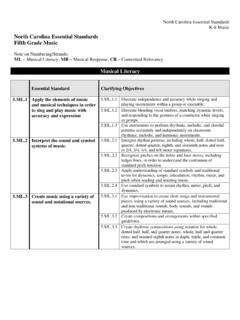
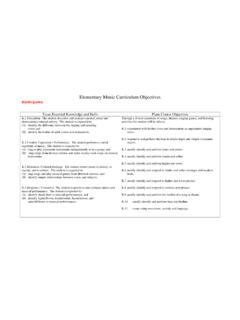
3 Demonstrate right-hand pizzicato over the fingerboard 2. demonstrate the ability to draw a straight bow at the proper contact point between the bridge and the fingerboard using an even bow speed The student will demonstrate the ability to adjust pitches while playing their instrument. The student will demonstrate a steady tempo while performing materials being studied. The student will use contrasting articulation: detache, pizzicato, slurring The student will demonstrate accurate execution of down bow, up bow, legato bowing, smooth STRING crossings, bow lifts, two-note slurs, and ties.
4 The student will perform selected one-octave major scales using simple bowings and rhythmic figures, ascending and descending: 1st Year: G, D 2nd Year: C, G, D, F 4 The student will perform rhythmic patterns using whole, half, quarter, eighth, dotted half, dotted quarter, and corresponding rests while maintaining a steady, rhythmic pulse. The student will use dynamic contrast as a means of expression: 1. p and f The student will demonstrate musical phrasing in materials being studied: 1. melodic contour 2. natural accents 3. use of bow The student will demonstrate ensemble skills: 1.
5 Balance: melody vs. harmony 2. match dynamic levels 3. respond to basic conducting gestures a. meter b. dynamics c. cueing d. cut-offs e. starting and stopping 4. maintain a steady tempo The student will sight read MUSIC of beginning difficulty. The student will sing selected lines from the material being studied. The student will imitate raising and lowering of pitch by ear, using his/her instrument. The student will imitate two-note pitch patterns . The student will perform MUSIC from a variety of cultures, styles, and historical periods. COMPOSING/ARRANGING The student will embellish two to four measures of a folk song after echoing sample rhythm examples found in folk materials being studied.
6 The student will compose a two- to four-measure melody using available technology and teacher-specified rhythms and pitches. 5 MUSICAL KNOWLEDGE The student will demonstrate knowledge of the instrument being studied: 1. identification of instrument parts 2. proper care and maintenance of the instrument The student will identify and count rhythm patterns from the instructional materials using an established rhythm -reading system. The student will provide answers to the instructor s questions regarding individual and group performance. The student will identify and define MUSIC terms and symbols from materials being studied: 1.
7 Letter names 2. location of notes in relation to the staff 3. fingerings and/or positions CONNECTIONS The student will identify secondary school orchestra opportunities in MUSIC . The student will demonstrate behaviors that result in increased MUSIC learning through a variety of MUSIC activities: 1. regular attendance with required materials 2. completion of assignments/practice 3. participation in class and performances 4. concert etiquette as a performer and listener The student will associate terminology common to MUSIC with other disciplines. The student will provide answers to the instructor s questions about cultures, styles, composers, and historical periods from materials being studied.
8 6 GRADE 6 VBODA LEVEL I-II-III essential ELEMENTS BOOK 2 BEGINNING ORCHESTRA PERFORMANCE The student will: Demonstrate correct posture and playing position. Demonstrate right-hand pizzicato over the fingerboard. Demonstrate correct left-hand position. Demonstrate comfort with all notes found in first position including backward and forward extensions. Perform selected one-octave Major scales using simple bowings and rhythmic figures: C, G, D, A, F, Bb, Eb Perform selected one-octave melodic minor scales using simple bowings and rhythmic figures: a, e, b, f#, d, g, c Display technical facility shifting up to third position.
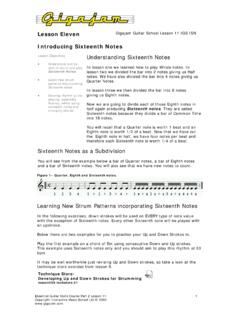
9 (bass) Demonstrate correct bow hold. Demonstrate the ability to draw a straight bow from the proper contact point between the bridge and the fingerboard using an even bow speed. Demonstrate characteristic tone production on all four strings. Demonstrate accurate execution of down bow, up bow, legato bowing, smooth STRING crossings, bow lifts, two- and three- note slurs, and ties. Demonstrate the ability to adjust piches. Perform rhythmic patterns using whole, dotted half, half, dotted quarter, quarter, eight, sixteenth, and corresponding rests while maintaining a steady, rhythmic pulse.
10 7 Demonstrate unison and beginning ensemble skills with emphasis on balance and tuning. Respond to basic conducting patterns in simple meters. Vocalize selected lines from materials being studied. Demonstrate knowledge of simple phrase structures and melodic contours by use of bow speed and dynamics. Use sound reproduction equipment such as tape recorders, compact disc players, etc. to interact with recorded accompaniments. Perform repertoire representing a variety of diverse world cultures. Perform repertoire at the grade I and II levels as identified in the VBODA manual.