Transcription of Lesson Plan: Health Insurance
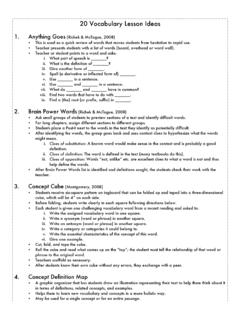
1 Lesson plan : Health Insurance Submitted by Marcia Allen, Murphysboro high school , Murphysboro, Illinois. Ms. Allen is a 2002 graduate of the Insurance Education Foundation (IEF), Insurance Education Institute at Illinois State University, Normal, Illinois. For more information on the Insurance Education Foundation, access the following Web Site: Subject: Consumer Economics Grade Level: 11 - 12 Length: One Class Period Objective: Students will be able to apply their knowledge of Health Insurance definitions by taking scenarios and determining the cost to the consumer and the cost to the Insurance company. Materials: Student - pen or pencil, page of scenarios and worksheets Teacher - copies of scenarios, transparency and overhead projector Background: Students will have completed Health Insurance vocabulary assignments found in most textbooks.
2 Activities: The teacher will present an example of how deductibles, co- Insurance , stop loss points, limits of policy, and exclusions are applied in a Health Insurance problem. Show-Me Standards: For more information access the MO Department of Elementary and Secondary Education website at: Knowledge Standards: Communication Arts (1, 2, 6) Health /Phys Ed. (6) Mathematics (1, 3) Science (8) Social Studies (4) Performance Standards: 1-5, 1-8, 1-10, 2-3, 2-7, 3-1, 3-2, 3-4, 3-5,3-6, 3-7, 3-8, 4-1, 4-5, 4-6 33 Sure, mom and dad s policy covers you now, butsoon you re going to have to make some you head out on your own, who will coveryou when you re sick? Most people will find healthcoverage through their employer. Some peopleown their own business and are not offered healthinsurance, or want an individual policy.
3 Here issome information to use when shopping you re headed out on your family policies will cover a dependent (you)while you re in the house and under the age of19. Once you are out on your own, the first thingyou need to know is whether or not your employeroffers Health Insurance . If not, you should startlooking for an individual policy. Dont wait untilthat first ER trip gets you $10,000 in you re headed to the military often will send you to the infirmarywhen you re sick. They may also cover you whenyou re off base. Most individual policies will notcover someone while they are on military duty. Ifyou are looking into a separate policy, rememberto read the you re headed to your parents policy.
4 If you are listed as adependent on your parents tax return andmaintain a full-time student status, you couldprobably stay on their policy. If the college isoffering a student Health policy, read the policyvery carefully. Some policies cover you adequately,but some may be lacking coverage important medical policies: generally have adeductible and a co- Insurance with a lifetimemaximum limit. (This is usually $1M or more)These policies cover medically necessary doctorvisits and hospitalizations along with physicaltherapy, outpatient surgery, etc. This type of policycan be offered with or without a PPO networkprovision. This offer would be up to the policies: Health Maintenance Organizationsoffer coverage similar to that of a major medicalpolicy.
5 These policies have co-payment obligationsfor you for the various covered benefits. This is amanaged care plan where you choose your primarycare physician (PCP) from a list of networkproviders. Your PCP is typically responsible forthe management of most aspects relating to yourhealthcare. HMOs require that an in-networkdoctor provide care in order to have your claimpaid by the HMO. (There are exceptions foremergency room care) Be sure to read the policyrelated to emergency room care coverage. ManyHMOs require referrals and pre-authorizations forany care other than a PCP visit. Be sure youunderstand your contract and your obligations forgetting referrals and pre-certifications before youreceive treatment. These policies will also haveexclusions and non-covered services in the sameway as a major medical policy.
6 Make sure youunderstand the limitations on your policies: Preferred Provider Organizationsprovide consumers with economic incentives ifthey contract to patronize a particular group ofhealthcare providers. There are many types andstyles of PPOs. One common style of PPO maypay 80/20 if you go to a doctor that is in thenetwork of providers. The PPO will pay for 80%of your bill; you pay 20% after any applicabledeductibles. If you go out of the network, theamount a PPO pays will change (usually less).hospital/surgical policies: offer a schedule ofbenefits for specific services. These policies listthe medical service and the maximum the policywill pay for each service. For example the schedulewill list various types of surgery with a limit.
7 Theremay be limits on the payment toward surgeon fees,daily hospital room fees, etc, regardless of theactual cost of the service. These policies alsoStep 1: Learn the basicsStep 2: Cover yourself Sick Insurance23 Don t1 RISKITStep 2: Cover Yourself4 Types of Box 690 Jefferson City, MO 651021-800-726-7390 exclusions and exceptions, so read thecontract policies: offer a fixed amount ofpayment for the type of service or disease or indemnity and specified disease (Cancergenerally) policies pay limited amounts. The policywill chart out when coverage is applicable andwhat the specific amount is that they will & customary charges: the company has astandard rate for a procedure or visit. If the doctorcharges above that amount, they exceed thecompany s usual and customary amount.
8 Co- Insurance : the amount you pay to the doctoror provider at the time of service. The doctordirectly collects this amount of your shared costof Insurance . Co-pays are listed as example a 70/30 plan means the company pays70% and your shared cost is 30%.deductible: the specific amount of claims you willpay before the company pays. The higher yourdeductible, the lower your premium can : a certain amount that you pay for medicalcosts. For example, you pay $5 every time youhave a prescription conditions: a condition that occursbefore you get Health coverage. Companies canand do exclude coverage for pre-existingconditions. Once you get sick or are diagnosedwith a Health condition, it is usually too late toget coverage.
9 If you do find coverage, the pricewill be higher or the options will be : GET Health COVERAGE WHILE YOU AREHEALTHY!waivers and exclusions: some companies developpolicies with certian exclusions in mind. A policyexclusion is a statement that the company willnot pay for certain types of accidents orsicknesses. A aaiver becomes part of the policyafter you sign it. A waiver usually is put togetherfor the company to exclude a specific illness youmay have or a previous injury. Most waivers arepermanent. Waivers may come off of a policy onlywhen you and the company agree to take themoff. If you sign a waiver, most of the time theonly way to get coverage is to go buy a new : HMO and PPO plans are required toprovide a way for you to appeal coverage orbenefit decisions you believe are wrong.
10 If youthink your claim is incorrectly denied or you arebeing treated unfairly, state law requires plans toadminister a process to resolve those gives you a quick and inexpensive way toresolve a grievance, but you still have the right tosue the plan if : some plans require that you pre-certify a healthcare service or procedure. If thepolicy states that prior approval by the companyis needed, you may be stuck with the bill if youdo not get a Bob s PPO states that his co- Insurance is 80 s bill just came in at $ The PPO pays$____ and Bob pays the doctor $_____?2. Heather signed a waiver that says her pre-existingcondition for bad hair coloring will not be signed up for an indemnity plan that pays forbasic accidents and sicknesses.