Transcription of Employment trends in textiles and apparel, 1973-2005
1 24 Monthly Labor Review August 1997 Textile and apparel Employment TrendsTextile and apparel Employment TrendsTextile and apparel Employment TrendsTextile and apparel Employment TrendsTextile and apparel Employment TrendsTextile and apparel Employment TrendsEvery industry in the American economyhas been affected in some way by in-creased globalization and new develop-ments in technology. Few, however, have feltthe effects of these trends more acutely than thetextiles and apparel industries. Indeed, thesefactors have been the primary reasons for thealmost continuous Employment decline in theindustries for nearly 25 years. In 1973, for ex-ample, there were more than million textileand apparel workers employed in the UnitedStates; by 1996, that figure had dropped to This 39-percent decline contrasts withthe 8-percent decline among all manufacturingworkers, and the 56-percent rise in employmentamong all workers over the same period.
2 In ad-dition, job losses appear to be intensifying inthe textile and apparel industries, and are pro-jected to continue in the coming much of the job loss resulted from textilemills and apparel factories going out of business inthe face of fierce domestic and international com-petition, a significant part of the decrease wascaused by efforts made by companies to survive. Inthe past few decades, textile and apparel compa-nies have been struggling to reinvent investing in new technologies, merging to re-duce costs, employing offshore plants to performcertain operations, and developing new productsand services, they have been attempting to find aniche in the international market.
3 According tosome measures, they have been successful, as pro-duction has remained stable and many companieshave been profitable. On the basis of other mea-sures, however such as Employment and foreigntrade balances they have not fared as emerges from recent changes in the in-ternational economy and the domestic textile andapparel industries is a complex picture of job lossand survival strategies. This dynamic is likely toincrease in the coming years, as internationaltrade continues to grow. As a result, employmentdeclines are expected to continue. Still, as manyfirms adapt to the changes, the textile and ap-parel industries will remain an important pro-vider of jobs, with Employment projected to bemore than million in the year This ar-ticle examines Employment trends in the textileand apparel industries, reviewing the likelycauses of both the recent historical and projecteddeclines, their varied effects across occupationalgroups, and the response American producershave developed to adapt to rapidly changing eco-nomic realities.
4 It attempts to sketch how the in-dustry and its workers will fare in an uncertainand rapidly changing two industriesThe two industriesThe two industriesThe two industriesThe two industriesAlthough the terms textile industry and ap-parel industry often are used interchangeably,they represent two distinct, albeit closely related, The two industries are importantlinks in the chain of production and distributionresponsible for providing consumers with cloth-ing as well as a number of other products. Tex-tile mills not only manufacture yarn, thread, andfabric for clothing, but also such products as car- Employment trends in textilesEmployment trends in textilesEmployment trends in textilesEmployment trends in textilesEmployment trends in textilesand apparel , 1973 2005and apparel , 1973 2005and apparel , 1973 2005and apparel , 1973 2005and apparel , 1973 2005 Mark MittelhauserMark Mittelhauser is aneconomist in theOffice of EmploymentProjections, Bureau ofLabor globalization and new technology were leadingfactors in recent Employment declines.
5 Although the declinesare expected to continue, the industries will remain an importantprovider of jobs, employing million workers in 2005 Monthly Labor Review August 1997 25peting, automotive upholstery, fire hoses, cord, and major processes in these highly automated mills includeyarn spinning, weaving, knitting, tufting, and nonwoven pro-duction. Although Employment is widely distributed through-out the different sectors of the industry, most workers areinvolved in the manufacture of products eventually used tomake apparel . In 1996, the textile industry employed 624,000workers (table 1), with the majority working in three States:Georgia, North Carolina, and South Also, nearlyhalf of the textile workers employed in 1996 were workers, on the other hand, convert fabrics pro-duced by the textile industry into clothing and other finishedgoods, eventually to be sold on the retail market.
6 In additionto being cut, sewn, and assembled, these garments and otherproducts must be designed, spread, pressed, dyed, washed,and transported to consumers functions requiring a varietyof occupations. Still, sewing machine operators, who performthe most labor-intensive step in apparel production, make upthe most common occupation in the industry. In part becauseapparel production is more labor-intensive than textile pro-duction, the apparel industry employs more workers about864,000 in 1996. (See table 1.) Most of these jobs are foundin eight States: Alabama, California, Georgia, New York,North Carolina, Pennsylvania, Tennessee, and Also,nearly three-quarters of the employees working in the ap-parel industry in 1996 were women, compared to about a thirdof the workers in the entire manufacturing Employment trendsHistorical Employment trendsHistorical Employment trendsHistorical Employment trendsHistorical Employment trendsAlthough a number of differences exist between the two in-dustries, they both share a recent history of Employment de-clines.
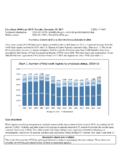
7 Between 1973 and 1996, nearly a million jobs were lostin the textile and apparel industries combined a decline ofnearly 40 percent. Although the number of jobs lost in apparelwas greater than in textiles , in percentage terms, both indus-tries declined by similar amounts. Not surprisingly, employ-ment fell most rapidly during periods of economic downturn especially the 1973 75 recession. In each of the subsequentrecoveries, however, Employment failed to return to prere-cession levels. As the current expansion got underway in theearly 1990s, it appeared that the industries might receive somerespite from job losses (especially in textiles ). But over the lastfew years, the rate of job loss has increased again with morethan 50,000 textile jobs lost from 1994 to 1996, and 143,000apparel jobs lost from 1993 to 1996.
8 (See chart 1.)The recent acceleration in job losses was due to a numberof factors, but the primary reasons seem to have been growthof imports and increases in productivity. Recent declines, forinstance, occurred in the context of investment in new tech-nological advancements and recent trade agreements thathave significantly altered trade regulations. The followingsections examine how these trends have affected textile andapparel trade and of the most salient trendsin recent years has been the growing interconnectedness of theinternational economy . Globalization has been driven by manyforces, including technological advances in transportation,communication, and production, as well as the worldwidesearch for markets.
9 These developments have allowed interna-tional investors and entrepreneurs to take advantage of differ-ing production costs by locating factories and offices in a num-ber of countries. As a result, a garment could be designed inNew York, produced from a fabric made in Australia, spreadand cut in Hong Kong, assembled in China, and eventuallydistributed in a result of these and other factors, textile and apparelproduction has grown rapidly in recent years in less-devel-oped countries (LDC s), such as China, Mexico, and Indone-sia. According to the International Trade Commission,roughly half of the total productive capacity in the apparelindustry has shifted from developed countries to LDC s overthe past three Many of these nations now play akey role in textile and apparel trade with the United States, asis clear from the data on exports and imports.
10 Several LDC sare among the top 10 countries receiving textile and ap-parel exports. As for imports, the largest supplier to the UnitedStates is China, followed by Hong Kong, Mexico, Taiwan,and South Korea. (See tables 2 and 3.) Among the major sup-pliers, apparel imports are growing most rapidly fromMexico, the Dominican Republic, Indonesia, and Theprimary incentive for transferring certain phases of produc-tion to LDC s is the lower cost of labor in these countries. It isestimated, for example, that the average apparel worker inHonduras earns about 10 percent of the hourly wage of acomparable worker in the United and apparel imports have grown substantially inrecent years, even under the Multifiber Arrangement (MFA), Employment in the textile and apparel industries, Employment in the textile and apparel industries, Employment in the textile and apparel industries, Employment in the textile and apparel industries, Employment in the textile and apparel industries,19961996199619961996[In thousands]Industry titleIndustry titleIndustry titleIndustry titleIndustry titleEmploymentEmploymentEmploymentEmplo ymentEmploymentTextile mill products.