Transcription of A STUDY OF APPLICABILITY OF HAMILTON DEPRESSION …
1 PISSN: 0976 3325 eISSN: 2229 6816 National Journal of Community Medicine Vol 3 Issue 2 April-June 2012 Page 247 ORIGINAL ARTICLE A STUDY OF APPLICABILITY OF HAMILTON DEPRESSION RATING scale IN A TERTIARY PSYCHIATRY CLINIC OF KOLKATA Ghosal Malay1, Debnath Asish2, Mondal Sukhendu3, Chowdhary Ranadip4, Mallik Sarmila5 1 Professor & Head1, Department of Psychiatry, Medical College& Hospital, Kolkata, 2 RMO, 3 Post Graduate Trainee, Department of Psychiatry, 5 Associate Professor, Department of Community Medicine Calcutta National Medical College & Hospital 4 Post Graduate Trainee, Department of Community Medicine, Kar Medical College ABSTRACT Background: According to WHO, DEPRESSION has been ranked fourth in the list of most urgent health problem Worldwide. One of the thumbing blocks in assessing DEPRESSION is the lack of objective set of measurements for its diagnosis.
2 Most often used is still the HAMILTON DEPRESSION scale (HAM-D) besides Montgomery Asberg DEPRESSION scale is increasingly used in antidepressant drug trials. Objective: The objective of the STUDY is to single out the unnecessary items of HAM-D, to develop a shorter form of the scale excluding such items and then validate it against Montgomery-Asberg DEPRESSION Rating scale (MADRS) an acceptable, standard scale for measuring DEPRESSION in socio-demographic set up like that of India. Methods: After identifying the patients with inclusion and exclusion criteria; two separate clinician of Psychiatry department of Calcutta Medical College used HAM-D & MADRS, one used HAM-D & other MADRS in one time, and in other time it is reversed. Two are totally blind to each other, to whom they used what scale in each time. Then the data were analysed for reliability and validity of HAM-D in SPSS version.
3 Results: The internal consistency of HDRS-17 is Cronbach s Alfa is scale -mean with item 9 deleted is & if item 17 is deleted then scale mean is The Cronbach s alpha is very similar if the item-9 & 17 are deleted. Conclusion: It can be concluded that as HDRS and MADRS have different levels of sensitivity over the severity spectrum of DEPRESSION , none of them is singularly satisfactory in assessment of DEPRESSION severity in the STUDY population. Key words: HAMILTON DEPRESSION scale (HAM-D), Montgomery-Asberg DEPRESSION Rating scale , Reliability, Validity INTRODUCTION According to WHO, DEPRESSION has been ranked fourth in the list of most urgent health problem World Studies quoted by Kapur & Singh and Venkoba Rao reveal that clinically recognizable depressive disorders are as common in India as in the Western world ;they were estimated to affect 3-5% in community survey carried at that From the mental health point of view, it is important to make an accurate diagnosis, carry on a systematic follow up and provide optimum treatment of DEPRESSION .
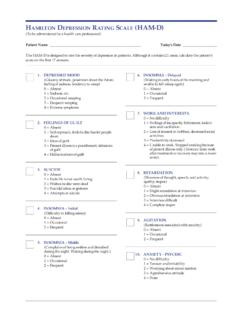
4 One of the thumbing block in assessing DEPRESSION is the lack of objective set of measurements for its diagnosis. Most often used is still the HAMILTON DEPRESSION scale (HAM-D) 3, 4 besides Montgomery Asberg DEPRESSION scale is increasingly used in antidepressant drug HAMILTON DEPRESSION Rating scale (HAM-D) has enjoyed a long and glorious reign as the most widely used DEPRESSION -rating scale in the world. It was published by Max HAMILTON in 1960 to measure the severity of DEPRESSION in pISSN: 0976 3325 eISSN: 2229 6816 National Journal of Community Medicine Vol 3 Issue 2 April-June 2012 Page 248 previously diagnosed depressed patients and quantitatively evaluate antidepressant s efficacy particularly tricyclic , 7, 8 Each of the 17 items HAM-D is concerned with semi-global symptoms these items were chosen because they are the most common symptoms of depressive illness.
5 Some items are defined in terms of a series of categories of increasing intensity ( Item, 2 Guilt), while others are defined by a number of term with equal values ( Item 13, somatic symptoms). However some symptoms often found with atypical DEPRESSION are not rated at all (hypersomnia, weight or appetite increase), and some so called endogenous symptoms are not covered, Quality of mood. In this scale , behavioral and somatic features account for at least 50% of the possible total Of the 17 items some items including somatic symptoms, increase the total score, particularly in the socio-demographic setting of developing nations like India. It has long been argued and demonstrated that in the patient-population of countries like India, somatic presentation of DEPRESSION are more commonly encountered than in the developed countries.
6 So extra emphasis on somatic symptoms may unduly increase severity in the depressive disorder and also misdiagnose somatoform disorder as depressive disorder. Also diurnal variation, one of the measurements of HAM-D, does not measure severity but only typing the DEPRESSION . Depersonalization derealisation, paranoid symptoms, obsession these items of HAM-D are very rare in depressive patients6. Montgomery and Asberg developed a DEPRESSION rating scale that is superior to HAM-D, called Montgomery-Asberg DEPRESSION Rating scale to assess the severity of DEPRESSION and also it can be used to monitor patients state over time. It has 10 items. Each item score range from 0 (normal) to 6 (severe DEPRESSION ). Minimum score is 0 and maximum score is 60.
7 The higher the score, the greater the degree of So, aims of the present STUDY are to single out the unnecessary items of HAM-D, to develop a shorter form of the scale excluding such items and then validate it against Montgomery-Asberg DEPRESSION Rating scale (MADRS) an acceptable, standard scale for measuring DEPRESSION in socio-demographic set up like that of India. METHODS & MATERIALS Inclusion Criteria: All patients of first episode of major depressive disorder diagnosed by DSM-IV-TR, attending the Psychiatry outdoor department in Calcutta Medical College & Hospital, patients aged in between 18 to 60 years of age group of Bengali speaking were taken in the STUDY . Exclusion Criteria: Any organic disorder including Medical, Surgical and Gynecological disorder associated with DEPRESSION , any type of substance abuse, any other associated diagnosed Psychiatric co-morbidity or past history of any Psychiatric illness, treatment resistant DEPRESSION , pregnant & lactating mother were excluded.
8 STUDY Location and Design: Scoring of two clinician rated instruments, HAM-D & MADRS are done by assessing the severity of first episode of Major Depressive disorder (diagnosed by DSM-IV-TR) patients attending Psychiatry outdoor department of Calcutta Medical College after using structured interview guide which increase the reliability of HAM-D and form shorter version of HAM-D. After that it is to be validated with MADRS. STUDY duration: One year. (Jan 2006- Dec 2006) Sample size: 103 patients who were attending Psychiatry department of Calcutta Medical College & Hospital who were suffering from 1st episode Major Depressive disorder as diagnosed by DSM-IV-TR and satisfied the inclusion & exclusion criteria during the STUDY period. Procedure: First permission of the ethical committee was taken.
9 We identified Bengali speaking of both sex between 18-60 years of age, coming to our Psychiatry department of Calcutta Medical College & Hospital and who met the criteria for Major Depressive disorder as defined in the diagnostic & statistical manual of Mental disorders, fourth edition, text revision (DSM-IV-TR) as first episode we strongly followed the inclusion & exclusion criteria. Then informed consents were taken from the STUDY subjects. Before giving HAMILTON DEPRESSION rating scale and MontgomeryAsberg DEPRESSION rating scale , structured interview guide were used to improve the reliability of the scale . Two separate clinician of Psychiatry department of Calcutta Medical College used HAM-D & MADRS, one pISSN: 0976 3325 eISSN: 2229 6816 National Journal of Community Medicine Vol 3 Issue 2 April-June 2012 Page 249 used HAM-D & other MADRS in one time, and in other time it is reversed.
10 Two are totally blind to each other, to whom they used what scale in each time. In this way each patient coming to Psychiatry department of Calcutta Medical College fulfilling inclusion & exclusion criteria were given HAM-D first by one clinician that took 15-20 minute & MADRS by another clinician that took also 15 minute. Total score calculated in HAM-D & MADRS & total score calculated in each patient. After taking all these data from each of 103 patients, they are to be put into computer and analysis is to be done to assess exact reliability & validity of HAM-D. Reliability, internal consistency of total 17 items are to be seen, and also after dropping each item, internal consistency is to be seen. We also see inter item co-relation of each pair item with total item, each item with total 17 items HAM-D.