Transcription of Managing neonatal abstinence syndrome - Joint Commission
1 (Cont.) Legal disclaimer: This material is meant as an information piece only; it is not a standard or a Sentinel Event Alert. The intent of Quick Safety is to raise awareness and to be helpful to Joint Commission -accredited organizations. The information in this publication is derived from actual events that occur in health care. The Joint Commission , Division of Health Care Improvement Issue 27 September 2016 Managing neonatal abstinence syndrome Issue: neonatal abstinence syndrome (NAS) is a drug withdrawal syndrome experienced shortly after birth by infants who were exposed to opioids in ,2 Symptoms of NAS include hyperirritability, excessive crying, poor sleep, poor feeding, diarrhea, hypertonia and ,3 Other symptoms include autonomic instability, poor sucking reflex, and in some cases, This issue has grown substantially over the last decade, in part due to a surge in opiate usage (methadone, heroin, morphine, hydrocodone, and oxycodone) during NAS is no longer considered to be an issue only for infants born to mothers who used illicit drugs, as maternal pain prescriptions have increased.
2 Heroin abuse has also increased, correlating to pregnant women with risky lifestyles, minimal prenatal care, and social, nutritional, physical and mental health ,3 Between 2004 and 2013, NICU admissions increased almost threefold, with an increased length of stay from 13 to 19 Infants with NAS are more than twice as likely to be readmitted within 30 days after discharge due to drug withdrawal compared to uncomplicated term Mothers using opiates and newborns with NAS are more likely to be covered by Medicaid and live in a low-income zip code. The increase in NAS also contributes to significantly increased hospital charges. Thus, this issue also has relevance to state Medicaid budgets, prompting the need for better NAS management strategies and Providing more efficient and effective care for pregnant women using opiates and their newborns could reduce these charges and potentially shorten length of stay.
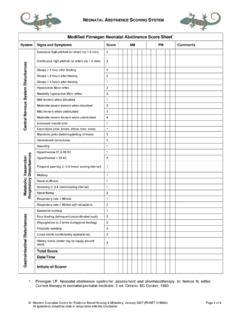
3 Evaluation, clinical practice guidelines, pharmacological therapy and recommendations For initial evaluation of withdrawal severity, the Finnegan Scoring System (FSS) tool is widely recommended. This system examines 21 behaviors associated with withdrawal, and recommends scoring the newborn every three to four hours until 48 hours after pharmacologic agents are The FSS may be used for either opioid or nonopioid withdrawal The FSS scoring system needs to be standardized and monitored for interrater reliability for maximum Also, this scoring system is designed for term infants, and thus is nonapplicable to preterm infants or infants over 30 days If there are issues with excessive variability in the FSS scores, super users may be trained on correct usage of the FSS, who then can train remaining nursing staff.
4 Instructional videos also may be Practice guidelines recommend Managing NAS both with clinical actions and nurse-driven interventions. For mild withdrawal cases, nonpharmacological therapy may be adequate. Continuous supportive care may help avoid pharmacological interventions and may promote earlier Maternal-dyad care is beneficial, rather than treating the infant alone. Mothers should be educated regarding addiction, and breastfeeding support should be With an initial and ongoing assessment of the mother s readiness, rooming in should occur if possible, with integration of the mother in the newborn s care ,4 The mother s behavior should be reinforced when she has an accurate interpretation of the newborn s behavior so that she may develop confidence in her parenting Medication is useful when supportive therapy is not controlling the symptoms, withdrawal scores remain high, the patient is having serious symptoms such as seizures, and/or withdrawal is associated with severe dehydration.
5 Notably, delayed pharmacological therapy is associated with higher morbidity and longer length of hospital Protocol-based drug weaning has proven to reduce both opioid treatment duration and hospital stay No single medication or regimen is considered suitable for every patient, and there are no Quick Safety Issue 27, September 2016 Page | 2 Legal disclaimer: This material is meant as an information piece only; it is not a standard or a Sentinel Event Alert. The intent of Quick Safety is to raise awareness and to be helpful to Joint Commission -accredited organizations. The information in this publication is derived from actual events that occur in health care. The Joint Commission , Division of Health Care Improvement standardized regimens for pharmacological management of This is likely due to the varying drugs, doses, weights and gestational Morphine is the most common medication used for NAS, followed by clonidine and methadone.
6 Buprenorphine and dilute tincture of opium are rarely Morphine decreases seizures, improves feeding, eliminates diarrhea, and controls severe symptoms, but also prolongs the length of hospital stay due to its short half-life. Methadone has a longer half-life than morphine, but is thus difficult to titrate. Buprenorphine can be given sublingually but studies are limited to show true support for this medication. Phenobarbital is most commonly used for non-opiate NAS, or as an adjunct to morphine or methadone for opioid Ultimately, the goal is for NAS infants to stop showing signs of withdrawal, feed well, sleep well, gain weight and maintain stable withdrawal scores with little medication support, if possible.
7 Literature supports a standardized, multidisciplinary approach combined with maternal participation in care of NAS newborns to achieve these Safety Actions to Consider: The use of NAS clinical practice guidelines4 have been shown to result in increased identification of newborns with NAS, lessened NAS severity, and a decreased length of stay in the hospital. Guidelines include the following: Identify maternal drug usage by reviewing records for prescription or illicit drug use, positive drug screens, and risky Initiate the Finnegan Scoring System (FSS) within 24 hours of admission or after the infant is removed from short-term narcotics. Assess with the FSS every three to four hours.
8 4 Place the newborn in a quiet dark room with minimal disruptions, sleep protection, and pacifier use. 4 Encourage self-calming efforts, skin to skin contact, and individualized caregiving. 4 Meet nutrition needs with on-demand feeding, avoid waking unless the baby is sick, and ensure adequate caloric intake to support growth with small frequent feedings of hypercaloric formula. 4 Encourage breastfeeding for HIV-negative mothers in opiate treatment programs. Opioid-dependent mothers should be encouraged to breastfeed if they have consented to seeing a substance use disorder treatment counselor, abstained from drugs for 90 days prior to delivery, had a negative urine toxicology test at delivery, received consistent prenatal care, and are not taking medications that are contraindicated during lactation.
9 7 Dress newborns in one shirt with loose swaddling, supine or side-lying. 4 Ensure appropriate skin care for the infant, including protective barrier cream. 4 Educate parents early in the hospital stay about NAS and comfort strategies with positive reinforcement. 4 Determine guidelines for when to notify the medical team that pharmacologic decisions need to be made. 4 Other practice recommendations for NAS management include: Having a standardized admission order set in order to better standardize care approaches. 4 Standardized protocols are more effective in reducing the length of stay associated with NAS than requiring a specific opioid for Educating the NICU staff frequently on NAS and use of the FSS to maintain a consistent knowledge base.
10 Protocols can reduce both length of stay and total duration of opioid treatment. 4 Combining inpatient and outpatient care in treatment programs has also shown to reduce hospital length of stay for NAS infants and results in a reduction of inpatient cost. Though in one research study the methadone treatment course was longer with combined inpatient/outpatient care, the cumulative dose of methadone was similar to that given to NAS infants who were treated only via inpatient care. Outpatient care should only be offered to mothers who also enroll in a program on methadone or Quick Safety Issue 27, September 2016 Page | 3 Legal disclaimer: This material is meant as an information piece only; it is not a standard or a Sentinel Event Alert.